I recently started playing the Resident Evil games, starting with the HD Remake of the first installment in the series. The game is often discussed as a great example of survival horror, and most of its qualities have been thoroughly discussed. That's why I want to take the approach I did for my Mario Odyssey article and focus on something specific I thought was interesting about the game: The fact that there is a cost to saving, that keeping your progress is a finite resource. Running out of Ink
Resident Evil is possibly the biggest horror franchise in all of videogames. The first game didn't just define what the rest of the franchise would look like, but had an effect on the genre as a whole. One of the cornerstones of this survival horror classic is limited resources. There are only a finite amount of healing items and bullets, and only a few spots of inventory space to keep them in. I was aware of that, but I wasn't aware of one other resource the game limited.
In their journey to escape the zombie-infested mansion, Jill or Chris - depending on who you picked to play as - need to use typewriters to save their progress. But it's not as simple as approaching a typewriter and hitting the button; you actually need to use an Ink Ribbon to use the typewriter. And Ink Ribbons are a resource you need to find, put in your inventory and take with you just like bullets and healing items. And once you've used them, they're gone.
This idea really caught me off guard. I've seen games that reduce your ranking if you save, or games that have a super hard mode with finite save points like LISA: The Painful, but never a game that requires you to use a specific finite item for each time you save.
Inky Black Horror
Limited resources have a way of building the tension. You don't want to waste all your bullets, but being too stingy will just get you injured or slow you down a lot. It's the same for healing items, and in this case, for the Ink Ribbons as well. Waste too many Ink Ribbons and you'll have to go long periods of time without saving until you find more... but if you're too stingy and wait a long time before you save, you'll lose significant progress if you run into trouble and die. I both loved and hated this idea.
People with a passion for videogames often declare that the best games communicate their atmosphere or aesthetic with their mechanics, not just their presentation. To clarify, for example, a horror game shouldn't just be scary because it looks and sounds frightening - playing it should be a frightening experience in and of itself due to how the game actually works. The limited Ink Ribbons definitely made playing the game a lot scarier because every enemy was now a huge threat to my progress. In one of my streams of the game I ended up stuck for a few hours and wasted too many Ink Ribbons on small bits of progress - I ended up having to cross two new areas filled with new enemies before I could finally save, and that hour of excitement was one of the scariest experiences I've ever had with a videogame. Because your progress hangs in the balance, you need to be twice as careful about your other resources and be intimately familiar with the layout of each area - and even that won't protect you entirely, because some rooms in the mansion change over time.
Good ideas and effective scares, however, can eventually turn into mere frustrations when you're exposed to them too often. We saw a bit of this in Silence of the Sleep, where a certain frightening monster appeared so often and reset your progress so often that it lost its impact and turned into an annoyance. The situation with the Ink Ribbons eventually became similar, though not quite as bad. You see, the fear that comes from limited Ink Ribbons is at its strongest when you haven't lost your progress yet. The true brilliance of the idea shines in those moments of tension where you decide to bite off just a bit more and see if it pays off, or when you're desperately going from room to room with zombies on your case. But once you've actually died and lost your progress, the tension is released and replaced with frustration and disappointment. Now you have to retrace your steps, and though you're more efficient about it, it gets old fast if it happens multiple times.
The Ink Ribbons really are a double edged sword in this regard. Ideally you'd have a situation with the same tension, but not the resulting frustration, but there's no way to change the Ink Ribbons that would make that a reality. The fear of losing your progress and the frustration of losing your progress are two sides of the same coin. If you died and you didn't lose your progress, then the tension wouldn't be there, but the fact that you do lose your progress inevitably leads to frustration and repetition. As a designer, a possible middle ground I could suggest is that the Ink Ribbons are required to save major story progress, but minor things like killing zombies and gaining resources are preserved. Of course, this could easily be exploited and break the game, so I understand why they didn't go for that.
All in all, Ink Ribbons really increase the tension and really put the survival AND horror in "survival horror." But having something as necessary and usually taken for granted as saving depend on a finite resource could be very frustrating for some people. The threat of losing progress is great for horror, but actually losing your progress can lead to repetition. I think how you feel about Ink Ribbons will ultimately come down to preference, but while it's a love-hate relationship for me, I love it more than I hate it because of the exciting experience it gave me. I'm excited to experience the rest of the Resident Evil franchise and see if the way resources are handled changes much throughout.
_
October's over, but I couldn't resist writing another article about a spooky game! Since I'm planning to do the whole franchise, you can probably expect more Resident Evil articles in the next few months. I hope you'll stick with me as I experience another series I missed out on. I want to thank the people on Steem again for all their support; you've made writing a lot more fun for me.
What do you think? Is it fair to have a function like saving your game depend on a finite in-game resource? Is that brilliant horror design or irritating artificial difficulty? Would love to hear your thoughts.
I decided to try another indie horror game. Today's subject is Uncanny Valley, released in 2015. This one was a lot more obscure than the others I've played, but it was reasonably well received, so I decided to give it a try. I got to an ending, of which the game claims there are many, but there were so many frustrations along the way that I don't know if I'll be returning to it. Credit where Credit is Due
Before I launch into the main point of this article, which are my complaints about the game, I do want to point out some of its positive qualities. For one, it looks and sounds great. Its visuals use pixel art, but it doesn't necessarily draw its style from a specific retro game.
Pixel art combined with complex lighting is an aesthetic I can appreciate, and the game sounds good as well. I also enjoyed the player character's expressive animations, especially when running. And even though the characters' sprites are basic, good design ensures you'll always tell them apart.
I've mentioned in the last few horror articles that a lot depends on when the game puts its cards on the table and reveals exactly what the deal is. This is another point in Uncanny Valley's favor. It has a few dreamlike visions involving scary shadowy figures, but in terms of the 'real world,' there is a lot of build-up. In the game you play as a recently hired security guard. You're tasked with looking after a building that recently fell out of use and make sure nothing bad happens while the powers that be figure out what to do with it. To get to work you have to walk through a dark forest every night, and you can't properly use your flashlight while running, so it's always a little tense, even if nothing ever happens. I spent several nights patrolling the abandoned building and piecing the information together before anything scary happened. You could even find tapes and listen to them to find out more about what was going on, and initially, it was satisfying to interact with the characters and start figuring out what had really happened in this old building.
But when the building lost power in the story, the game completely lost its momentum and all the small but frustrating design problems came crashing down on top of it.
Bad Communication Kills
For context, I'll give you a quick explanation of how the game works. It's another 2D puzzle exploration game that functions much like a point and click adventure. It comes closest to Silence of the Sleep, a game I played recently, as you can also run, use a flashlight and use items on objects.
The text boxes in Uncanny Valley are rather small. This would be fine if the characters barely spoke, but they actually have a lot to say. This results in sentences getting cut off in the middle a lot and forces you to press the button to continue the dialogue constantly if a character has more than a three word sentence to say. In spite of the importance of the dialogue, the developer decided not to let it interrupt the gameplay - so you can walk around and interact with things with the dialogue box still overhead and can only progress the dialogue with a separate key from the interact key. To be specific, you interact with E and progress dialogue with the space bar. Problem is, moving around or interacting with stuff can overlap the dialogue, and in some cases, even glitch it out to the point that two dialogue boxes appear on top of each other.
This separation between the dialogue and gameplay caused me endless frustrations as I played the game. Sometimes my character would be right on the edge of a screen transition. A dialogue box would suddenly appear and I would instinctively press E to progress it, only to move to a new screen and skip over the dialogue entirely - or a character would be talking to me, I'd press E to progress, which accidentally had me examine an object and skip the dialogue as well. In a game that revolves around mystery and figuring out vague clues, it's completely unacceptable to be able to just easily miss dialogue like that. There was even an occasion where I, somehow, managed to go right back to bed after waking up. I interacted with the bed, the character said "I shouldn't be sleeping on the job," I pressed E again and then he proceeded to sleep on the job. No separate question or option, just the fact that I pressed interact twice had me make what could've been a fatal decision against my will. The game also aggressively autosaves at every step to ensure you can't just jump back a step.
At one point, a major story progression occurred, and the lights in the building went off. I received an objective to fix the lights by turning on the power again, but it was very unclear how. I don't know if the lack of clarity was because the developer failed to write proper instructions, or if the weird way the dialogue was implemented caused me to skip over the explanation. Regardless, I found myself stuck on this objective and actually think I got an ending before ever resolving it.
From this point onward, I'm not sure if the game was glitched, but the player character went from regularly speaking to barely speaking or interacting at all, even when he really should. For example, at one point, I found the corpse of a recently decreased person, but could not interact with it. The player character never acknowledged it and continued on his merry way without this gruesome discovery affecting progression in any way, even though it really should have, as the body was in the same shed I needed to go to to fix the power. The player character also refused to try to fix the power, simply stating that he didn't want to "mess with it."
The way I reached an ending seemed like a series of complete non-sequiturs. I found car keys in one of the apartments, used them on a car parked in front of the building, crashed into some gangsters, got beat up and then woke up in a home with a wife the player character didn't know, even though she identified him as her husband. I found another corpse that I couldn't interact with in the storage room, tried to use a glass shard on it just to see if anything would work, but apparently I dragged the item too close to the main character because he proceeded to attempt suicide with the glass shard. This then led to an ending that was much, much more horrifying than the suicide would have been. I won't spoil it, but it was bad enough that I might not want to go back even if the game wasn't a frustrating mess. I remember sighing and rolling my eyes in exasperation several times in a row during that sequence of events because I had no idea how my choices had let to any of what had happened, and the ending managed to actually spoil some critical details about certain characters that I probably would've found out had the story progressed normally.
This is a situation where the old saying "Keep it simple, stupid" applies. Just let me progress dialogue with the interact key and just stop the gameplay for the dialogue. The player won't mind if the dialogue is important and well written. And if you're going to have them separate, make absolutely sure nothing is permanently missable. If you set goals, make them easy to find - not insultingly easy, just make sure it's clear. And if ANY interaction is going to lead to something you can't go back on, like deciding to sleep on the job or committing SUICIDE, you could at least give me a little prompt asking me if I'm sure, or you could at least not autosave every time something happens. I don't even know if I got the ending I did because of a bug, a glitch or sheer bad luck, but in choice-based narratives you never want the player to think "I don't know how my choices affected this at all" at the end.
Out of the Valley
That was my initial experience with Uncanny Valley. I wish my experience hadn't been so negative, but I can't lie and say I enjoyed it so far. But like I tried to emphasize by starting the article with some positives, there is a good game under there somewhere. Maybe the skipping dialogue and confusing interactions were partially my own fault; maybe one or two freak accident glitches that normally never happen somehow got in the way. So I do think I want to give the game another chance at one point. If I do and my impression of the game doesn't improve, I'll leave it here, but if the game redeems itself, I'll owe it another article. We'll see, but until then, I'm moving onto the next spooky experience.
It's still the month of Halloween, so I had a look at the 2016 indie horror game 'Pony Island,' a self described suspense puzzle game in disguise. The game represents part of a recent trend for games to amuse or horrify using meta game elements - that is to say, the game is aware it's a game and uses that to its advantage. It's hard to review a game like this in the traditional sense, but I still wanted to share my experiences with you. The order is going to be a little different than usual, but please bear with me. Equestrian Evils (Premise and Metanarrative)
Pony Island gets 'meta' right from the get-go. The premise is that you're a person playing a game on a haunted arcade cabinet - so you're playing a videogame on your computer, wherein you play as a person playing a game on an arcade cabinet. That's where the rabbit hole - or pony stable - starts, and it only goes deeper from there.
Pony Island drops the cute act really fast; there's no long con here. It's interesting to compare it to 2017's Doki Doki Literature Club, which takes a few hours before it gets scary. Pony Island describes itself as a game in "disguise," but the shenanigans begin as soon as you get to the menu proper, which forces you to fiddle with the settings before the game actually functions. One way of doing it isn't better than the other; Doki Doki would have no tension and basically just be an edgy jumpscare game if it played its cards too early, but Pony Island would get tedious and annoying if it just let you play the basic runner game that 'Pony Island' supposedly is for an extended period of time.
So that's how it starts. You're stuck in an arcade playing on a haunted arcade cabinet, and trying to escape by making your way through the dark depths of Pony Island. There's only one way to achieve your goal - seek out the game's three core files and delete them to destroy the game for good.
While the game hinges strongly on the idea of being a game inside a game, it doesn't actually do stuff like mess with files on your PC. You won't be required to dig through the game's files or find a clue posted on your desktop like certain other games with meta elements that I won't name specifically. There are only a few really strong stand-out moments, and I will admit, the game really did get me with those. There's one particularly brilliant moment of deception that you'll know when you see it.
There is a hidden background story to be found about the player character and their history, but that's optional and will require you to dig a bit deeper.
All in all, I like the game's story and meta elements, even if the latter are mostly limited to what happens within the borders of the game. The setting is interesting and distinctive right off the bat, but it keeps you grounded by giving you a clear and easy-to-understand goal. What? Escape. How? Delete the core files.
Struggle Against The Creator (Gameplay)
The way Pony Island controls is very simple - you mostly use the mouse, and on some occasions, the keyboard. What's interesting is how the context changes how you use the mouse completely. After fiddling with the settings and solving a few basic puzzles, the arcade cabinet finally starts Pony Island, and it's an endless runner. Now your mouse isn't used for selecting options, but rather, you can use the left mouse button to jump.
The gameplay during the runner sections is very basic, but the game continues to evolve. As you play, you're constantly addressed and berated by the developer - Satan. He constantly changes the game, often adding unfair or tedious elements, and you have to "hack" around those with little programming puzzles. For example, after you've cleared a level in Pony Island, he adds devil heads that circle around you and kill you and there's nothing you can do, so you hack your way through the options until you unlock a cheat that lets you shoot lasers.
A lot of the game's puzzles involve changing things around the actual runner game to progress, but I don't want to spoil too much of it - this game is at its most fun when you let it surprise you. But I will say that the majority of puzzles - the programming puzzles I talked about earlier - essentially have you figuring out the and changing the flow of a simple program to make it work for you. You do this by dragging around simple commands represented by icons, like arrows that change which lines get read, to different places. It's funny that Human Resource Machine, a puzzle game revolving entirely about simple programming puzzles, was released just a few months prior to Pony Island. The two games have completely different ways of going about it, but it's an interesting comparison nonetheless.
Pony Island's gameplay is fairly simple when you learn how the programming puzzles work. The runner gameplay is a basic two-button affair and there are many moments where you simply explore menus looking for another way forward. On rare occasions, you're asked to type a password or ask a question, but don't expect it more than a handful of times.
You can lose at Pony Island, but it's not very punishing and usually sets you back only a small bit. Some of the runner stages do drag on a little bit, and it can be frustrating if you lose your focus and die near the end so you have to do the whole thing again. The game's simplicity is to its advantage almost 100 % of the time, but I would say the longer runner stages are the exception.
All that's left to say is that the game is quite short, but there are optional tickets to find throughout the game, so there's plenty to do for players that love to discover secrets. You'll really need to think outside the box for some of them.
All in all, Pony Island's gameplay is simple but effective, consisting of simple reflex-based gameplay, mouse-based exploration and puzzling, with occasional typing and a lot of secrets to discover.
Back to the Arcade (Presentation)
Pony Island's presentation is basic, but effective. There are a few layers to it; the game is actually in 3D, but you spend almost all your time with your face stuck to an arcade cabinet, so you'll only catch glimpses of the arcade around you or the hand of your player character if you acquire a ticket.
But most of the game's sights and sounds happen right there on the arcade cabinet, so let's discuss those.
Once the game starts properly, the visuals are much like what you'd expect from an old arcade cabinet, maybe even a bit more basic. The sprites are simple in shape and the visuals are mostly black and white until Satan adds some colorful visuals to the game a bit later down the line. The clever use of filters and visual effects will convince you you really are looking at an arcade cabinet.
Basic though it may be, I really liked the designs in the game. You'll encounter a few demons throughout your adventure, for example, and they're portrayed in various ways - from simple sprites to ASCII art. They're all recognizable and interesting looking, which is praiseworthy considering the lack of detail.
The sound design is right up there with the visuals. Most of it is distinctly retro, but there are many fun details to it - for example, different characters making a different sound when the words they say appear on screen. The game has many punchy and glitchy sound effects to emphasize your progress and the corruption occurring within the haunted game. There are also a few good music tracks, including the one that plays when you finally play Pony Island for the first time. It's really communicates the tension that what you're playing is not just a cute runner game.
The game really does look good, but I will say that it's never all that scary. At best, it'll unsettle you or fool you a few times, but most players will probably not feel any genuinely fear or terror when playing.
All in all, the presentation can be summarized as simple but effective. It keeps it all very basic but good use of effects and interesting and creative designs really elevate the game, even if it's not all that scary.
Conclusion
Pony Island is a short, fun puzzle horror game with an interesting spin on having a 'meta narrative,' with a few meta moments that'll really throw you for a loop. It doesn't do anything crazy with its story, but it's entertaining and will probably surprise you a few times as well. The game has unique puzzles, many of which revolve around "hacking" the game by fixing the broken programming with your own logic. It also hides many secrets for the enterprising player. It wraps all of this up in a retro presentation that'll convince you you really are at the arcade playing on a haunted arcade cabinet. The runner segments are basic, but they aren't really what the game is all about.
_ Another Spooktober article complete. I played another game just earlier today, but I haven't decided if I'm going to write about it yet. Stay tuned for more content in October!
Today, I'd like to talk about a lesser known game developer called 'Miwashiba.' This Japanese developer has created various games in an RPG Maker program, specifically the WOLF RPG Editor. Miwashiba's games were initially released for free, but have since been released on Steam for a small price. In this article, I want to talk about said games - in a sense, this article will be a collection of mini 'Some Thoughts About' segments. LiEat
LiEat on Steam is actually not one game, but a collection of 3 short games in the same series. It was released on Steam on February 26, 2016. LiEat takes place in a world where humans and dragons coexist; but the dragons in this world are magical, humanoid creatures that are each born with a special ability. The protagonist of all three games, Efina, is such a dragon. When people tell lies, she can allow them to manifest as physical creatures and eat them.
The LiEat games set a few standards that all of Miwashiba's future games adhere to: they're mainly focused on story, have bad endings you can run into if you fail critical battles or miss vital details and they all have truly adorable artwork. In LiEat specifically, the game looks alright in general, but the unique scenes drawn for important story moments are especially charming.
LiEat's gameplay is pretty basic. Outside of battle, you walk around and interact with objects and people from a top down perspective. Battles are much like in any turn-based RPG, and about as basic as it gets. The range of abilities is limited to attacks that hit single enemies, attacks that hit multiple enemies and healing. Aside from bosses, of which there are few, the enemies are also all the same.
The real fun comes before battles. After all, where would a lie detecting dragon be most useful? When solving crimes and mysteries, of course. At certain points a character will make a few statements, and these statements will manifest as little lie creatures. You need to fight the correct one to progress the story, although there's no penalty for fighting the wrong ones as well. The concept of listening to "testimonies" and figuring out the lies would return in 1BitHeart, but we'll get to that one a bit later.
There's a separate mystery in each of the three games, but there is an overarching story as well about Efina's true purpose. Dragons are always born to a specific human, for a specific purpose. But I don't want to spoil the story or its conclusion, so you'll have to play it to find out what it all leads to. Will you be able to find Efina's true purpose?
To summarize it briefly, LiEat is a set of 3 short RPGs with a focus on story, cute art and some light exploration and battling.
Alicemare
Alicemare was released on Steam on 22 November, 2016. It's quite different from LiEat and a lot more like other popular games made in RPG Maker and Wolf RPG Editor - it could easily be listed with games like Crooked Man, Mad Father, Ib and so on. While you can explore and interact like in LiEat, it has no combat and is purely based on exploration and puzzles. And while it still has cute art, it is tagged as horror and has some disturbing scenes.
In Alicemare, the player takes on the role of Allen, a young boy who ends up at a mysterious orphanage. Allen explores the dreams, or nightmares, of the other children at the orphanage and learns dark secrets about each of them as a result. As the name implies, the game draws some inspiration from Alice in Wonderland and its dreamlike setting, even featuring characters such as the White Rabbit and the Cheshire Cat.
The game has a good atmosphere, but is very simple in terms of actual gameplay. It also has many endings depending on a difficult choice you have to make at the end, but like so many RPG Maker games, a 'perfect' ending can be reached by collecting all the little collectibles.
All in all, I really liked the game's atmosphere and visuals, but its gameplay was very basic and its story rather ambiguous. But it's a short and easy ride, so if you're looking for something a little spooky and atmospheric, you won't regret trying it.
So, in short, Alicemare is a purely exploration based Wolf RPG Editor game with light puzzle solving and a mysterious and spooky atmosphere.
1bitHeart
1bitHeart is Miwashiba's largest and most ambitious game project... as far as I know. It was released on Steam on August 28th, 2017.
The game is set in Japan, in the nearby future, where technology has progressed to a point where it dominates the lives of everyone. In this game we take on the role of Nanashi, a young man who spends most of his time indoors. He's quite intelligent, but rather socially awkward. He meets a girl called Misane and learns of a frightening plot to take control of people via hacking, which is entirely possible in this technology-dominated future where everyone is hooked up to technology one way or another. Together, the two set out to stop this evil plot and hopefully make some friends for the rather lonely Nanashi.
1bitHeart shares some fundamental qualities with the prior games, like the cute art and characters and mystery aspect, but there are many notable differences and improvements. First off, while the game is still mainly exploration based, it's a 2D side scroller now instead of using the top down perspective the other games did. I think this was a good decision; it makes going from A to B a lot more straightforward, and it allows for larger side view portraits of the game's many characters, which really allows the game to emphasize's Miwashiba's incredible skill at designing cute characters. The portraits themselves are also larger and much more detailed during dialogue.
The game doesn't have turn-based battles like LiEat, but it also doesn't solely hinge on exploration like Alicemare. Rather, it has its own unique systems. First, when hackers attempt to hack the player characters, you defend yourself with a series of directional inputs; it's pretty basic. The real fun happens during investigations and the subsequent confrontations. There are various cases to solve in the game's chapters, during which you gather evidence and information. You subsequently use this evidence in discussions with suspicious characters, in what is more or less a rudimentary version of the Cross Examinations in Ace Attorney or the Nonstop Debates in Danganronpa. Miwashiba clearly expressed an interest in mystery solving gameplay in LiEat, and in 1bitHeart, it comes to fruition quite nicely.
Speaking of Danganronpa, the game takes some structural cues from that series. Between the chapters, you'll get the opportunity to give gifts to the characters that hang around the city and trigger unique scenes with them once you become better friends. This leads to one of the game's most impressive parts: There are actual dozens of characters spread across the city, and each has several fleshed out scenes that form an overarching story with a conclusion - which vary from heartwarming to sad to hilarious. The end goal, of course, is for these characters to become the main character's friends. And as I mentioned before, each character has a unique design. It's impossible to ignore the amount of love and effort that was put into this game. The backgrounds during dialogue could use a little work, though - they look like basic shapes with Photoshop filters applied to them. They do the job, but that's about it. They pale in comparison to the amazing characters.
Even so, there are things to criticize about the character interactions as well. Like I mentioned, you need gifts to build up your friendship with characters, but you need money to buy gifts. You get money by playing Tetris-type minigames. You can spend as much time befriending characters as you want between the chapters, but it'll take a lot of grinding to get enough money to befriend everyone. Fortunately, it seems the developer was aware of this weakness, as there is a secret in the game to acquire endless money, and thus, endless gifts. You do this by interacting with a secret panel in the virtual world where the minigames are played. I recommend this approach if you were planning to befriend all the characters. You probably don't want to be playing Tetris for hours just to get a few scenes.
The game's soundtrack is fine, but I was truly baffled by the clash between the art and the music during the first confrontation - when I was greeted with something I can't do justice by describing it. Just view the adorable characters and colors and then imagine this playing as you watch that:
But most of the tracks suit the game and its pleasant atmosphere just fine:
Minor gripes aside, 1bitHeart is a truly impressive leap forward for Miwashiba. The game is comparatively long, consisting of several chapters, has a cast of dozens of characters with their own designs, stories and interactions, it has its own investigation and interrogation gameplay for mystery solving and so on.
1BeatHeart
Miwashiba has created a follow-up to 1bitHeart called 1BeatHeart, although it's focused more on muder mysteries than hacking and making friends. The art is even more detailed in this one, although it sheds some of its cuteness. Note the more muted colors:
This game has been translated, but is not officially released on Steam yet. I don't know if there are any plans to do so, which is why I've held off on playing it for now. If it turns out there are no plans, I may simply download the free version and share my thoughts at a later date. You can try the game yourself, if you're interested: http://vgperson.com/games/1beatheart.htm Do note that it'll spoil some events from 1bitHeart, though, so play that first if you care about chronological order.
The Faceless Double
Miwashiba has created an impressive library of adorable and interesting RPGs, but it's clear the well of creativity has not run dry. In fact, 'The Faceless Double' is currently in production, and is listed on Steam as 'coming soon' as of writing this article. We don't know a lot yet, but I'm already hooked just by reading the description:
"In this world, there sometimes appears a comet that grants wishes. It is said that the comet will grant any wish – however, payment for a granted wish takes the form of a curse. The people of this world called the comet “God”. When Double awakened, he had lost his previous form. He can’t remember how this happened. Cloena proposes to Double that they embark on a journey to seek out God, in order to remove the curse."
Having a faceless, cursed figure seek out God sounds like a fascinating premise and invites you to speculate who this character, 'Double,' was before he lost his form and whether the 'God' in the story is benevolent, malevolent or neither. Either way, this journey of discovering one's purpose has been a prevailing theme in all of Miwashiba's games right from the start and I can't wait to see what new form it will take in this next adventure. From eating lies to exploring nightmares to saving the future from hackers to seeking out God - we're definitely going into new and exciting territory!
Closing Thoughts
I've been wanting to write this article for a long time. I discovered Miwashiba's RPGs just last year and immediately fell in love with the charming art and interesting settings. 1bitHeart is easily my favorite of the bunch, pushing both the art, mechanics and story to the best they've been, but all these games are worth playing as far as I'm concerned.
I'm also excited to try the game I haven't played yet, 1BeatHeart. I genuinely considered putting off this article to play through it first, but the game looks and feels so different from the other games that I think it needs its own article. I'm especially looking forward to seeing what Miwashiba makes of The Faceless Double as well, and hope we can expect an English version. Speaking of which...
Translators are often unsung heroes, so I want to give a quick shoutout to the individual who goes by 'vgperson.' If you've seen any Wolf RPG Editor or RPG Maker game from Japan translated to English, there's a good chance it was done by vgperson. They also make original works, and translate many things besides games as well. Check out vgperson's website to see what I mean: http://vgperson.com/
In writing this article, I misspelled Miwashiba's name as 'Miwashibi' and 'Miwashabi' various times, proving that I'm not good with Japanese names. I hope I haven't left any of those errors in here.
_
And that's it! Hopefully, I've convinced you to try at least one of these games! Or if you've tried them already, can you let me know what you think? Are there obscure RPG Maker or WOLF RPG Editor games I should know about? All comments are appreciated.
Nine Hours, Nine Persons, Nine Doors (which I'll refer to as 999 from this point) is a puzzle game which alternates between visual novel sections and escape room segments. It's famous for its inventive puzzles, complex story and branching narrative based on your choices. I have a history with this game - when it came out in 2010 (amusingly, 9 years ago) a few critical plot details were spoiled for me. That, combined with my lack of confidence in my ability to solve the escape rooms, dissuaded me from playing the game for a long time. Just a few days ago I saw the game's PC rerelease was on sale, and decided it was finally time for me to try it. Find a Way Out (Gameplay)
The main 'gameplay' in 999 is in the escape rooms. You're given a quick overview of all the rooms and angles, and a simple objective: Find a way out. The way it controls is no different from what you'd expect in a point & click adventure. You click on objects in the environment to interact with them, either to examine them, pick them up or use an item on them. You can also combine items you've picked up to potentially create new items. The game does take advantage of the fact that the items are in 3D; papers will often have hidden messages on the back that you can only find by rotating them, and holding items at a certain angle may help you figure things out.
The item menu is clearly designed to be simple, so the items are big and central. This is usually fine, but scrolling through or finding the right combination can be a little tedious if you're carrying a lot of items. This usually won't happen if you're solving a room in the right order, but it can happen.
In escape rooms, you're stuck with a few predetermined angles that you can move between. This is a bit restrictive, but it ensures that wherever you look, there will be something of interest.
If I had one point of criticism that isn't just a minor quality of life improvement, it's the inconsistencies with which information is stored. You have an item menu for items, but there is also a 'file' menu where important papers are stored. Some papers end up under items, some under 'file' which is a bit harder to reach. This would be easy to fix by combining the item and file menus and simply allowing for more text to be displayed on the item menu.
Beyond that minor gripe, I had a great time solving all the rooms and it was always a good feeling when you slowly see the exit open as soft music begins to play and you're greeted with a simple, clear message:
From Two Screens to One (Presentation)
I played the PC version of 999, which is a remake of the DS version. There are clear improvements - all characters have larger resolution portraits and animations, the music has been redone and the visual novel sections have been provided with full voice acting - and you can pick the original Japanese version or the English translation, whatever suits you. This is a very significant improvement and makes the remake worth looking into even for people who played the DS original.
The characters and unique illustrations for important situations look great, but the escape rooms - which seem like they're changed the least from their DS versions - are very simple and varied in quality. In the picture above, you'll have noticed that they had to tack the word 'cheese' onto those yellow blocks to get across what it is. There are also many items that really could've used some more polygons and better textures, but in the end, it gets the job done - and the characters are still the main attraction. Each one is very distinctive.
As I mentioned earlier, the soundtrack has also been redone. It's very effective at what it does and the tracks lend a lot of tension to the rooms. Most of the tracks aren't exactly the kind I would listen to for fun, but there are a few standout tracks I really did enjoy. Here's an example:
Branches (Story)
999's story is worth the price of entry all by itself and I don't want to spoil it, so I'll keep this short and just list a few general selling points to convince you to try it:
- 999 has an intense, high stakes story. As its name implies, 9 people are put together in a deadly situation and forced to play a sadistic game known only as the Nonary Game. In this game, they players have only 9 hours to escape with their lives. Who do you trust? Who do you group up with?
- The cast of characters is distinct and well written. You'll undoubtedly take a shine to a few of the characters and start to dislike certain others; they're all very unique and it's a treat to see how they respond to each other and the various situations they end up in.
- 999 has a branching narrative and multiple endings. The real fun is in seeing all the different ways things can go and the game has a few useful functions to help you out with that. From the start, you have access to a flowchart that shows you exactly where the story branches and where critical decisions happen. You can jump to any part of the flowchart at any time, no strings attached, so if you regret your decision or want to try a different combination of choices, you're welcome to do so.
Conclusion
999 is a puzzle game with sharp writing, amazing characters and a branching narrative - not to mention vibrant animated portraits for the characters and heart pounding music tracks from start to finish. The game's escape rooms will challenge your puzzle solving skills, though they do lack some conveniences and aren't visually appealing. If you love story and puzzles, get this game. If you're only into story or only into puzzles, consider getting it on sale. It's bundled with its sequel that I am currently playing and will share my extended thoughts on in the future. Check it out here:
I stumbled on another game I've had for years and simply never took the time to start. Today, I'm sharing some thoughts about Cogs, a sliding puzzle game with a few twists. Old Fashioned in a Good Way
Cogs' visuals have aged a little bit, but they still hold up surprisingly well. The game revolves around sliding puzzles - but instead of completing an image, you're completing a machine. On top of the sliding panels are cogs (of course) or pipes, and you're tasked with making sure all the cogs connect and make a specific cog move, or to guide flowing glas to a balloon.
Because the game is all about cogs and steam, its visuals consist entirely of wood and metals. This lends the game a pleasant old-fashioned atmosphere with some hints of steampunk, though purely aesthetically and not thematically. It's very satisfying to see it in motion; having a machine spring to life thanks to your efforts offers great feedback for your actions compared to just popping up a "stage clear!" message like so many puzzle games do. It gives the puzzles a "real" purpose instead of being a series of abstract pieces you put together in an arbitrary order.
The music also matches up perfectly, and is very relaxing and pleasant - though there isn't too much of it.
Let it Slide
The game's aeshetic is beautiful and the simple joy of watching a machine activate because you solved a puzzle is worthwhile, but what about the actual gameplay?
At its core, Cogs is a pretty basic slide puzzle game - but that doesn't mean it has no tricks up its sleeve. For example, many of the puzzles use 3D space, forcing you to think about how the moving parts will interact across multiple sides of the machine.
In the prior section, I gave praise to the game's use of moving parts as a way to make a sliding puzzle into a way to operate a machine. The game takes advantage of this on a gameplay level as well, with some of the harder puzzles requiring timing - for example, you may have to set up the cogs so that they activate two machines at the exact same time, forcing you to time when exactly you put the slides in place. This adds yet another dimension to the puzzles that your average sliding puzzle simply doesn't have.
The game is short, simple and sweet, so I don't really have any problems beside this minor nitpick: you have to pause to restart; I think games with short puzzles really benefit from having a quick restart button or option, as the game rewards you for completing puzzles with as few moves and in as little time as possible.
Those are my thoughts. Cogs is a simple but enjoyable sliding puzzle game with a charming presentation and a few twists that keep it interesting. Check it out if puzzles or intricate contraptions are your thing.
While digging through my backlog, I discovered I acquired turn-based strategy game 'Ticket to Ride' years ago, possibly from a Humble Bundle. I decided to give the game a quick look.
In Ticket to Ride, you and the other players take on the role of a railroad tycoon, connecting as many cities as possible by drawing cards with train carts and locomotives or building railroads each turn. When I opened the game and noted its fairly simplistic presentation, it was obvious: This is a digitized version of what was originally a traditional boardgame. Apparently it's pretty popular, but I hadn't heard of it before now.
Losing Charm
Now, the game is fun, and I'll talk a bit more about that later, but it's immediately apparent that a lot was lost in the transition from traditional to digital. One of the game's charms in its traditional form is placing the little train carts of your color down onto the routes between cities, clearly indicating that you've claimed them. Just look at how charming and appealing this looks:
In the digital version, the adorable train carts are replaced by colored squares on a flat map. It does the job, but it has no charm whatsoever:
If there is ever a new iteration of this game, adding a little depth could go a long way. Changing the perspective, or even having simple 3D models of the plastic pieces, would be perfect. There's a reason why engines like Tabletop Simulator have garnered an audience; the feeling of messing around with pieces on a board, even digital, has an appeal of its own that can't be underestimated.
As a matter of fact, some fans have actually made Ticket to Ride in Tabletop Simulator, showing that the "official" version couldn't quite scratch the itch that the original boardgame did.
In spite of some missing details, however, the game itself functions perfectly well. It's a turn-based strategy game that's easy to pick up and understand, and the digital version has the advantage of telling you when and why a certain action cannot be taken - for example, if you're trying to claim a route between two cities because you think you have enough train carts but you're missing the necessary locomotive to make it happen. If that happens, the game will stop you and explain why the move is against the rules without wasting your turn.
Another great advantage of this digital release: It has a thriving online community. Before I wanted to post my impressions, I really wanted to try an online game but I dreaded how long it might take to find one. But there were many games to join and you could just as easily start your own, much to my delight. I wanted to try a simple match with one other player, so I did just that - and in my home territory of Europe, of course.
The game may initially seem like you just need to get the right train carts and just keep building between the cities, but planning ahead is actually very important. You can choose which 'tickets' you're trying to validate (that is, which cities you are trying to create a route between). If you claim a ticket, you'll lose points if you fail to connect the cities by the end of the game, but if you wait too long, it can be too late; your opponent could claim the necessary tracks or you could run out of carts. There's a nice bit of risk/reward involved.
Unfortunately, planning ahead isn't my strong suit, so my opponent proceeded to crush me into the ground.
But all in all, I had a good time with the game. It's a fun concept that's simple and easy to understand. I just wish they could've preserved some of that original board game charm. If you're into turn-based strategy or just really like trains, you might want to look into this game.
I've been playing a lot of Rare's Sea of Thieves lately. The game has had a tough time of it, struggling to captivate people due to its unpolished nature, lack of content and rather steep price. But even though those are all valid problems, I want to highlight a few ways in which the game still has that Rare spark we've known since many console generations ago. Jiggies and Jingles
During Rare's peak, they made several "collectathon" platformers like Banjo-Kazooie. One of the many ways in which these classics outperformed the competition was its soundtrack, and particularly, its sound design. Every single pick up has a distinctive sound to it.
Sea of Thieves' soundtrack usually stays in the background, but like in Banjo-Kazooie, Rare made sure that there are still distinctive sounds and jingles to each situation and achievement. At the start, you can do voyages for 3 main guilds. Each guild has a distinctive music track when you come close to one of its representatives, but it doesn't end there - each guild has a jingle for when you start one of their voyages, when you complete an objective within the voyage (like discovering a chest or defeating a skeleton captain) and when you sell an item to them. Some unique items, like the Chest of Sorrows or the Chest of 1000 Grogs, even have their own unique jingles as well.
And even in battles, there are unique musical flourishes for getting a hit on another player, getting a hit on a Kraken's tentacle (a very small jingle for landing a sniper shot, a slightly longer one for landing a cannonball shot) and getting a hit on the Megalodon. The list just goes on and on; Sea of Thieves' entire library of sound and music is a labour of love - and that famous 'Rare flair' is in more than just the jingles.
Environmental and Reactive Music
The Nintendo 64 was a breeding ground for all kinds of revolutionary and groundbreaking developments, not least of all in terms of game audio. Contextual musical changes weren't unheard of (take the added drums when riding Yoshi in Super Mario World), but Banjo-Kazooie and its sequel pioneered having radical seamless changes between various very different versions of the same theme. For example, Treasure Trove Cove has a theme for being above and underwater which it can smoothly transition between:
Sea of Thieves is a very different game; there are no levels with their own default themes that can subsequently be iterated upon. Rather, the whole world is open to you, and the music can transition to many themes to fit the situation. Like Banjo, you'll be treated to unique and beautifully relaxing music if you decide to explore the ocean beneath the waves and you'll hear a given company's musical theme if you approach their representative at an outpost. Like Ocarina of Time, another N64 classic, unique music plays when you encounter an enemy - and there are unique tracks depending on the kind of encounter. Are you fighting the megalodon at sea, or a cursed skeleton ship? Or are you fighting skeletons on the shore? There's a track for most any situation.
And with every new update, the game's already massive library of contextual jingles and tracks expands. In an update, The Hunter's Call was added to the game - an entirely new faction with its own jingles. With the Hunter's Call came the ability to fish, and fishing has its own music as well. It seems there is no brake on this train, or rather, ship - it's clear that Rare is committed to making Sea of Thieves' audio as absolutely perfect as it can be. If you needed any more proof that music is a high priority, note that any Sea of Thieves character comes with 4 instruments by default that they can play a few tracks on - with other players, too.
Eye Candy
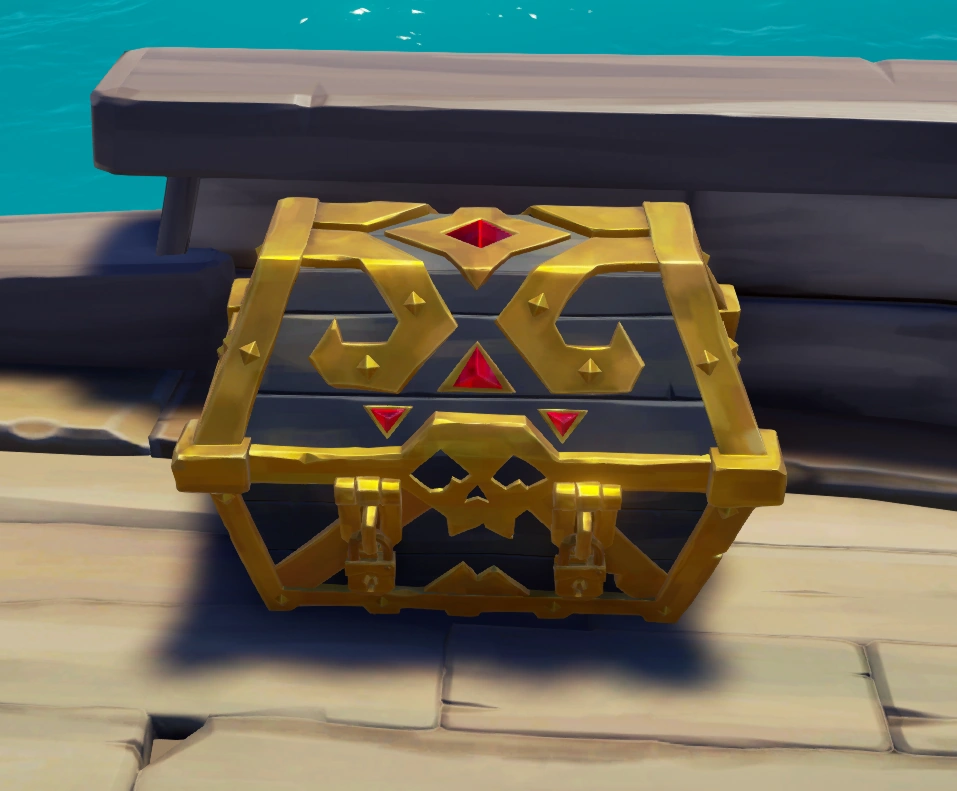
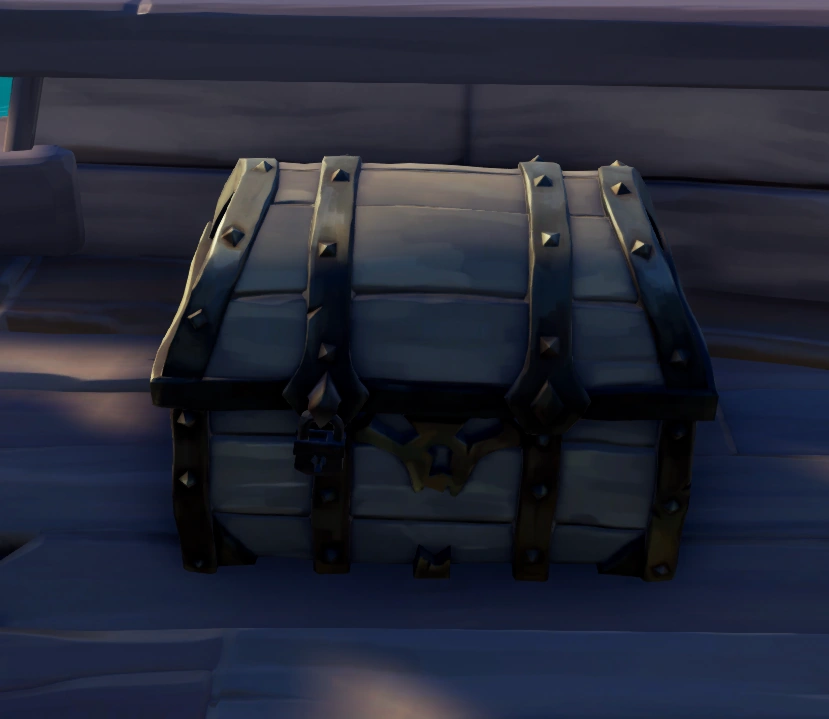
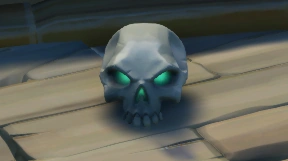
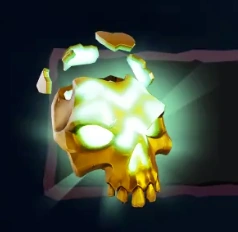
When it comes to that 'Rare magic,' I think the music and sound comes to mind first. But their games have visuals to match; just as each collectible in Rare's classic collectathons had a distinctive sound, it also had a distinctive design. But a major difference between the games of yore and Sea of Thieves is that the items in Sea of Thieves don't have a unique utility (like the ability to fly or become invincible in Banjo); they just have a unique value and are meant for a specific faction. For example, the Gold Hoarders want treasure chests, and the Order of Souls wants skulls.
So rather than design the items based on their function, they're designed based on their associated faction and value. You can immediately tell by the look of an item which faction it's for and how valuable it is. Consider these two chests:
You don't need anyone to tell you which of these is more valuable, and that goes for the skulls too:
And this is just barely scratching the service, as each type of treasure has more tiers than I've shown, the Merchant Alliance has its own line of treasure, there are different types of enemies with clear visual cues and colours - the game's presentation is as splendid visually as it is in sound.
Conclusion No one can deny that Sea of Thieves has had, and still has, its problems. But the Rareware we know and love is still clearly visible in the details. Their flair for giving every little thing its own distinctive sound, music and look has stayed alive to this very day and is one of the main attractions of Sea of Thieves on the whole. And they're still expanding on the game, so the amount of little details will only increase as time goes on.
Have you had any experiences with Sea of Thieves? Did you enjoy it, or did the game's shortcomings get in the way of your enjoyment? Please let me know!