Pagina's

Thursday, October 15, 2026

Some Thoughts About 'No, I'm Not A Human'

 'No, I'm Not A Human' is a 2025 horror game by Russian developer Trioskaz. Since it's the scary month, I thought I'd share my experiences with the game. Discovery is an important part of this game, and I will be spoiling some gameplay systems to clarify my opinion. Please consider playing the game first!


Premise

You play as a man with a troubled family history, living alone, when an apocalyptic event occurs: the sun is burning so bright that the outside temperature is lethal during the day, and mysterious humanoid creatures called Visitors roam around at night. Every night, a certain amount of people come to your door asking for shelter. After a brief conversation, it's up to you to decide who you let in. Let Visitors in, and you'll find the safety of your home compromised. But if you don't let any people in, you'll fall victim to a powerful Visitor who preys on those who live alone. 

Gameplay Loops

The game is divided into two phases. As described in the premise, people will knock on your door in the night-time phase. Some people appear on specific set dates or under specific circumstances, but most of them are randomized. When people show up to your door, a brief conversation with some limited dialog options will occur. After the conversation ends, you simply get the choice to either welcome or send them away. In some cases, they may attempt to bribe you if you initially refuse. There are a few unique NPCs that can't be let in and instead have a unique interaction. Every few nights, the Pale Visitor will visit and ask if you are alone. If the player is alone or claims to be alone, the Pale Visitor will breach the front door and kill the main character, leading to a game over. Once the night-time phase ends, the player character goes to bed, and if you'll be told if anyone fell victim to a Visitor that night. 

The day-time phase is the maintenance phase. At the start of the day, a news program will play and usually inform you of a specific sign to determine if someone is a Visitor or not. After that, you can speak with anyone staying in your home, test them for Visitor signs and make phone calls. You have a limited amount of energy to spend during the day, so you only have a few opportunities to check for signs. If a sign makes you suspect that someone is a Visitor, you're given the choice to pull out your gun. Do this, and the suspected Visitor will make a final appeal before you make your final decision to shoot or refrain. You can order and use resources that give you more energy, but they are fairly limited.

The game does not allow easy save scumming, so you really have to think about your decisions. You can save and quit, but this creates a temporary save that's deleted when you load it. You can only save consistently by drinking kombucha, which is a very limited resource. You have one jar at the start of the game, you can order one jar from the delivery service and certain characters may bribe you with it. But you're not guaranteed a consistent save point, so you even need to think carefully about when you save. 

No, I'm Not That Complicated

Now that we've established the game in general terms, I want to explain my own thoughts about it. To begin with, let's talk about where the game really excels.

The game has a very strong sense of atmosphere and mystery. Everything just feels a bit off. Characters have strange proportions, expressions and personalities. Even the main character is cagey about his history. Most of your exposure to the world is through dubious news programs, radio signals, the snippets you happen to catch through your windows... and of course, the people who show up at your door. This fragmented information invites you to take notes and speculate about everything you're being told... and not told. Fundamentally, you're working with limited information, and this is represented on every level - from the world to the individual people that come to your door. If someone's story doesn't add up, does that mean you're talking to a Visitor? People could have any number of reasons to be secretive. If you check someone for the concerningly unreliable Visitor signs, like red eyes or perfect white teeth, do you immediately reach for your gun, even if there's a plausible reason? And of course, you can't fully depend on 'better safe than sorry,' because the Pale Visitor will make you regret it if you find yourself alone.

With all that considered, the game loses a lot of flair once you look under the hood and examine the sheer mechanics. This is where I really ruin the magic of the game, so this is your last chance to back out if you haven't played it yet!


So, first off: While there are a small group of characters that are always human and a small group of characters that are always Visitors, this is randomized for the vast majority of characters that come to your door. This means that, sadly, looking for inconsistencies in their stories doesn't really pay off at all. I suppose this adds to the sense of having imperfect information, but it does take away some of the magic of trying to reason out someone's identity based on the dialog. 

Second: Visitors appear to be quite varied. Some are openly malicious while others don't even seem to know what they are. Nonetheless, the gameplay rule is quite simple: If there are two or more Visitors in your home, a human will die that night. It's smart that the game waits for there to be two Visitors, since it will draw suspicion away from any Visitors that come in early - though there isn't really an explicit story explanation for it. One can assume that once Visitors know they are in a group, they'll instinctively begin to weed out humans. More information or speculation on the subject might've been interesting as in-game dialogue. In any case: Once you know this rule, it can be a lot easier to determine who is a Visitor and who isn't.

Third: The game will use achievements to happily spoil for you whether or not you made the right call when you first shoot one of your unfortunate lodgers. But there's actually an easy way to tell: If you shoot someone and you're assaulted with some scary faces flashing on the screen, it was a Visitor. If a visible, partially censored corpse is left, it was a Visitor. If, instead of a corpse, the character is replaced by three trash bags, it was a human.

Fourth: The game gradually reveals signs to you that someone might be a Visitor. These signs can be useful, but vary strongly from character to character. Sometimes they can be outright misleading; there are characters whose human incarnations display Visitor signs, while their Visitor incarnations don't. This also serves the sense of imperfect information and the justifiable doubt in the supposed signs you're told about... but it makes it difficult to strategize and invites metagaming, at least for me (which you can tell I started doing, since I started taking note of all these technicalities). There is only one sign that is absolutely guaranteed for identifying Visitors - seeing a bug crawl out of someone's ear. But it's also quite rare to come across it.

Fifth: You can check yourself for Visitor signs, and certain items will actually cause you to display them or remove them. For example, if you drink many energy drinks, you can get red eyes. If you smoke, you can yellow your white teeth. This feature adds a cool dimension to your energy management that ultimately goes wasted: It's used exactly twice in the entire game, both times when the Vigilante comes to your door and demands that you show a sign - both times, you only have to show one sign, so it doesn't really take any prep or thinking ahead. 

When you lay it out like that, the game is actually quite simple, mechanically. It's the most enjoyable on a first playthrough, when you're still impressed with the smoke and mirrors of its presentation and atmosphere. After that, it can turn into a pretty simple process of elimination. That's not to say that it's bad, of course. It's still fun to strategize about who to let in, especially when you know that FEMA (the morally dubious government agency) will occasionally take some people away and you have to prevent yourself from ending up alone. Some players might even enjoy it more once all the cards are on the table, but it definitely takes away from the horror and tension once your imperfect information becomes just a bit more perfect.

No, I'm Not That Polished

The prior segment really layed out what I think the game excels at and where it falls apart. Here, I'm just going to share some of my pet peeves, annoyances or simply observations I thought were interesting. These probably shouldn't be dealbreakers.

I can't really say what the localization quality is across all languages, but the English localization - courtesy of Dragonbaby - is a bit rough around the edges. One of the telltale signs of a sloppy translation is pronoun inconsistency in the interface buttons and dialog. It feels unnatural when characters go back and forth and the bearded man is suddenly referred to as 'they.' I'm not very familiar with Russian, but apparently, it's actually a heavily gendered language where adjectives, past tense verbs and pronouns all have a linguistic gender - a complete reverse from a context dependent language like Japanese. Thus, it should theoretically be unnecessary to lean on ambiguity. If any Russian speakers want to correct me on this, please do! I thought at first that the interface buttons might be neutral as a convenience, but then, for several people (at least one), it does display the correct pronouns. Aside from that, there are some errors or odd choices (like a guy with an inexplicable British accent). It's not bad enough to break the experience entirely, but it's something I hope can be cleaned up if Dragonbaby isn't too busy vandalizing another Japanese game's script.

The game has a huge cast of crazy characters, and it can be... quite something, to see them in the same room together.


This is extremely subjective, but it felt strange to me that some of them look pretty close to normal humans, while others look bizarre or downright monstrous - and not just the guaranteed Visitors, either. To use a word, it felt inconsistent to me. But every time I say something like that, I feel like I have to clarify once again that this does support the feeling of having imperfect information. It's difficult to nail down anything just based on a character's appearance. Even so, I think the characters could be a bit more visually consistent with each other.

The energy system functions as a limited resource. You can only check a limited amount of people for a limited amount of signs. I don't think this is a bad feature, but I do think it's a minor annoyance that the game demands you use up all your energy before going to bed. You can do this by using a beer, which you have many of, but it feels like an unnecessary extra step. It does prevent you from accidentally skipping your day in a game where saving is an extremely limited resource, so I understand it as a way of preventing a frustrating worst-case scenario. Maybe a simple warning asking for confirmation would be better?

Each character you let in has a 'storyline' for you to explore. You can only have one conversation a day. Once you reach the end of a character's story, sometimes an event takes place, and sometimes you're simply stonewalled with a note that the "conversation is over" whenever you speak to that character again. But there are a lot of interesting and unique events to encounter, which adds a lot of replayability.

Speaking of such events, I reached the end of a specific character's story, and she took my gun and shot herself with it. Then the game cheerfully awarded me an achievement for mistakenly shooting a human. So that was interesting. I know there's a unique bad ending you can acquire by shooting 4 human beings, and I wonder if unique events where you're "forced" to shoot someone count towards that.

The option to shoot someone comes up after checking for any sign, but if you back off, you need to check for another sign before you can choose to do so. On the one hand, this is good. It means you have to spend your energy to take a shot, and it's a costly decision whether or not you back off. On the other hand, there isn't really an in-world reason as to why you'd have to check for signs again. Your mileage may vary on this one.

If the Pale Visitor breaches your house and kills you, a 3D animation plays. I can't say that I'm very impressed with the 3D model of the Pale Visitor and his completely flat and unanimated face. Some of the limited animations you can see when you reach the end of a specific NPC's dialog impress me a lot more and fit better with the game's artstyle.  

That's everything I noticed. Like I said, these are minor observations or annoyances, so they're interesting to note but won't ruin the game.

Conclusion

In the end No, I'm Not A Human is a great concept with a great presentation that falls apart a bit once you figure out how basic its systems really are. For this reason, it's absolutely worth a playthrough - but maybe less so after reading this review. I sincerely hope you gave the game a shot first! And I hope we see more from this developer. 

I thought about including a long section where I proposed alternatives to the systems I criticized. For instance, one idea would be a 'threat level' that ticks up by X amount depending on which Visitors you let in, meaning certain Visitors are more dangerous than others - and people only get killed after a certain threat level is reached. That would theoretically work as a replacement for the basic "2 or more Visitors == someone dies at night" system. But proposing design changes as if they would definitely improve the game would be a bit arrogant. I'm almost certain that whatever idea I could propose was already considered by the developers and the game turned out the way it did for good reason.  

So, that's it! Feel free to let me know your thoughts as well. 


Check it out on Steam: https://store.steampowered.com/app/3180070/No_Im_not_a_Human/ 


Sunday, January 19, 2025

Chaotic Thoughts about Rain Code 1 - Pointless Deaths & Screentime Starvation

I recently played and finished Master Detective Archives: RAIN CODE, a 2023 mystery solving puzzle game by Spike Chunsoft (the company also responsible for Danganronpa). In the game, we play as the amnesiac detective Yuma Kokohead on his journey to solve the hidden secret of Kanai Ward, an isolated community where it always rains. I won't go over the entire story, just specific parts that stuck out to me.

I have a lot of thoughts about the game, but my mind hasn't settled enough to call this a proper review. So I'm just going to go over a few of the things that stuck out to me. This article has spoilers for the entire game as well as Danganronpa V3.

The Old Switcheroo

The game's prologue wastes no time in introducing us to a colorful cast of characters - 5 Master Detectives with special powers for our main character to interact with, all of them with pretty elaborate designs and backstories. I won't go over them all, but Pucci Lavmin was a standout for me.


Pucci is a Master Detective with the ability to hear distant sounds and conversations, but her constant focus on sounds in the distance has caused her to start losing her sense of self, often referring to herself in the third person. Her power is very interesting for investigating mysteries and her personality would've been interesting to explore, considering her power is almost like a curse. Another standout is Alexander Zilch, who can control animals, a power that we sadly never get to see.

Other detective powers include the ability to detect any living beings nearby, transferring things you've seen to electronic devices and even channeling the dead.

When the cast and their powers have been properly introduced, they are promptly killed off to serve as the first murder case of the game - quite gruesomely, too. They're all drugged and burned alive. This definitely sets the tone for the game and keeps the player guessing. But considering how the characters were marketed, it almost feels mean-spirited to me. 

Danganronpa V3 pulls a similar twist, but on a much smaller scale: Rather than replace the entire initial cast of side characters, it instead has a switch of protagonist. How successful a twist like that is depends on how strong the new protagonist, or cast, is. In the case of Danganronpa V3 a strong-willed, creative and determined (female) character is replaced with a passive, unsure (male) character. 

Danganronpa's protagonists already tend to be more passive and plain, so the switch was a pretty tragic downgrade in my opinion. With that said, the twist does work in the context of the story. It plays an important part in the new protagonist's arc, and the prior protagonist's sacrifice has ramifications on the story from beginning to end. And aside from that we still got to enjoy the full cast for an extended time - including the bait-and-switch protagonist. In the case of Rain Code, half the cast that was marketed is unceremoniously killed off almost immediately after their extended introductions, and it only really seems to serve shock value. It facilitates the first case and sets the tone, but the characters from the prologue are never mentioned again (with one notable exception) after that. Their deaths also don't play into the protagonist's theme of fearing to reveal the truth, which comes up later. So, all in all? I'm not a fan of how the twist was handled, but like I said, it's down to the cast that remains. If they're interesting enough and we can get to know them properly, there's still a lot to enjoy in the story.

But sadly...

Enter Stage, Exit Stage

The Danganronpa games work on what I think is a pretty elegant system: The entire cast, except maybe a surprise reveal or two, is known from the start. This gives you plenty of time to interact with all the future murderers and victims before they actually become murderers and victims. Monokuma, who generally plays the part of the antagonist, is also known from the get-go. It's a great way to get invested in the characters and tends to make the later cases devastating - after all, you'll be seeing people you've hung around with for 15+ hours die.

So why am I bringing up Danganronpa again? Rain Code steps away from this system in favor of a 'revolving door cast.' Almost every case introduces a new location and a new cast of suspects, as well as a new Peacekeeper antagonist to sabotage the investigation. Additionally, you're accompanied by only one of your Master Detective companions per case, while the others take a back seat. This certainly keeps things fresh, but also makes it really hard to get invested into any character - it also means there's no room for characters to develop very much. 

Compare and contrast with Ace Attorney. Ace Attorney also switches out its cast of suspects for each case, but quite importantly, it tends to stick with the same partner and prosecutor for multiple cases - and if a new prosecutor or partner gets swapped in, it's usually a familiar character that's been built up. It also generally keeps the same judge and detective. It provides the necessary stability to allow for a controlled amount of new characters and locations to enter the stage.

In this sense, Rain Code has the advantages of neither solution. The cast changes fundamentally for each case, yet we don't get the opportunity to get used to anyone but the main character and his partner Shinigami. As a result, there are a lot of characters that feel either completely pointless, or that feel like a waste of potential. To illustrate the undercooked nature of the former - the suspects in Chapter 1 aren't even named. They're called 'Priest,' 'Nun,' 'Church Servant' and 'Worshipper.' To illustrate the wasted potential of the latter - the suspects in Chapter 2 are named and relatively fleshed out, but 80% of the chapter's cast is dead by the end of it. If a character survives a chapter, the best you can expect is an optional sidequest afterward. And whichever Peacekeeper was antagonizing you also disappears, never to be shown again (or maybe in one or two cutscenes if you're lucky). 


As a result, the problem from the very first case persists throughout much of the game, though it's more via screentime starvation than proper "deaths." On the subject of character deaths, there's something that bothers me about the way this game handles 'solving the case.'

Pointless Sacrifice

This is something Danganronpa and Rain Code share: When the murderer is caught and the case is solved, he or she dies. It adds a level of tension and tragedy to solving cases, especially if the murder is committed for sympathetic reasons. I don't dislike this idea conceptually, but let's explore the difference in execution (pun fully intended).

In Danganronpa, the mastermind in control of the game is also in control of the executions. The rules are pretty simple: Either you figure out who the murderer is and prove it in a trial, or you and all the other students get executed instead. You're under duress and not directly involved with the actual death of the culprit. While it's depressing to see a sympathetic murderer get executed in an ironic and humiliating fashion, all you did was prevent the deaths of all other students by revealing the truth. There isn't really any moral ambiguity to your own actions here. 

In Rain Code, the situation is a lot more ambiguous. Your helper, Shinigami, lets you enter a metaphysical space - the Mystery Labyrynth - which you navigate by answering questions in various mystery solving mini-games. If you conquer the Labyrinth by figuring out who the true culprit is, Shinigami destroys the Labyrinth by reaping the culprit's soul. The exact mechanics of this are unclear, but the game puts it simply: This kills them. I'd be happy to leave it at that, but the game's finale raises a lot of questions about this. But for now, let's put a pin in it and go back to the 'reaping problem' when it's relevant.


There's a lot that bothers me about the concept of Mystery Labyrinths. The idea is that this Labyrinth represents the unsolved mystery as it exists in the real world. By choosing to enter it, you sign an unspoken agreement to either catch and kill the culprit or to be absorbed by the labyrinth, leading to your own death. It's also implied by Shinigami that not resolving the Labyrinth could let it affect the real world eventually, though this isn't ever really shown or elaborated on. The game clearly tries to put pressure on solving the case like Danganronpa does, but it's a lot harder to swallow because it's pretty unclear what the rules are, who or what enforces them, and why. To contrast, in Danganronpa, it's understood that a sadistic mastermind is imposing these rules on you to serve the 'killing game.' 

To further confuse the issue, what happens in the Mystery Labyrinth "stays" there. Even though the Labyrinth supposedly represents the mystery in the real world, Only Yuma and Shinigami even remember that the case was solved after it's destroyed. The culprit simply dies on the spot, and Yuma usually still ends up standing there at the firing end of the Peacekeepers' guns, sputtering and mumbling before being saved by the random appearance of a companion - or by Shinigami possessing the corpse of the culprit and awkwardly "confessing" to the murder (I will admit that the first time this happened, the delivery of the lines made me laugh out loud). It feels a lot more awkward and less clean than revealing the murderer in a closed circle of suspects and witnesses, so no one has any doubts. The Mystery Labyrinth doesn't feel like a tool for finding the truth - because it doesn't - it's a tool for killing the culprit. Finding the truth is secondary and is awkwardly handled after the fact with no evidence or debate. 

While I think it's hard to argue with the awkwardkness, you could offer a counterpoint and say that the game is aware of the moral ambiguity. The main character is depicted as very conflicted about essentially committing "murder." The game casts doubt on his actions, and in so doing, also casts doubt on the player's actions. But because the mechanics of the Labyrinth and reaping aren't explained very well, not to mention the fact that you don't really have a choice if you want to keep playing the game, it almost makes it worse. I firmly believe that if you're asking a character or person to make a choice, he or she should have the necessary cards to make an informed decision. And in this case, you just don't.

Morality aside, the problem about the nature of the Labyrinth I mentioned earlier continues to rear its ugly head. If conquering the Labyrinth - the representation of the mystery in the real world - destroys it, but the mystery is actually still unsolved anywhere but in Yuma's head, then what's the actual point of destroying the labyrinth? What does that actually do? The game demonstrates no way in which the Mystery Labyrinth affects the real world at all, aside from the aforementioned killing. But the reverse is not entirely true; things get more confusing during the finale: Yuma decides not to 'reap' the "culprit," lets him go with the promise that he'll reveal the truth and thus destroy the Labyrinth from the outside. It's all but spelled out that this actually works, so why doesn't the inverse work? Why did we have to kill so many culprits, including sympathetic ones, because we're stuck in an arbitrary 'kill or be killed' scenario without any clear insight on the rhyme and reason?

I'm willing to accept that I might be missing something here, but it'd take a pretty solid explanation to convince me. Please do let me know. 

If you thought we'd reached the worst part of how pointless character deaths end up being in this game, just wait until we get to the finale and the big twist.

Homunculus Narrative

In the finale, the characters end up in a mysterious abandoned part of town... inhabited by zombie-like people. I'll give one more warning in case you've become interested in playing the game yourself - this is where the game puts all its cards on the table.


You encounter the "undead" versions of people you've personally "reaped." I was thinking initially that the game was going to use this haunting visual to confront the main character with his "decisions," but it took it in a different and arguably even worse direction.

Every person who lives in the isolated Kanai Ward is a cloned homunculus created by the Amaterasu Corporation. And not only are they homunculi, they are 'immortal' - if they die, they are simply resurrected a day later. But then, they are defective homunculi, so their revival causes them to lose their intelligence and memories. The degree of this loss varies individually, with some of them able to carry conversations, while others are essentially cannibalistic zombies. They're all kept in an abandoned corner of Kanai Ward where they can safely shamble around without harming anyone.

On the one hand, I think this is a pretty cool twist. The idea that the corpses resurrect and that the inhabitants of Kanai Ward aren't quite human is subtly built up throughout the story - I don't actually think it's a bad inclusion when taken on its own. But in the larger story, it creates a massive disconnect with Shinigami and the Mystery Labyrinth. I mentioned earlier that Shinigami's 'reaping' was going to cause massive problems later, and this is where the 'reaping problem' finally comes in.

What we see in the Mystery Labyrinth is Shinigami quite literally attacking and presumably destroying the culprits' souls in a supernatural ritual. This leads to their death, but one assumes it'd be a lot more thorough and final than just a conventional killing. However, because the culprits were all Homonculi, they just come back after being reaped - and some of them are pretty coherent at that. They're clearly damaged, but it's hard to say if they've lost their "soul." 


So the question has to be asked again: What does reaping actually do? Is it, for all the dramatic presentation, just Shinigami killing them, with the soul being a symbolic representation? And why does this supernatural ritual not work properly on Homunculi? Why is Shinigami not aware that the soul she's reaping belongs to someone that isn't human? Could a "resurrected" Homonculus theoretically be Reaped again in the Mystery Labyrinth? Basically, this is a twist that breaks the already fragile established rules over the Mystery Labyrinth. Again. 

While all these questions frustrated me, I admit I was a little elated as well. If the victims and murderers were still around in some form, that could create a really interesting situation. Some of the sacrifices I felt were unneeded could be undone. However, this is where the game double dips - it wants the twist of having all the deaths be "undone" while still keeping the emotional weight of a death. To illustrate this: Yuma has a final interaction with his deceased-but-resurrected boss, Yakou. He wants to follow him when he shambles away but is told to move on "from the dead." But... he's not dead. He's immortal. He just has some kind of brain damage from his resurrection. In a normal situation, it's vital for the process of grieving that you move on, but the fact is that he just isn't really dead. The situation isn't final at all and it bothers me that the game pretends it is. This twist could only work if you adhered to the following:

- The resurrected Homonculi are truly mindless and there's not a fragment of the former person left.

But it doesn't. You have conversations with the resurrected Homunculi, some more coherent than others. There's also a very emotional scene between a victim and her friend that frustratingly happens off-screen, but this implies the resurrected Homunculi are still capable of both thought and emotion. It follows, then, that if they are biologically alive and maintain parts of their selves, they're simply not dead in the way the game wants you to think of them as.

To put the icing on this frustrating cake, the game then proceeds to never acknowledge the resurrected Homunculi again after the final Mystery Labyrinth begins. In the game's closing stages, the inhabitants of Kanai Ward know they are Homonculi. Their leader is helping them figure out ways to live normal lives. But the resurrected ones just aren't acknowledged. You'd think Amaterasu Corp would invest in finding ways to restore their cognitive abilities and memories at least to some extent - it'd be insane to just have a corner of the city filled with mindless (and not so mindless) zombies now that the secret is out. However, it seems acknowledging this gaping hole in the story would cheapen the deaths so they just gloss over it.

All this just leaves me feeling very conflicted and unsatisfied about the way each case turned out.

Concluding for Now

I realized as I was writing this article that I have way too many thoughts for a single coherent article. I'm not even sure if this article is particularly coherent. But the bottom line is that the game's story has some frustrating patterns: It introduces and then dismisses characters at such a rapid pace that you can barely get attached to anyone at all. Further, it makes a big deal of us "killing the culprits" without explaining it very well, to then undo the "killing," to then try and pretend it hasn't been undone because reasons. It's a game where the supernatural Mystery Labyrinth is at war with the sci-fi intrigue of Kanai Ward and it can never reach a satisfying resolution.

I have a lot more to say about the game, but I think I should make a different article about that, since this issue is the one that bothered me the most. In spite of that, though, I actually had a good time with the game. The individual cases, mysteries and characters are good. In fact, I wouldn't even care that characters were introduced and dismissed so quickly if I didn't care about them - it's just a waste of potential in my opinion.

Hopefully my next article will be a bit more positive. Thanks for reading and do let me know if I made any errors. I'm happy to be wrong if it means clearing up my frustration.


Saturday, July 13, 2024

Some Thoughts about Paper Mario: The Thousand-Year Door Remake

 Paper Mario: The Thousand-Year Door is a 2004 cult classic RPG for the Nintendo GameCube. Many consider it the peak of the Paper Mario series, which stopped focusing on RPG mechanics and then discarded plot in its entirety after its release. After a long time, it seems Nintendo finally heard the fans' cries and announced a remake of this beloved classic, to the delight of many a fan.

I've finally had the chance to play and finish the remake myself, and I'd like to share some thoughts about it with you. There will be some spoilers. Rather than a traditional review, I'll be discussing how this game holds up as a remake.

Gameplay


Paper Mario 2 is a turn-based RPG, and its gameplay is mostly unchanged. The major differences between this game and the original come down to framerate and quality of life additions.

The framerate is in the original's favor, as this game - surprisingly - runs at 30 FPS and even chugs when some events occur (a paper boat rotating caused the frames to dip on my end). The GameCube original ran at 60FPS. 

The remake does introduce a lot of smart quality of life additions: Fast travel has been streamlined by putting the important warp pipes in a single room, some backtracking has been cut down on due to a new warp pipe in Twilight Town (though bafflingly, you have to backtrack a few times before you get to use it) and many other small conveniences have been added. The changes are very welcome, although they feel a little noncommittal. The game still suffers slow periods and drags on here and there due to the still-present backtracking and sheer amount of small cutscenes.


Arguably, a remake lives or dies by what it can add to the original. If that is the standard to go by, then the remake is more dead than alive; aside from the quality of life changes, there is one new boss and a NPC that adds tutorialization for various battle mechanics. It's slim pickings compared to the multiple bosses added in Super Mario RPG's remake.

Conversely, one might say a remake lives or dies by how faithful it is to the original. If that is the standard, then the remake is alive and well. Aside from the quality of life additions, it plays just about the same as the original with some helpful changes.

All in all, it's a tossup on which is better in this regard. If you're indifferent to the 30FPS downgrade, then the remake is easily the superior choice for a first experience thanks to its better fast travel and other conveniences. But considering the lack of meaningful additions, the $60 price tag might be a tough sell for anyone but the most passionate fans.

Presentation

Gameplay is the core of any game, but one might argue presentation is the core of a remake - it's about giving a new coat of paint to a beloved game after all. And presentation is where the Paper Mario: The Thousand Year Door really shines. All the visuals have been polished up, and each character has even been provided with additional sprites, allowing for much greater expression.


There's really no argument: The remake is beautiful and clearly improves over the already stylish looking original.

I'm a little more mixed on the music. Not to go off on a huge tangent - there will have to be a separate article for that - but I find that rearrangements and remixes can often lose the appeal of the original. Classic Japanese videogame music often lets the melody reign supreme with complete clarity. Comparatively, some of the new arrangements let the melody fall into the background a little. 

Compare the original battle theme:


With the new:


And let me know what you think!

I think this is a very subjective point, however; and the fact that they added a ton of music means it's a net gain. Each partner has a new theme song, each chapter has at least one unique battle theme - some of which are real bangers - so I can't be too upset about the tracks I personally didn't like. Especially so since the game lets you switch to the GameCube original soundtrack with a badge!

Some cutscenes have also been expanded upon with more animation or different camera angles - and sometimes the music has been adjusted to match. For example, in the final dungeon, the battle theme will not play when you enter combat in the first few areas, instead sticking with the ominous background music. This helps preserve the atmosphere.

The remake really shines here due to the sheer amount of added sprites, details, effects and music. Even if you prefer the original's music, you can simply wear a badge to switch to that. This is clearly a point in the remake's favor.

Story

You might be thinking, how does story come into this? Isn't this a beat-for-beat remake of the original game? Well, kind of.

Those of you who know me might be rolling your eyes already, because it's about my personal pet issue: Censorship. I believe no art or writing should ever be altered because it may be offensive or because we disagree with it, because art is the artist's self expression. To me, this seems like a common sense position.

So why am I bringing that up? Because the localization staff at Nintendo went through the script with a fine-tooth comb and removed anything and everything that could possibly be considered offensive. This isn't one or two instances, it's dozens. Here are a few side by side examples found by a Twitter user:


This is just the tip of the iceberg. Any mention of the words "loon" or "nut"? Those might be seen as ableist, so they're gone. "Airhead"? Well, that's offensive to say to a woman, that might be considered sexist, so it's gone. I don't like to play at politics, nor do I care about any kind of label people want to attach to this sort of thing. I just wanted the script to be as fun, irreverent and witty as it was. And it's still part of that, but the changes are common enough to be noticeable.

Take the interaction between Goombella and the Goomba hoodlums, who more or less catcall her. This scene established Rogueport, and the setting of Paper Mario 2, as a lot more gritty and real. But nope, we can't have that, let's put some weird Twitter writing in there about sunlight or something.

On the other side of the conversation is Vivian.


In the original game's Japanese script, Vivian presents herself as female, but is described as male. Some people interpret this as her being transgender, while others say this makes her a "femboy." Due to the flexibility of Japanese first person pronouns, it's hard to come to a conclusion. This left localizers unsure what to do, which is why each localization in 2004 handled it differently. The English version removed all references to her being male or trans, while some versions like the Spanish made her explicitly male instead. 

The remake fully accepts the interpretation of Vivian as trans (and as far as I can tell, all localizations are following suit this time). This is lauded by some as a restoration and decried by some as more censorship. I don't feel comfortable drawing a final conclusion on that one, so I won't hold it against the game. It may be worth its own article also.

The unnecessary scrubbing of dozens of lines in the game's script is undeniably a mark against the remake. I'd say 95% of the script is still untouched, though, so whether or not this is a big issue to you will come down to your values.

Conclusion

The Paper Mario: The Thousand-Year Door remake represents a willingness from Nintendo to give the fans the Paper Mario they wanted, with beautifully updated visuals and music as well as quality of life additions. Even though the remake is faithful in terms of gameplay and visuals, there are marks against it:the lower framerate, the lack of additions and the extensive script censorship. I think it's worth experiencing, but consider getting it on sale and modding the game. People are working on script restorations as we speak!

_

So, that was another article, finally! Sorry it devolved into a lot of complaining about censorship, but I have to say I am a little bummed they felt the need to treat a 2004 classic like this. I hope to write more articles in the nearby future, but we'll see. It might be another year or something; life has a way of getting busy.

Wednesday, August 9, 2023

First Impressions on Persona 5 Strikers

Persona 5 Strikers is an action RPG released in 2020. It was developed Omega Force and P-Studio and published by Atlus. Similar to how Hyrule Warriors is a 'Dynasty Warriors' spin on the Zelda franchise, Persona 5 Strikers is a 'Dynasty Warriors' spin on the Persona franchise. As of writing these first impressions, I've been playing the game for about 20 hours, so maybe it's a bit more than just first impressions. There will be spoilers for the first two dungeons, or 'Prisons' as they're called.

Expectations

In 2022, I finally got to sit down and play my way through Persona 5 Royal. I'd say the game is very much deserving of the praise it got, with its incredibly stylish presentation and highly entertaining RPG gameplay. It's also notable for its fun and recognizable cast of characters. The battle system offers quick ways to manouver through the One More and Baton Pass systems, which let you take another turn if you exploit an enemy's weakness and hand over your turn to another party member respectively. Since Persona 5 Strikers is a 'Warriors' type game with real-time combat, I was curious to see how many of these elements could be inherited and which would have to be dropped.

While I enjoyed Hyrule Warriors' story for the crazy crossover it was, I was especially excited by the prospect of Persona 5 Strikers because in terms of story, it's actually a sequel to Persona 5. I was particularly excited to see the characters again, since I had become really attached to the cast by the end of Persona 5.

So, what expectations has Persona 5 Strikers met so far, and which has it failed to meet?

Good Impressions - Presentation

From the moment you start the game, it's obvious that it's faithful to Persona 5's style. It has all the same flair and plenty of new artwork and music to enjoy that can easily match the original in quality. And the main cast all make a return, and they're just as charming as ever. 


The game starts you out in familiar territory, but you soon get to visit the new type of dungeon, the 'Prisons.' Each has a unique visual flair, just like the Palaces. 


As for audio, the sound effect get the job done, and the voice actors - just like in Persona 5 - do a great job portraying their characters. It'd be a sin to spoil you on all the amazing new music, but I'll share one of the combat themes that made an immediate impression on me:


I was so happy to hear Lyn came back to provide vocals for Strikers, since her performances in the Persona 5 soundtrack are legendary. 

All in all, I can't really argue with the presentation. It's top notch. 

Mostly Good Impressions - Story

The Metaverse, an alternate dimension formed by people's cognition, is a concept that leaves plenty to explore even after finishing Persona 5's story. We get to see that there aren't just Palaces formed by distorted desires, but Prisons where people's desires are stolen. And of course, it's up to the Phantom Thieves to put a stop to these tools of mass brainwashing once and for all - and find out who's truly behind their creation.

Like I mentioned under presentation, the main cast all made a return, but that doesn't go for a lot of the side characters. Tae Takumi (the doctor) and Munehisa Iwai (gun shop owner) are not present, and are instead replaced by shops in the town and a shop provided by a new character. It's not really fair of me to judge a game by what it doesn't have, but I was a little sad we don't get to see how many of the confidants are doing. If it turns out they appear much later in the game, I'll note that in my following article.

The new supporting characters are quite a success, though, in my opinion. Zenkichi, the detective working with the Phantom Thieves, is very witty and got a chuckle out of me several times. Sophia, the mysterious AI being helping out the Phantom Thieves is also endearing, has a good design and is the one now in charge of the shop.


Whether you consider this something to criticize or praise is subjective, but most of the Palace Rulers in Persona 5 were deeply unsympathic people, very close to being purely evil (with two notable exceptions). Persona 5 Strikers, on the other hand, has put some amount of effort into making the Prison Monarchs more sympathetic. They're not painted as good people, but it's explained more clearly how they came to be this way. It's explored how they went from people with noble ambitions to becoming cruel and selfish, usually due to the way they were treated. I think this has led to some really interesting interactions with the cast, but I'll reserve my final thoughts for when I finish the game completely.

All in all, Persona 5 Strikers picks up where Persona 5 left off very nicely and further expands the world. Just don't expect every fun side character from Persona 5 to make a return, and instead, enjoy the very well implemented new characters and more interesting antagonists.

Mixed Impressions - Gameplay

Outside the dungeons, Persona 5 Strikers feels almost exactly like Persona 5. You walk around town, interact with characters and shops and so on. It's when you enter the Prisons that we start to see what could and couldn't be taken from the original Persona 5.

I will start by saying the game deserves praise for attempting to implement many of the systems present in Persona 5. Personas function the same, including the way they can be crafted and taught moves. Enemies can also be knocked down by exploiting their weaknesses, perform a follow-up similar to a 'One More', and knocking many enemies down allows you to perform an All-Out Attack. You can even 'Baton Pass,' although this mostly just boils down to taking control of another character. All in all, the systems that made Persona 5 into what it is are here in some way or another. However, in some cases that is purely symbolic. 'One More' is really just a follow up attack, rather than an extra 'turn,' since there are no turns to take. And switching characters can be important in the heat of battle, but the same kind of tactical planning ahead with the Baton Passes isn't possible in an action game like this. It was inevitable that these systems would be simplified for real-time combat, but it is worth pointing out either way.


The combat itself is very flashy and satisfying, though especially on the hard difficulty, sometimes the game has trouble finding a sweet spot between enemies that just crumble in seconds and damage sponge encounters. The easy encounters are fine - Warriors type games are meant to make you feel powerful a lot of the time, after all - but it's the enemies with a lot of health that cause the most troubke. This leads to one of the biggest problems I have with the game: To knock down a boss or elite enemy (and thus do any kind of respectable damage), you need to exploit its weak spot many times, especially on the hard difficulty. Sometimes you're expected to hit the weakness more than a dozen times. This means that, if you happen to have brought the wrong characters or Personas for a given encounter, it can quickly turn into a 15-minute slog or a nearly unwinnable game of cat and mouse. This is mainly owed to the fact that enemies do damage your characters a lot with singular attacks and can easily inflict debilitating status effects and knockdowns on you while you chip away at their massive health bar and defenses with attack after attack after attack. This is further agitated by how hard it is to recover SP, which you need to cast spells. It just doesn't always feel as balanced as it should be.

I've only completed 2 Prisons so far, but they've already started feeling a little formulaic - you're tasked with retrieving 3 McGuffins to gain access to a miniboss, which will then unlock the boss proper. The Prisons definitely don't feel as complex or involved as the Palaces in that regard, which is a shame. Maybe future Prisons will change my mind on this, however.

To wrap this part up: The game tries to implement a lot of Persona 5's systems into 'Warriors' style gameplay, and it succeeds, if mostly in a shallow way. Balance issues and repetition hold the game back from greatness, however.

Conclusion so far

All in all, I fully embrace the great presentation and story, both the old and new parts. I'm a bit mixed on the gameplay due to repetition and balance issues, even if the game is very fun and satisfying when you bring the right team to the right battle.

I will stick with it just to enjoy what the game does really well, but I am secretly hoping some of the problems I've laid out will be ironed out in the third prison and beyond (if there is indeed a beyond).

Thanks for reading! Did you play Persona 5, and do you intend to try out Strikers? Or did you already play it? Let me know!


Thursday, May 4, 2023

Some Thoughts About The Last Day of June

 I recently played through a game called Last Day of June. It's a short narrative driven puzzle game developed by Ovosonico and released in 2017. I wanted to share my thoughts on the game.

Presentation

Last Day of June immediately distinguishes itself with its pleasant, painterly environments. The game immediately makes a great impression with its lush environments and the adorably designed props that decorate them. Its characters resemble rudimentary wooden dolls, lacking very defined features. This took some getting used to but I was completely fine with it after just a short time. The simple style ensures each character is immediately recognizable, which is good for both storytelling and gameplay.

Sometimes things in the distance can lose a little clarity under bright light, though fortunately, the light isn't as intense in most areas as it is in this starting area:


Characters have voices, but they all speak in wordless vocalizations. The lack of spoken dialog is a conscious decision to let you interpret the story through visuals and sound. The scenes are all set against beautiful background music by Steven Wilson, as well.

All in all, I think the presentation is uniquely charming, in spite of a few potential readability problems.

Narrative

Note: I'll discuss the premise of the game and some parts of the plot, but won't spoil the ending or vital details. Use your own discretion to decide if you want to read this segment.

In The Last Day of June, you take on the role of Carl. The story kicks off with Carl going out with his wife June. A tragic car accident causes June to lose her life, leaving Carl all alone. 

Though it's hard for him to face now that she's no longer with him, one night Carl decides to look at the paintings June made. They're paintings of their various neighbors. As Carl looks at the paintings, he realizes they have some kind of magical quality which allows him to experience what the person depicted was doing on the day of the accident.

Thus starts his journey to prevent June's death, hoping the answer can be found in what one of his neighbors did or didn't do that day.

The narrative is simple and effective, and I mean simple in a good way. Feelings of loss and the desire to protect and save a loved one are very moving and relatable themes. You may want to bring some tissues if you decide to play this one through.

Gameplay

Last Day of June is a puzzle game that uses basic third person exploration. You can walk around, you can interact with the environment and you can carry a single item around in your hands. It is a fairly slow-paced game, so go into it with a relaxed mindset and don't expect things to happen too quickly.

Each of the neighbors you take control of through the magic paintings has a unique way of interacting with the environment - the Kid has his ball which can knock over certain obstacles, for example. The most interesting part of the puzzle solving process is that the puzzles affect each other and choosing one solution in a given puzzle may lock you out of solving another puzzle a certain way. In the interest of illustrating this concept without spoiling too much: One of the ways the Kid's segment can be solved is by having him fly a kite. However, you need to take the rope to let him fly his kite. This means that the next neighbor, the Best Friend, cannot use the rope to secure the luggage on her car. And paths opened by one neighbor can then be accessed by the other. I enjoyed that you had to consider the other puzzles as you solved each puzzle, though it never got very complicated.


My only major problem was that certain scenes were unskippable. For example, when you resolve a character's scenario one way or another, you always get a scene of how this affects the accident. If you made a mistake, that means you have to sit through the same accident multiple times, damaging the dramatic value of a serious scene and wasting a decent chunk of your time. Having unskippable scenes is a cardinal sin in a game where said scenes can repeat.

Aside from that, the game is a fun and inventive puzzle game that'll make you think but probably won't really make you wrack your brain to get through it.

Conclusion

With its charming presentation, moving story and simple-but-fun puzzle solving, The Last Day of June is well worth playing for any fan of puzzle or narrative games. The only caveat is that the game can easily be completed in around 3 hours, which some players may consider a tough sell for its 20 euro price tag. But if you're thinking of checking it out, you can find it right here or wishlist it if you want to wait for a sale: https://store.steampowered.com/app/635320/Last_Day_of_June/

Thank you for reading! If you give the game a shot, let me know what you think.

Monday, May 23, 2022

Parental Bonds in Ace Attorney - DGS Addendum (spoilers)

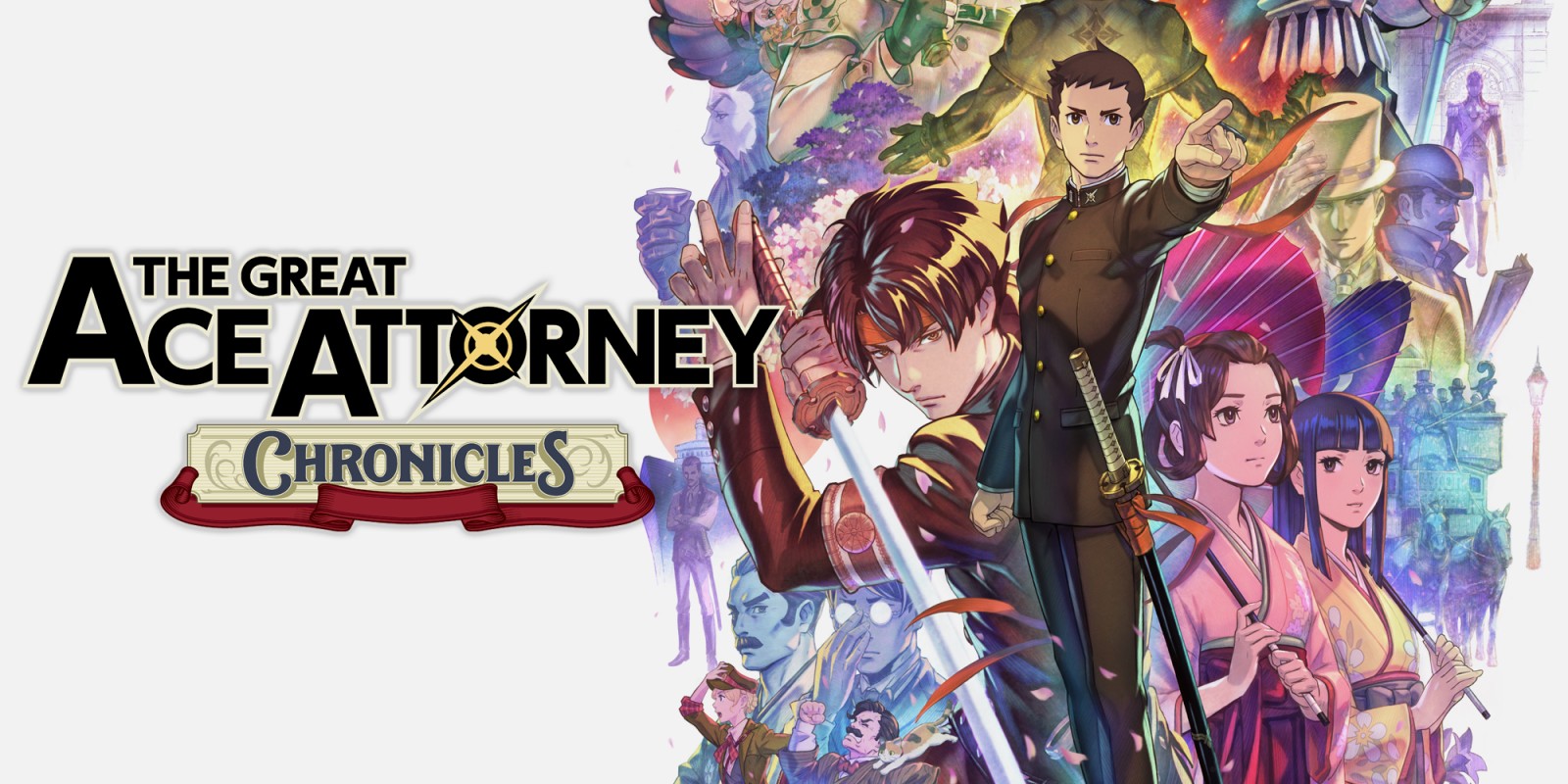
 Way back in 2018, I wrote two articles where I examined the Ace Attorney series. I specifically focused on the theme of parenthood, or more specifically, the bond between parents and their children and the profound impact this bond has on those children. Since then, the previously Japan-exclusive 'Great Ace Attorney' games have finally been localized in a 'Great Ace Attorney Chronicles' bundle. And now that I've had the opportunity to play them, I can tell you the theme of parenthood also plays a vital role here. Let's talk about it. This article will fully spoil The Great Ace Attorney Chronicles (both games), so readers beware!


From Across the Sea

The Great Ace Attorney games are about Ryunosuke Naruhodo's adventures as a lawyer as he travels from Japan to Great Britain in the early days of an alliance between these empires. As Ace Attorney games do, they pose questions about the law and justice as you defend clients from false murder charges. But the universal, timeless theme of family is just as present here, even though it may initially not seem that way. Like Ace Attorney Investigations 2, the Great Ace Attorney games take some time to build up before they show the true extent of this theme in the narrative.


Fathers - The Great Ace Attorney 1

In the prior Ace Attorney games, both mothers and fathers played an important role, from Misty Fey to Gregory Edgeworth. In the Great Ace Attorney, the focus is mainly on fathers. Let's go through each example in order of appearance:

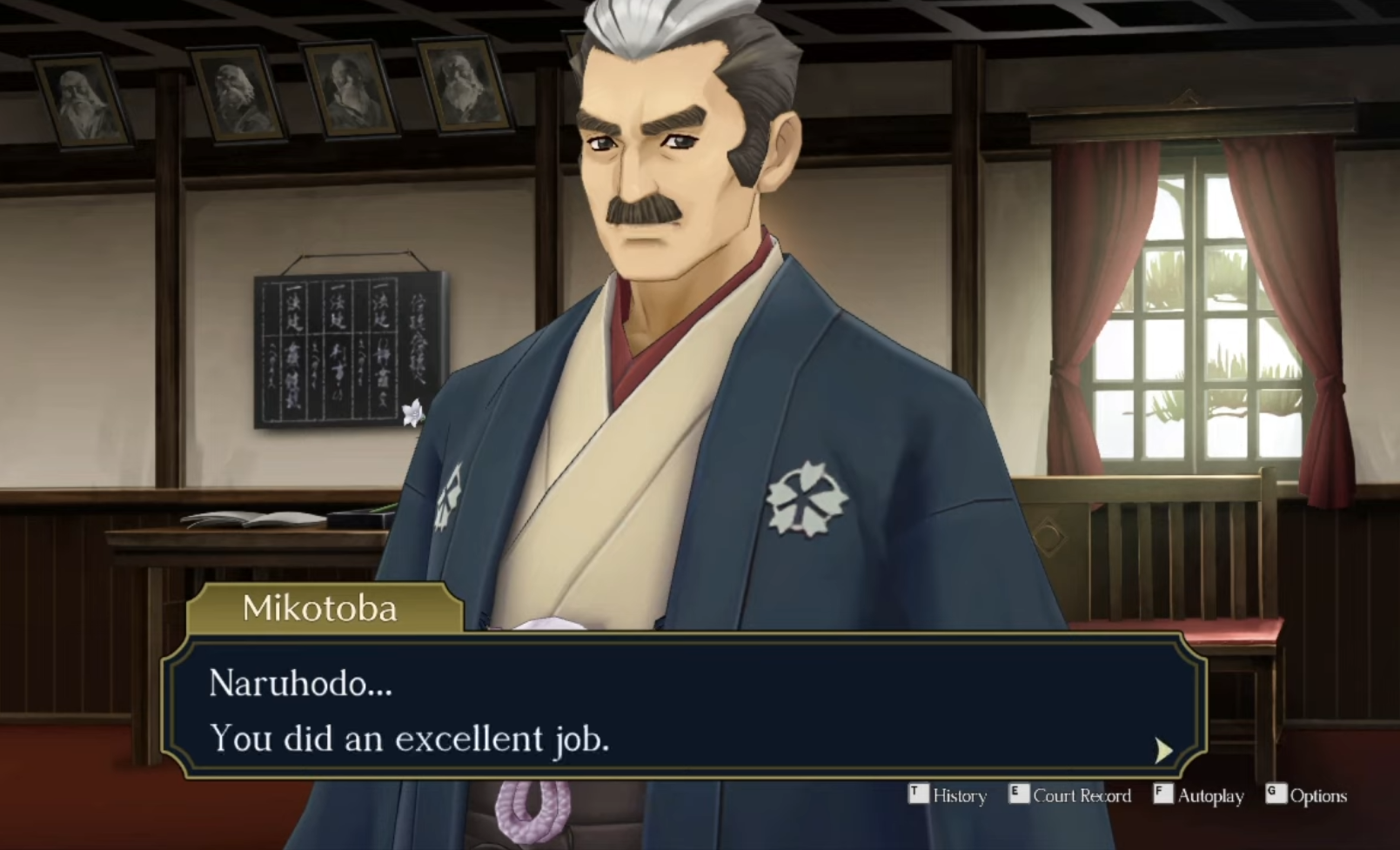
Ryunosuke's partner througout the game is Susato Mikotoba, and the first parent to become significant to the story is her father, Yujin Mikotoba. He is a kind and supportive father whose role in the story becomes more important in the second game.


In the third case we are introduced to Gina Lestrade, who is an orphan and a very endearing character with a great theme song. Her having no parents leads to an important and ultimately tragic development in the second game.

At around the same time, we meet Iris Wilson, believed to be the daughter of John H. Wilson. She hasn't ever met her father and Herlock Sholmes is taking care of her in his stead. Quite tragically, John H. Wilson actually died in the first case. Fortunately Iris doesn't find this out until she also discovers that John Wilson was not actually her father after all - more on her true parentage later.

Finally, the murderer in the final case, Ashley Graydon. A shocking relevation comes up in the final trial when it's revealed his last name is actually Milverton, and the victim in the third case - Mason Milverton - was his father. 


The Great Ace Attorney does a lot of setting up for the second game, which holds the true climax of the story. I haven't even mentioned some of the most critical characters yet, like Kazuma Asogi - mainly because he "dies" at the start of the 2nd case. But he and his parentage become a very important part of the story in the 2nd game as well.

Fathers (and a Mother) - The Great Ace Attorney 2

In TGAA2, Yujin Mikotoba continues the trend of being a good father, helping Susato defend her friend in court in spite of women not being allowed to work as defense lawyers at the time. 

Gina Lestrade makes her return, working for the police under Tobias Gregson. Gregson ends up taking on a parental role, helping this young orphan find a purpose for herself. This heartwarming development turns to tragedy when Gregson dies in the final stretch of TGAA2.


Courtney Sithe is the one mother in this group of parents, but has a similarly poignant place in the story. She was part of the plot to help the Professor escape, and to later hide the circumstances of his death. Her daughter Maria Gorey looks up to her skills as a coroner, but decides to assist Ryunosuke and Susato in finding out the truth behind that case, deciding to walk a different path from her mother. 

The next two parental figures are the most critical to the overarching story, with their influence reaching back as far as the first game, which is why it's so interesting that they are only truly introduced over halfway through the second game:

Genshin Asogi. At the end of the third case, it's revealed that Kazuma Asogi's father was convicted as a serial killer known as 'The Professor.' He's one of the reasons why Kazuma came to Great Britain in the first place - to find out the truth behind his father's death. He believes his father was unjustly executed, and he is completely correct, because the real serial killer was...

Klint van Zieks, brother of the games' prosecutor Barok van Zieks and the Professor's supposed last victim. The shocking revelation that he is the true serial killer proves that Genshin Asogi was completely innocent, aside from killing Klint van Zieks himself. But the final reveal that completes the circle is that after Klint's death, Yujin Mikotoba went to find Klint's wife, who was about to go into labor and gave birth to a child. She tragically died in the process. The child she gave birth to is the girl known as Iris Wilson. 


Gotts, a child who appears as a witness in the third case, could technically be seen as relevant because his father is the King of Bohemia. However, while this is another fun way the series shows how your parents can affect your status and attitude, it's mostly played as a joke and doesn't tie into the overarching story.

Legacy 

Ace Attorney is a series where both family and death are major themes. As a result, the series often looks at how the bonds between parent and child continue after death, for better or for worse. 

Kazuma and Ashley were both consumed by their fathers' deaths and it led them both down a dark path, with Kazuma only barely escaping his fate. I think it's very poignant that Karuma - Genshin Asogi's katana that Kazuma inherited - proves to be both the way Kazuma almost condemns himself and the tool that saves him from condemnation. Kazuma was very close to killing Tobias Gregson with his father's sword as an act of vengeance, but backed down at the very last moment. Then, during the trial, Ryunosuke discovers the vital clue to find the mastermind behind the Professor killings in the hilt of same sword, clearing the Asogi name once and for all. If Kazuma had committed to taking vengeance with Karuma, his father's legacy, he would have been arrested and convicted and the truth would've been lost forever. But because he held back, and with the help of Ryunosuke, his father's legacy saved him instead. 


Iris is consumed by the idea of finding out who her father is, obsessing over the stories of her father with Herlock Sholmes. The story plays along with this as well; initially we are made to believe John H. Wilson was her father, then it's implied Yujin Mikotoba might be her father and finally it's revealed to have been Klint van Zieks - a hated serial killer. Iris doesn't find out who her biological father is in the story, but her arc comes to a heartwarming end. She realizes that it is not blood that makes a father. She fully acknowledges Herlock Sholmes - who raised her and cared for her all these years - as her father in the end. And in some way, it's not entirely unreasonable to consider Yujin Mikotoba her father as well. He was the one who brought her into this world, named her and took care of her with Sholmes until he had to return to Japan. Ryunosuke says it all when he describes Sholmes, Iris, Yujin, Susato and himself as a family.

And Gina finally found a father figure, a person to look up to, only to tragically lose him again. She initially believes she has no reason to remain with the force anymore, until she's given Gregson's pocket watch that he used to diligently wind up every night, a symbol of his dedication, now stopped. She inherits the pocket watch from him, and with it, his legacy. She decides to become a fully fledged police detective in his honor. She's finally found her own place in the world. 

Conclusion & Some Thoughts


Like other games before it, The Great Ace Attorney has strong themes of parenthood being something more than just being related by blood. It also shows us that the memory of those who pass away can be a blessing and a curse, depending entirely on how you deal with it. Obsessing over their deaths to the point that vengefulness leads to more death and destruction is a path that leads to ruin. But learning from those who love you and carrying on their legacy can help you find your place and it might even save your life.

In my prior analyses of the 'parental bonds in Ace Attorney', I didn't really draw any particular conclusion beyond the premise of the articles. I just demonstrated how present the theme is throughout the franchise. I've tried to do better with this article and I also want to draw attention to how the more unique ways The Great Ace Attorney handles this theme.

Yujin Mikotoba is a kind, supportive father figure who is present, alive and does not get killed in the story. This is extremely unusual for the series, but also serves as some great misdirection. Depending on the clues and foreshadowing you pick up on, you may be led to the wrong conclusion that Yujin is the Professor or is at least involved with the conspiracy. It makes the real twist that he's Sholmes' true partner and an all around great person all the more surprising and delightful.


I also really like the literal double edged sword of Kazuma inheriting his father's sword and the role it plays in his story. We've seen a parent's legacy be helpful or harmful to characters in the series, but not in such a way that it was both the instrument of his (almost) doom and his redemption. It really reinforces what I said earlier; that the memory of those who are gone can affect us in completely opposite ways depending on how we handle it.

_

Thank you for reading!

As a final note, it's been a long time since the series has seen a proper new game release. I'm very excited to share my thoughts with you again once Ace Attorney 7 comes out, although I might also just start on that article about siblings in the Ace Attorney series that I teased in... uh, 2018. It's been a while. On that note, it's also been a long time since I posted any article at all. Let's just say life's been busy and unpredictable. Here's hoping for more articles soon!


Sunday, September 5, 2021

The Missing Heart of CONTROL

 In 2010, Remedy Entertained released Alan Wake, a horror game about a writer who sees a horror story he wrote become reality as he tries to find his missing wife. The game was well received and I personally enjoyed its compelling story and surprisingly addictive combat. I recently had the opportunity to try Remedy's most recent game, Control. Control is an action game in which Jesse Faden explores the Federal Bureau of Control, an organization dealing with paranormal threats, in search of her long-lost brother. In some ways it's a lot better than Alan Wake. But it's missing something at the core of its story, and I'd like to discuss that in this article. There will be spoilers.

Greater Control by Design

Horror games often hinge on a sense of helplessness or vulnerability. 

In the case of Alan Wake, the titular writer is always outnumbered by the monstrous Taken and only safe in the light. To make matters worse, he barely has any stamina, after months of indulging in alcohol and parties while frustrated with his inability to come up with a new book. But the game also went against this by making the combat "cool," and giving the player a wide arsenal of tools to defend themselves with. The game has cinematic dodges, enemies fall apart in thousands of sparks in slow motion when defeated and weapons like the flare gun and flash bang grenades decimate crowds of the Taken all at once. The player can be so loaded with powerful resources that the game resets your inventory at many points in the story to prevent it from becoming a cakewalk. Similar to Dead Space 2, the game struggles to find a balance between an empowering action game and being a disempowering horror game.

As its title implies, the developers commit to a certain path with Control. While it is still a game with horror themes and unsettling content, it is much more a third person action game than anything else. Throughout the game's story, Jesse Faden is empowered with a multitude of amazing weapons and abilities, none of which hinge on limited resources - even her ammunition regenerates automatically. And while both Alan Wake and Control have linear story progression, Control allows you to explore much more freely and includes many optional areas and sidequests as well, gaining more and more resources and claiming ever more of the Bureau's ground for yourself. 

The game's design fully ties back into the central theme of control, and that's something to be praised. It makes the game less of a horror game, but it has a more consistent vision than Alan Wake did in this regard.


A Reason to Control

Alan Wake and Jesse Faden have a similar goal, to save a missing person who is dear to them. The way these two games approach that goal is very different, however.

At the start of Alan Wake's story, he and his wife Alice get into a fight. He leaves her alone for a moment to cool off, but in that moment, a malicious being known as the Dark Presence captures her. This lends two important qualities to Alan's motivation as a character:

- Urgency. The Dark Presence makes people into its mindless, lifeless puppets. Every moment wasted feels like a moment you could lose Alice forever.

- Personal responsibility. Alan got angry with Alice and then left her alone in their cabin, giving the Dark Presence the opportunity to strike.

At the start of Control's story, Jesse finds the Federal Bureau of Control after years of searching for her brother Dylan, who was separated from her when the Bureau attempted to capture both of them because they were involved in a supernatural event.

While both stories share a central theme of trying to save a lost loved one, Jesse's story lacks the same sense of urgency and responsibility. On a gameplay level, this does make sense; Alan Wake follows a linear path to the end, but Control allows you to freely explore and do sidequests. If the story presented a sense of urgency but the game itself did not, some people would describe that as 'ludonarrative dissonance.' Regardless, this is a significant difference between the two games, and I think Alan Wake manages to involve the player more in the story. But there's more to it than just pushing the player forward with a time limit; I don't think the game necessarily needed urgency; it just needed something to motivate the player, something to allow a connection to form with Jesse. 


Throughout Alan Wake's story, we get a very clear idea of his relationship with Alice. Quite importantly, we see them interact and learn the dynamic of their relationship. This isn't limited to the opening cutscene, either, there are a few flashbacks that show just how much Alan needs Alice, and the events of the story are set in motion because Alice is trying to help him overcome his writer's block.

To contrast with this, in Control's story it doesn't seem like Jesse needs Dylan beyond just wanting to save him. While there is some lore material to read and listen to about Dylan Faden and how he views his sister, we see no actual interactions from their past. And what material there is doesn't hold any fondness; quite the contrary, in fact. Dylan expresses he feels abandoned by Jesse and has actually sided with the malicious Hiss, helping it take over the Bureau. And as for Jesse, beyond wanting to save him, it's hard to see what exactly she thinks about her brother. They were separated as children so it makes some amount of sense, but it feels like there's hardly a connection between the two by the time they meet again. There are a few optional conversations to go through, but Dylan is (albeit willingly) possessed by the Hiss and the conversations end up being strange, surreal and cold. 

In Control's defense, I believe the heart of the story wasn't meant to be derived from Dylan, but from a different character. Jesse Faden is accompanied by an unseen force, a supernatural being that established some kind of link or connection with her mind and communicates with her telepathically. She calls her Polaris, the guiding star. She came across Polaris during the supernatural events after which she and her brother got separated. Polaris' presence in Jesse's mind is the only reason she's safe from the Hiss, and it allows her to cleanse the Hiss' influence from the Bureau. As a neat detail, she quite literally guides Jesse in gameplay by indicating where your next objective is as well.

Polaris has been with Jesse for all those years, guiding and supporting her. These characters have a clear connection. There's just one problem, though - while Jesse hears Polaris, we, the player, do not. When Polaris speaks, this is indicated by a vignette of triangles around the screen, and we are meant to infer what she's saying based on how Jesse responds. Sometimes this works; one time, Jesse talks about Polaris to someone and initially refers to her as 'it' - a vignette briefly covers the screen to indicate Polaris is speaking and Jesse subsequently corrects herself and refers to Polaris as 'her' instead. It can be inferred that Polaris was unhappy being referred to as 'it.' Sadly not all interactions in the game are as clear cut, and there really aren't that many conversations to begin with. Jesse even opens the game apologizing to Polaris that she often ignores her. Not being able to see or hear Polaris at all stops us from forming the connection that we have with Jesse, or the connection we built with Alice. This doesn't serve to say that Jesse or Polaris are bad characters, just that we as the player can't easily form a connection with Polaris or understand their relationship. I don't want to be so presumptuous as to call it shallow, but we can only see the surface - that's the problem.

Of course, it might be unfair to compare these characters, as their roles in the story are wildly different. Alice is the motivation for Alan Wake's entire quest, while Polaris is a guiding force; more like a partner character. But in that case, we can look to Barry in Alan Wake. He's Alan's agent and best friend, and accompanies Alan in many parts of the game. Most importantly, because we can see and hear him, we get a much better feel for what kind of person he is and how he relates to Alan. The two don't just talk about the task at hand, they're two people who work together but disagree on a lot of things. Some people might even consider Barry's critical attitude towards Alan annoying, but it's undeniable that he has much more of a visible personality than Polaris does.


Throughout the story, Alan meets, and is accompanied by, many characters with whom he has aggressive or warm interactions - like punching Dr. Hartman in the face, or giving Barry a hug right before the end. He has a pretty short temper and expresses a lot of emotion; many of them negative. Jesse is accompanied by no one but Polaris, and while she has cordial interactions with characters like Emily Pope, her interactions rarely have any kind of emotional intensity. Jesse as a character is generally quite stoic and reserved. There's nothing wrong with that on principle, and it certainly suits the idea of a character gaining control over her life, but perhaps it would've been good as the endpoint of her arc. Perhaps initially Jesse could've had a very short temper or be more expressive but she learns to control that side of her. Again, I must stress that this doesn't mean Jesse is a bad character; she is mistrusting of everyone in the bureau initially and learns to trust people like Emily over the course of the story. There is depth and character development there. Sadly, I feel that the lack of emotional expression and the lack of emotional interactions lends a very sterile feel to the story. To come back to the title, the story is intelligent and interesting, but it lacks a heart.

Conclusion

As a videogame, purely looking at its mechanics, Control is Alan Wake's superior in many ways. It has a consistent vision, a great sense of progression and freedom, while Alan Wake seems unsure if it wants to be cool and empowering or scary and disempowering.

But when we examine the story, Control ends up being quite sterile or clinical. Very few of Jesse's relationships are built upon in a meaningful way, and those that are are either distant and cold or difficult to grasp because the characters involved are unseen and unheard. The game isn't completely lacking friendly interactions or emotional moments, but they are too few and far between to keep the player emotionally invested in its story. Said story revolves more around freely exploring the Bureau and learning about it than saving Dylan, who barely has a connection with Jesse in spite of being her brother. There are positive interactions with side characters, but those end up mainly being info dumps and side quest dispensers.

Alan Wake's distinctive personality, the personalities of the characters he interacts with, and the expressive and intense nature of those interactions lends something more human to the narrative. Alan Wake has an urgent goal to fulfill with a great emotional incentive. His connection with other characters drives him forward - namely, his love for his wife, his friendship with his agent Barry and so on. No characters just dispense info and there are no sidequests to distract from the main goal. 

All in all, Jesse Faden has a much better head on her shoulders, but she lacks the heart that Alan Wake has. Taking control is all well and good, but why is more important.


_

Whoa, it's been a while since I've posted anything, hasn't it? I hope the rust wasn't too apparent. I've started on several articles but just couldn't bring myself to finish any, but this particular critique of Control's story had been on my mind for a while. 
What do you think? Am I right, or way off base? Did you like Alan Wake? Did you like Control? All responses are appreciated, and as always, thanks for reading!