
I recently finished Resident Evil 0, the prequel to the classic Resident Evil. Unlike its more popular predecessor, Resident Evil 0 had a lukewarm reception and is usually considered "just alright." In light of the article I wrote about Resident Evil and the limited Ink Ribbons, I wanted to discuss the ways in which this game is both kinder and more cruel. This is going to be a bit more anecdotal than my usual article, because I want to describe my personal experience with the game as well as analyze it.
On the Right Track

Resident Evil 0 brings a few new ideas to the table. You're playing as two characters, Rebecca and Billy, which presents new possibilities and challenges alike. Each has their own inventory space, so you can hold more, but who needs to hold what? You have two people who can fight, but also two people who you need to protect and keep in good health. While I thought puzzles using the two characters separately were underutilized, I did really appreciate this concept. There's a unique terror to controlling your two characters separately, focusing on one of them for too long and then hearing the other character call for help on your walkie talkie. Can you rush over there? Or will you switch and deal with the problem on your own? The few moments after you realize one of your characters is in danger are always tense.
Written in Ink and Blood

The main point of my article about Resident Evil was discussing the Ink Ribbons, which effectively turn saving into a limited resource. I felt this was a daring design choice with great potential payoff, but great risk as well. I think Resident Evil HD ultimately came out on top with it, but Resident Evil 0 much less so. The Ink Ribbons return here, and strangely, they're actually a bit more common - further compounded by the game's shorter length. I found myself having an overabundance of them and kicking myself for not saving after certain deaths because I was so used to them being rare after the first Resident Evil.
But the abundance of Ink Ribbons combined with another of the game's quirks quickly led to major frustrations - namely, the layout or structure of where the game takes place. Resident Evil takes place in a mansion first and foremost, with each of the separate areas being an offshoot of that. Resident Evil 0 is a bit more linear in that regard - the first area, the train, is actually closed off permanently after you leave it, and each area after that becomes mostly irrelevant after you move on to the next. This means there is less room for exploration and fewer paths to take at any one time. Combine that with some really mean enemies and enemy placements, the fact that health items are still as rare as ever, and you've got a situation where you can quite easily save yourself into a corner.
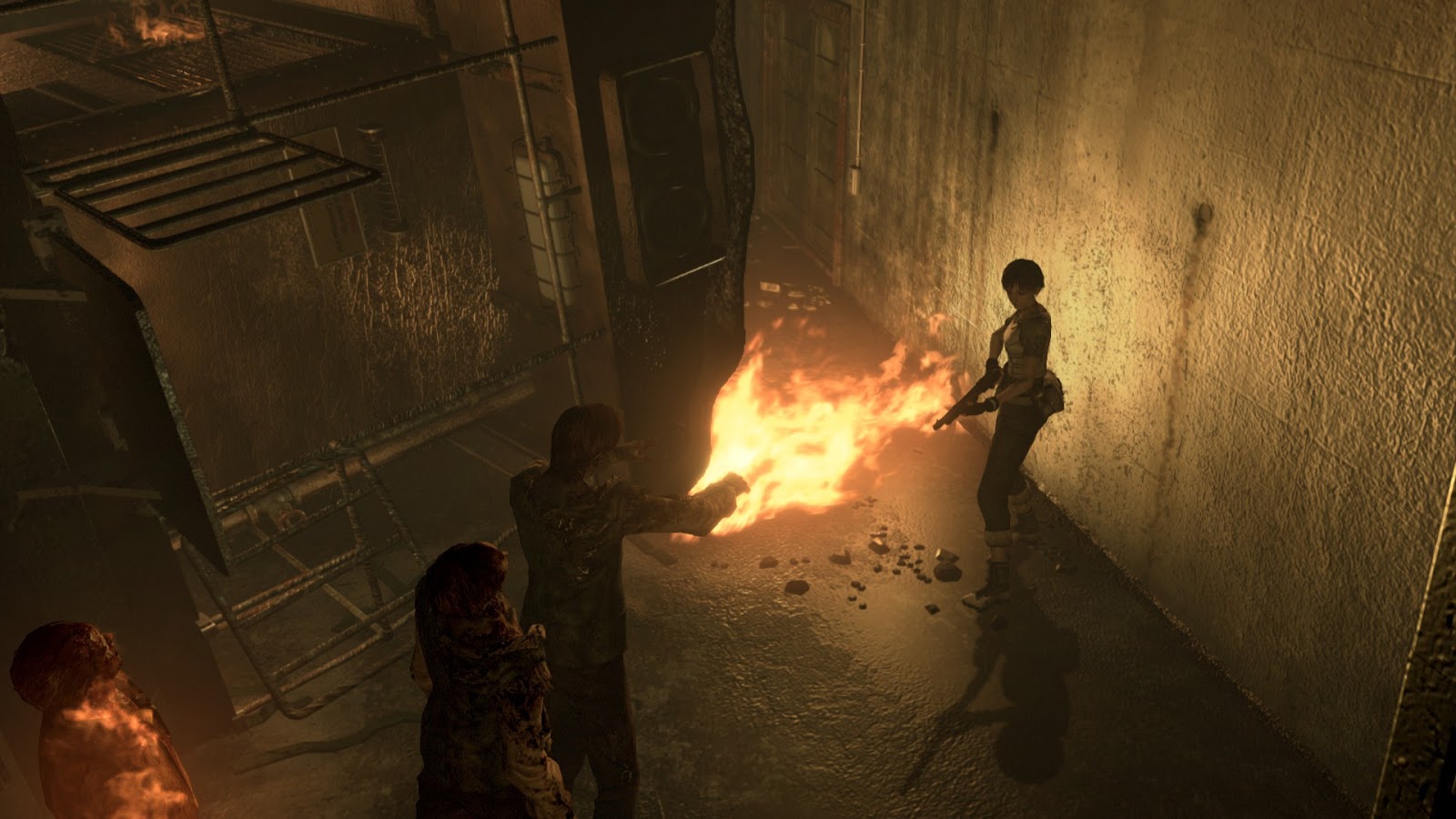
Right from the start, the game felt a lot more challenging than Resident Evil 1, but I was able to make my way through at a slow and steady pace... until I hit a solid brick wall, the Giant Bat. I had just barely made my way to the third area after finishing the Training Facility, saved in the church area and was then immediately thrown into a boss battle. Both playable characters were at low health but I had a decent amount of ammunition, so I assumed it would be possible to overcome the battle regardless. Unfortunately, the bat has a lot of health and is surrounded by many smaller bats that continuously fly at you, dealing chip damage. After dozens of attempts where the smaller bats killed me or my ammunition simply ran out, I realized I had saved myself into an unwinnable position. I lacked the ammunition to kill the boss, but getting more ammunition - if there was any left - would require backtracking through rooms with many enemies, wasting more health and ammunition.
After a few more stubborn attempts, I was ultimately forced to do something that hadn't happened even a single time in Resident Evil 1 - return to an earlier save, redo a few hours of progress and make it back to the same spot with more resources. This really took the fun out of the game for me for a while, but after I finally got back and made it past the boss, I was willing to give the game another fair chance. And for a while, that worked out fine - I made it through the next few areas without much trouble, and started to really enjoy myself again. And then, at the very end, I hit another solid brick wall: The first phase of the final boss. The situation was much the same as with the bat - not only did I have low health, I simply didn't have enough bullets left to take it down. And returning to a slightly earlier save didn't help the situation much at all, either, so I was in yet another situation where I would have to go back to a save of several hours ago to even be able to make it through this boss. After trying many more times, my patience had unfortunately run out, and I did something unprecedented for my streams: I loaded up CheatEngine and gave myself infinite ammunition to make it through the boss, then beat the rest of the final boss legitimately. I prefer not to resort to illegitimate methods to complete games, but if a game can create a situation where an obstacle becomes impassable, I consider that cheating as well. I described the frustrated feeling in my streams something like this: "You've made it to this point with the resources you have fair and quare, saved, and the game just wags its finger at you and calls your progress invalid because you don't have enough bullets or health." That's how it felt, and that's why I didn't feel particularly bad about cheating in this one segment.
In short, the game's abundance of Ink Ribbons but lack of other resources, combined with its highly linear structure, easily allows you to save yourself into an unwinnable position, particularly before boss encounters - many of which require a lot of ammunition to take down, especially on harder difficulty settings. The first time this happened, I played ball with the game's limits and re-did a two hour segment. The second time it happened, my patience ran out and I cheated for a few minutes to overcome the otherwise insurmountable obstacle. It is my personal opinion that this was perfectly fair, as I consider it a game design flaw that you can so easily save yourself in a bad position. I admit that this is mostly subjective, however, and high skill players will likely not run into this problem.
Not With Zero Merits

There were many frustrations in my experience with Resident Evil 0, but except for the 'brick walls' I encountered, the game was still solid. Its presentation is beautiful, and its areas - while derivative - are a joy to explore. I particularly liked areas that really capitalized on the two-character system like the Train and the Lab. And while the narrative was rather bare bones in its execution, I really liked the concept of a special agent and a death row criminal being forced to work together and having to learn to trust each other.
Because of all its qualities, I can still recommend the game to fans of the genre or series, although it is a cautious recommendation. If you play the game, play it on an easy difficulty to breeze through and enjoy the atmosphere and locations. If you do feel brave enough to tackle the hard difficulty, remember to be stingy with your Ink Ribbons and make sure you're keeping as many resources as you can.
And that's all I had to say! I'm aware that this article was more negative and anecdotal than usual, but I just wanted to share my experiences with this game. Any feedback would be appreciated!


