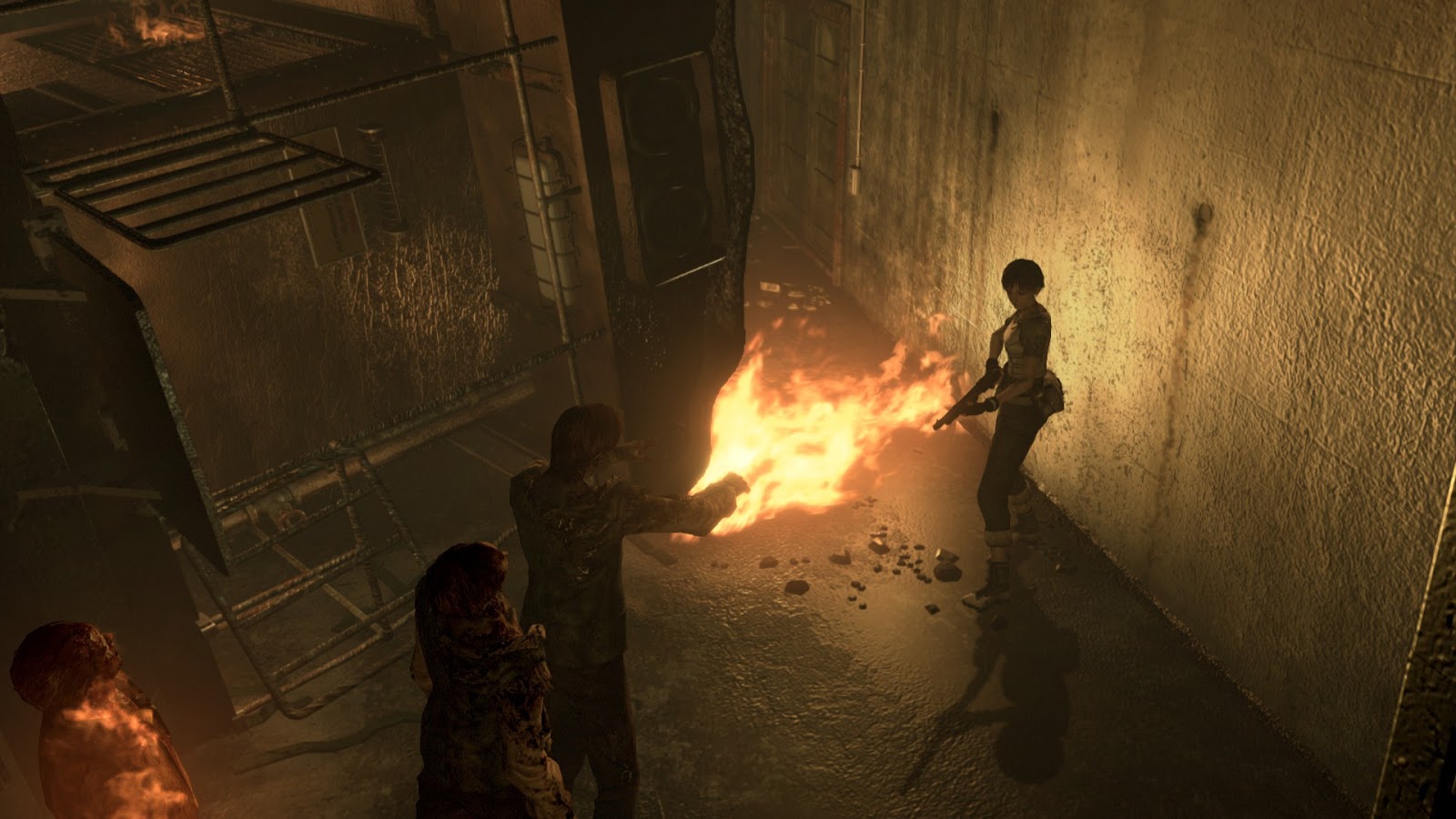
I recently finished Resident Evil 0, the prequel to the classic Resident Evil. Unlike its more popular predecessor, Resident Evil 0 had a lukewarm reception and is usually considered "just alright." In light of the article I wrote about Resident Evil and the limited Ink Ribbons, I wanted to discuss the ways in which this game is both kinder and more cruel. This is going to be a bit more anecdotal than my usual article, because I want to describe my personal experience with the game as well as analyze it. On the Right Track
Resident Evil 0 brings a few new ideas to the table. You're playing as two characters, Rebecca and Billy, which presents new possibilities and challenges alike. Each has their own inventory space, so you can hold more, but who needs to hold what? You have two people who can fight, but also two people who you need to protect and keep in good health. While I thought puzzles using the two characters separately were underutilized, I did really appreciate this concept. There's a unique terror to controlling your two characters separately, focusing on one of them for too long and then hearing the other character call for help on your walkie talkie. Can you rush over there? Or will you switch and deal with the problem on your own? The few moments after you realize one of your characters is in danger are always tense.
Written in Ink and Blood
The main point of my article about Resident Evil was discussing the Ink Ribbons, which effectively turn saving into a limited resource. I felt this was a daring design choice with great potential payoff, but great risk as well. I think Resident Evil HD ultimately came out on top with it, but Resident Evil 0 much less so. The Ink Ribbons return here, and strangely, they're actually a bit more common - further compounded by the game's shorter length. I found myself having an overabundance of them and kicking myself for not saving after certain deaths because I was so used to them being rare after the first Resident Evil.
But the abundance of Ink Ribbons combined with another of the game's quirks quickly led to major frustrations - namely, the layout or structure of where the game takes place. Resident Evil takes place in a mansion first and foremost, with each of the separate areas being an offshoot of that. Resident Evil 0 is a bit more linear in that regard - the first area, the train, is actually closed off permanently after you leave it, and each area after that becomes mostly irrelevant after you move on to the next. This means there is less room for exploration and fewer paths to take at any one time. Combine that with some really mean enemies and enemy placements, the fact that health items are still as rare as ever, and you've got a situation where you can quite easily save yourself into a corner.
Right from the start, the game felt a lot more challenging than Resident Evil 1, but I was able to make my way through at a slow and steady pace... until I hit a solid brick wall, the Giant Bat. I had just barely made my way to the third area after finishing the Training Facility, saved in the church area and was then immediately thrown into a boss battle. Both playable characters were at low health but I had a decent amount of ammunition, so I assumed it would be possible to overcome the battle regardless. Unfortunately, the bat has a lot of health and is surrounded by many smaller bats that continuously fly at you, dealing chip damage. After dozens of attempts where the smaller bats killed me or my ammunition simply ran out, I realized I had saved myself into an unwinnable position. I lacked the ammunition to kill the boss, but getting more ammunition - if there was any left - would require backtracking through rooms with many enemies, wasting more health and ammunition.
After a few more stubborn attempts, I was ultimately forced to do something that hadn't happened even a single time in Resident Evil 1 - return to an earlier save, redo a few hours of progress and make it back to the same spot with more resources. This really took the fun out of the game for me for a while, but after I finally got back and made it past the boss, I was willing to give the game another fair chance. And for a while, that worked out fine - I made it through the next few areas without much trouble, and started to really enjoy myself again. And then, at the very end, I hit another solid brick wall: The first phase of the final boss. The situation was much the same as with the bat - not only did I have low health, I simply didn't have enough bullets left to take it down. And returning to a slightly earlier save didn't help the situation much at all, either, so I was in yet another situation where I would have to go back to a save of several hours ago to even be able to make it through this boss. After trying many more times, my patience had unfortunately run out, and I did something unprecedented for my streams: I loaded up CheatEngine and gave myself infinite ammunition to make it through the boss, then beat the rest of the final boss legitimately. I prefer not to resort to illegitimate methods to complete games, but if a game can create a situation where an obstacle becomes impassable, I consider that cheating as well. I described the frustrated feeling in my streams something like this: "You've made it to this point with the resources you have fair and quare, saved, and the game just wags its finger at you and calls your progress invalid because you don't have enough bullets or health." That's how it felt, and that's why I didn't feel particularly bad about cheating in this one segment.
In short, the game's abundance of Ink Ribbons but lack of other resources, combined with its highly linear structure, easily allows you to save yourself into an unwinnable position, particularly before boss encounters - many of which require a lot of ammunition to take down, especially on harder difficulty settings. The first time this happened, I played ball with the game's limits and re-did a two hour segment. The second time it happened, my patience ran out and I cheated for a few minutes to overcome the otherwise insurmountable obstacle. It is my personal opinion that this was perfectly fair, as I consider it a game design flaw that you can so easily save yourself in a bad position. I admit that this is mostly subjective, however, and high skill players will likely not run into this problem.
Not With Zero Merits
There were many frustrations in my experience with Resident Evil 0, but except for the 'brick walls' I encountered, the game was still solid. Its presentation is beautiful, and its areas - while derivative - are a joy to explore. I particularly liked areas that really capitalized on the two-character system like the Train and the Lab. And while the narrative was rather bare bones in its execution, I really liked the concept of a special agent and a death row criminal being forced to work together and having to learn to trust each other.
Because of all its qualities, I can still recommend the game to fans of the genre or series, although it is a cautious recommendation. If you play the game, play it on an easy difficulty to breeze through and enjoy the atmosphere and locations. If you do feel brave enough to tackle the hard difficulty, remember to be stingy with your Ink Ribbons and make sure you're keeping as many resources as you can. And that's all I had to say! I'm aware that this article was more negative and anecdotal than usual, but I just wanted to share my experiences with this game. Any feedback would be appreciated!
I've finally finished 'Zero Escape: Zero Time Dilemma,' a game I was so mixed about that I actually wrote a preliminary article detailing the reasons I was taking so long to get through the game. Now it's finally time to get really deep into what exactly I liked and didn't like about this controversial conclusion to a well-liked trilogy. I'll structure this much like the articles on the other two games, as I'll be comparing them a lot.
Gameplay Dilemmas (Escape Room Gameplay)
999's escape rooms worked with restricted angles, while Virtue's Last Reward had you moving through escape rooms on a set track. Zero Time Dilemma finds a happy compromise by giving you a static position in the center of the room, but allowing you complete 360 degree control over where you look. This comfortable and consistent style does come with a price, however: There are no multi-room escape segments like in 999, and no larger rooms with complex layouts like in Virtue's Last Reward. The game also gives up the idea of having a harder secondary puzzle or separate difficulties like Virtue's Last Reward; there is only one solution, and the characters will aggressively hint at the solution whether you ask them to or not. All in all, I'd describe the gameplay in puzzle rooms as more streamlined and comfortable, but maybe just a bit too simplified as well.
Some puzzles force you to back out if you enter a wrong solution, most likely to prevent you from trying to brute force it, but this occasionally felt like an annoying waste of time.
As far as I know, there were no fatal mistakes in the prior games' escape rooms. For some strange reason, however, there was a single escape room that could trigger a 'game over' if you failed the puzzle. I thought this was very strange and inconsistent with the other games, and all the other escape rooms in the same game. I admit that I could've simply missed other occasions where this had happened, but it just feels out of place in general; Zero Escape is all about reaching bad endings as a consequence of your choices, not because you didn't get a puzzle right on the first go.
One thing I did appreciate is how quickly puzzle rooms wrap up when you get the solution. There is no meandering like in Virtue's Last Reward, where you acquire a code to a safe which you open to acquire a key which you use to finally open the door. When you find the solution, boom, 'you found it.' The game doesn't waste your time at all in that regard; a positive way the escape rooms have been "streamlined."
Moving on from the quality to the quantity, Zero Time Dilemma is a small step back. Both 999 and Virtue's Last Reward feature 16 escape rooms, many of which are much larger than Zero Time Dilemma's. Zero Time Dilemma, on the other hand, only has 13. With the rooms being smaller and shorter, you'd think there would be room for more, but perhaps this is because the game is more focused on the segments outside the escape rooms.
All in all, I don't have any major problems with the escape rooms in Zero Time Dilemma. They're more streamlined and simple, but are still filled with entertaining puzzles and minigames to solve. It is a shame that there are fewer of them, though.
Zero Interaction (Visual Novel "Gameplay")
I referred to this section as "visual novel gameplay" to be consistent with the articles about the other two games, but in reality, there is almost none. Between the escape rooms and major decisions, there are only lengthy cutscenes. Very early in the game, you're allowed to pick between a few conversation topics - although you need to pick all of them eventually - and after that, cutscenes are just that; animations that play out without any input from the player. Some useful functionality was kept, however. You can still pause at any time, and scenes you've already seen can be skipped. Even so, it feels frustrating to have control removed from you at every turn; it feels like you have a very passive role outside of escape rooms. This way of doing things also removes the possibility of showing the player what the player character is thinking at all times and doesn't allow for describing the environments in much detail.
But what really sets the Zero Escape games apart is the branching narrative, and this game certainly has its own spin on it.
A key point of the game's story is that the characters are injected with memory erasing drugs after each segment, so they have no idea which events take place when - for this reason, the player is also kept in the dark about the structure of events until you complete them. Each "event" has its own, smaller flowchart with 2 to 4 branches depending on choices. Once you complete them, you'll learn their position on the global flowchart, but until then, they are represented as a group of unorganized images in a circle, many of which you can access in whatever order you choose - there is a set for each of the three teams.
Allowing the player to experience the story in a nonlinear order is an interesting and daring design choice, but it doesn't do the pacing any favors. Depending on what events you happen to choose, you could be faced with several escape rooms all in a row with very little else in-between. I do appreciate the option of switching between the teams at will, as you may get tired of certain characters after a while.
One of the major facets of the visual novel gameplay that is still intact is the choices, and I'm happy to say they are an improvement over the other two games in various ways. In 999 and Virtue's Last Reward, your choices amounted to little more than choosing a door or choosing to 'ally' or 'betray.' There weren't really wrong decisions, you just picked the branch you wanted to go down. In Zero Time Dilemma, choices take many forms; from entering in a name to answering multiple choice questions, from simply choosing action or inaction to things determined by random chance.
This is one of the major advantages of having many smaller "isolated" flowcharts, all taking place in separate timelines - it allows for many more of these choices, and it allows them to have dire consequences. Picking the wrong door in 999 or Virtue's Last Reward could eventually lead to a specific bad ending, but Zero Time Dilemma isn't scared to let your characters die in a horrific fashion the moment you slip up. In fact, instead of just having a few major turning points with a decision, every single event has a choice of some kind. I can gladly say that out of the three games, the choices in this game had me the most tense.
All of these separated events and small choices are going to feel overwhelming and unpredictable compared to the neatly structured 999 and Virtue's Last Reward and they certainly make a confusing first impression, but looking back at it, I really enjoyed seeing the flowchart slowly come together. Playing a major story event, seeing some common threads between another and checking the flowchart to see how they relate becomes a game in and of itself, and the more you play, the more you see everything is connected - the game just takes its sweet time showing you the connections. The awkward pacing is still a concern, but I can really see what they wanted to achieve with this structure and it is a success in some ways.
The game has preserved a few other good habits from its predecessors - you can jump to any point in the flowchart at will if you wanted to make another decision and it's always clear how many branches there are.
All in all, a lot was lost in the transition from visual novel to cutscene, allowing for less insight into the characters' thoughts. The nonlinear structure is a daring design choice that pays off in some ways, but hurts the pacing a little. At least there are more choices with higher stakes and immediate consequences, many of which force you to think on your feet, which is a nice step forward.
Zero Steps Forward (Presentation)
I think it's fair to say that this is the game's greatest misstep. I discussed it at length in my preliminary thoughts, but it really can't be understated what a huge leap backwards this game is compared to 999
and even Virtue's Last Reward. I disagreed with Virtue's Last Reward's decision to use 3D models for its characters, but in retrospect, the models had a cute and simplistic charm that - while still not as good as the beautiful drawings from 999 - at least had its own charm. Zero Time Dilemma uses more "realistic", detailed 3D models, and that's where the problems begin.
Back when I studied Game Art, my animation teacher shared this important guideline about animation: the detail of the animation ought to match the detail of the art. South Park can get away with incredibly simplistic animation because the art, too, is incredibly simplistic. That kind of animation could never work with Disney's much more complex animated classics. I was reminded of this lesson when I saw Zero Time Dilemma in motion. Every movement is slow, simple and very robotic, which is all the more grating because of the detail in the 3D models. Worse still, because the developers opted for hours of cutscenes instead of visual novel segments, you'll be watching these 3D models stiffly shuffling around for the better part of the game's runtime. And the problems don't even end there; just like in Virtue's Last Reward, the lip sync is not good and voices will regularly play over closed mouths. Parts of characters will sometimes clip through their own bodies or through setpieces.
The camera also barely moves in cutscenes, cutting from place to place and seemingly mostly to try and hide awkward movements or prevent the animators from having to do more work. All in all, it just seems like amateur work and I don't understand why they opted for this style if they lacked the resources to make it work. Spike Chunsoft made a similar mistake with Danganronpa Another Episode: Ultra Despair Girls, a spin-off of the Danganronpa series. Fortunately, that game still had moments of important dialogue depicted with the handdrawn 2D portraits, but during gameplay and more active cutscenes, the characters were portrayed by somewhat simplistic 3D-models. Strangely enough, they were still a lot better animated than the characters in Zero Time Dilemma, even though the latter (2016) came out a year after the former (2015).
In the game's defense, there are parts of the presentation that look good - the interfaces. Little motion graphics animations play whenever you have to make a decision or when you start an escape room, and these are all very slick and fun looking. It makes you wonder why they didn't capitalize on their strength in 2D design more. Was it really less effort to make these 3D models?
The music in the game is fine, but it borrows many of its tracks from Virtue's Last Reward. I'll post one track that I like - it often plays after you've made a good choice that'll move the story forward:
The audio mixing wasn't always great, however, with the music occasionally drowning out the voice actors. It didn't happen a lot, but still often enough to notice.
I personally felt that the voice acting in this game was somewhat weaker than its predecessors. It's fine in normal conversations, but whenever shocking or horrifying things need to happen, not all the voice actors can convincingly communicate it. I think this was especially noticeable because Zero Time Dilemma has many more shocking events than its predecessors; almost all scenarios have a choice that can potentially lead to injury and death, and in some scenarios, both options do.
All in all, the presentation is bad. Slightly more detailed models and neat interface elements can't make up for awful animation, bad camera work and dull environments. The music is still fine, though it does re-use many tracks from Virtue's Last Reward. The voice acting is also decent enough, but has more rough edges than before.
Wrapping up a Trilogy (Story)
While I won't go into specific spoilers, Virtue's Last Reward left a lot of things open to be resolved by its sequel - it was a lot more ambiguous than 999 in that regard. Zero Time Dilemma, being the third and final part of the trilogy, therefore has to deal with the expectations of resolving everything that was left unresolved in the last two games. Does it? I'll share my conclusion at the end of this segment.
In Zero Time Dilemma, the cast of characters is once again trapped in a closed space and forced to play a life or death game. In this case, the game is a lot more mean-spirited and revolves strongly around sacrificing others or presenting problems that are unfair and based on chance. You won't be an hour in before you're asked to decide which 3 of the 9 characters have to die, and the choices only get meaner from there. To really drive the point home, Zero himself repeatedly shares anecdotes about how good people were hurt or killed by unfortunate coincidences and ends these stories with "life is simply unfair, isn't it?" This is a major theme in the game.
Zero Time Dilemma is unique in that it has three protagonists, each of which is the leader of their 3-person team and in charge of making the important decisions. Unfortunately, I have a lot of problems with the cast. When it comes to the 9 main characters, 5 are new and 4 are returning characters from the previous games. I want to talk about the returning characters, so there will be minor spoilers in this section:
[Returning Characters Spoilers]
Junpei and Akane are back from 999. Sigma and Phi are back from Virtue's Last Reward. Both "couples" are together as part of two separate three-person teams. I'm mostly content with the latter pair; they act much the same as they did in Virtue's Last Reward and are easily two of the more likeable characters in the cast. I have a really big problem with the return of Junpei and Akane, though. In 999, Junpei was optimistic and kind - in this game, he's what I can only describe as "edgy." He pushes the player to make decisions sacrificing other people, he's regularly snide or spiteful and generally unpleasant to be around. This is given an in-story justification, but because the justification happens off-screen somewhere between 999 and this game, it's not very convincing. I thought the dynamic between Junpei and Akane was very endearing in 999; a little cliché, perhaps, but I have a soft spot for the idea of childhood friends reuniting and reigniting those old flames. But in this game, Junpei is just constantly a jerk and most of Akane's personality - when she's not spouting exposition - consists of pointing out how much he's changed or how amoral he's being. In the interest of fairness, I will say that it gets better as the game progresses. Junpei thaws out a little bit and there's even room for a few heartwarming cheesy moments, so I won't consider their team a total loss.
[Returning Characters Spoilers End Here]
Leading C-Team is Carlos, the first character you'll play as. I played through the entire game and still couldn't get a very clear view of what kind of person he is, a problem worsened by the fact that the cutscenes don't allow you to see the characters' thoughts. He's a fireman and he has a sick sister, and that's basically the extent of his character. He does have a background and motivation, but it's pretty bare bones.
Leading D-Team is Diana, one of the more likeable characters. Unlike Carlos, she plays a vital role in the story, which does mean I can't say a lot about her background without spoiling it. She's mild-mannered and unsure and seems genuinely aghast with herself if you make amoral choices while playing as her.
The final team, team Q, consists entirely of new characters. The leader and playable character is a kid with a weird round helmet on his head, who is simply called Q.
Q is pretty shy and scared, as you might expect from a kid in this situation, but he's also surprisingly intelligent. He's this game's amnesiac, because every Spike Chunsoft game has to have one of those. He becomes more interesting as the story progresses, and he's the only remotely likeable character in his team. He's accompanied by Eric and Mira, the worst characters. Mira mostly hangs back but does try to guide Q into making amoral choices, while Eric constantly verbally assaults Q and even gets physical with him at times. The only remotely interesting thing about them is the romantic relationship between Eric and Mira - whenever the topic comes up, Eric becomes marginally more likeable. It's communicated quite clearly that he deeply cares for Mira, but that's hard to think about when he's screaming in poor Q's face or grabbing him by the collar half the time. But again, in the interest of fairness, there are a few really decent humanizing moments between even the hard-to-love members of Q-Team.
One thing you'll notice about how the teams are structured is that the playable characters are all fairly plain and passive - even Diana, as decent as she is. They seem to exist mostly as a faceless player character, a way for the player to view and interact with the more interesting couple of characters that accompany them without getting in the way. Personally, I would've preferred just having control of the more interesting characters instead of having to observe them as a third party. It's particularly egregrious that Carlos, Eric and Mira have so precious little to do with the overarching story. In 999, every character is involved in the Nonary Game for a very particular reason, but in Zero Time Dilemma, it's just a mish mash.
Setting aside the characters' relation to the overarching story, I've mentioned that the characters I don't like do have good or humanizing moments. The reason why these characters stay unlikeable for an extended period of time all comes down to the structure again. You can play the events in any order, which means the game has to account for that. So, in the game, Zero injects the participants of the game with a convenient memory erasing drug after most events. This means that with most events, they all think it's the first time they've woken up, and their entire arc restarts from the beginning. Eric may freak out at Q, grab him by the collar, but then learn something about working together to survive and apologize... and then the memory drug kicks in, and the same thing happens again in the next event. The nonlinear structure and memory drug cause a lot of general repetition; expect to hear about Carlos' sister for the "first time" several times, and many other stories as well. If you commit to completing all the events, you'll get past this eventually, but it'll test your patience. And of course, the repetitive parts can't be skipped because they're "technically" new scenes.
The structure isn't the only reason for the repetition, of course. I think having the three teams completely separate from each other is to the game's detriment as well. Both 999 and Virtue's Last Reward had the fantastic idea of allowing you to take different paths which allowed you to accompany different characters and different combinations of characters. I didn't get bored for a second doing the alternate branches in 999 because it gave me completely new insights on how certain characters interact with each other. In Zero Time Dilemma, each event just has you waking up in a room with the same three characters. Sometimes one of the characters is missing, which is a worthwhile attempt at making it more varied, but it doesn't really compare to seeing all new combinations.
Moving on from the characters, I want to talk about the story itself.
As I said, the characters are once again involved in a death game, but the rules are much harsher this time. The game won't end until at least six participants are dead, after which the survivors will be allowed to escape. This does raise the stakes quite nicely and gives a far greater incentive for the participants to betray each other than in the last games, where cooperation was ultimately always the best strategy.
For starters, I do want to give credit where credit is due. Like I mentioned under gameplay, the structure is interesting. It has its problems, but there's something to be said for seeing a story get built up one fragment at a time and seeing how all the good and bad endings connect to each other. The flowchart even changes shape as you figure out vital plot details. Just like the other Zero Escape games, you actually need to explore multiple branches and choices to see everything, and this game just takes that to a whole new level. If we leave out the repetition and the characters I don't particularly care for, it's actually really cool how the story builds up. I'd say it gets really good after you've done the first set of events for each of the teams and you enter a long string of interesting story developments where you jump from timeline to timeline. Unfortunately, things start to fall apart again near the end, and it all boils down to the conclusion.
The reason why this death game was organized, and who the mastermind behind it is, are both twists in the story that just don't land. The game does a lot of lying by omission to make it work and continues to introduce new concept after new concept. For example, the game casually springs a room on you with alien technology that allows you to send a copy of yourself to a different timeline, or a new character suddenly comes out of nowhere. Some would argue that there is clear foreshadowing to these events, but when I think of foreshadowing, I think of twists that surprise me and yet make me go "Wow, I should have seen that coming," not twists that force me to completely reinterpret everything that's been said and done to make it work. In a moment that has become a bit of a meme in the fanbase, the mastermind behind it all actually proclaims "My motives are complex." This is the antithesis of 'show, don't tell.' We're just informed that, yes, the mastermind's motives are complex.
When you're done, and I mean really done with all the endings, the game just ends unceremoniously without resolving much of anything. You can read up on what happened to some of the characters afterwards, but in terms of what you see in-game, it's all very ambiguous and fails to give any closure or pay-offs for everything it set up, not to mention all the things the prior two games left unresolved. Maybe Virtue's Last Reward just set the expectations too high, and they simply didn't have the resources to cover all that ground? But regardless, the ending left me very disappointed and unfulfilled. I spent a truly ridiculous amount of time getting all the endings and exploring every single story branch, just to leave everything so open? The game was content to drop minutes and minutes of exposition on me at every turn, but when the time came to neatly tie up all the plot threads, we just get another vague speech before quickly cutting to the credits.
All in all, the story in Zero Time Dilemma is deeply flawed. Half the cast is unlikeable and any character development that could've amended this is regularly reset due to the convenient memory erasing drug. The overall lack of a clear structure means you need to play through most of the game before you have any idea what's even happening and when. The ultimate reveals and ending are also disappointing and don't answer the questions that the game and its two predecessors raised. In the game's defense, the good characters are quite good and the bad characters aren't always terrible. Once you do get past the strange structure, the way the story is built up is really impressive. But that can't make up for all the problems.
Conclusion
I've already spent over 4000 words (Good Lord) trying to articulate all my problems with this game, so I'll keep this short and sweet.
Zero Time Dilemma streamlines its escape rooms, but simplifies them a bit as well. Your mileage may vary. Its presentation is where it really falls apart, however, with terrible animation and boring environments. This is made worse by the fact that you're stuck in unskippable cutscenes for minutes on end. The only high points in its presentation are its music and some of the performances. The story is very messy, with many unlikeable characters and the confusing structure working against it. There are likeable characters, good moments and the timeline jumping is always interesting, but those can't make up for the downright silly twists and disappointing ending.
Only recommended if you really, really liked the Zero Escape games - if you did, get it on sale and see if there's something in it for you.
_
Wow! This might be my biggest article yet. It took me ages to finish because, just like the game itself, it was hard to find the motivation. I write my best stuff when I feel inspired or happy, but this article is mostly a product of frustration and disappointment. I'll let you be the judge on whether or not it measures up to my other work. That's all - as always, comments are appreciated!
Nine Hours, Nine Persons, Nine Doors (which I'll refer to as 999 from this point) is a puzzle game which alternates between visual novel sections and escape room segments. It's famous for its inventive puzzles, complex story and branching narrative based on your choices. I have a history with this game - when it came out in 2010 (amusingly, 9 years ago) a few critical plot details were spoiled for me. That, combined with my lack of confidence in my ability to solve the escape rooms, dissuaded me from playing the game for a long time. Just a few days ago I saw the game's PC rerelease was on sale, and decided it was finally time for me to try it. Find a Way Out (Gameplay)
The main 'gameplay' in 999 is in the escape rooms. You're given a quick overview of all the rooms and angles, and a simple objective: Find a way out. The way it controls is no different from what you'd expect in a point & click adventure. You click on objects in the environment to interact with them, either to examine them, pick them up or use an item on them. You can also combine items you've picked up to potentially create new items. The game does take advantage of the fact that the items are in 3D; papers will often have hidden messages on the back that you can only find by rotating them, and holding items at a certain angle may help you figure things out.
The item menu is clearly designed to be simple, so the items are big and central. This is usually fine, but scrolling through or finding the right combination can be a little tedious if you're carrying a lot of items. This usually won't happen if you're solving a room in the right order, but it can happen.
In escape rooms, you're stuck with a few predetermined angles that you can move between. This is a bit restrictive, but it ensures that wherever you look, there will be something of interest.
If I had one point of criticism that isn't just a minor quality of life improvement, it's the inconsistencies with which information is stored. You have an item menu for items, but there is also a 'file' menu where important papers are stored. Some papers end up under items, some under 'file' which is a bit harder to reach. This would be easy to fix by combining the item and file menus and simply allowing for more text to be displayed on the item menu.
Beyond that minor gripe, I had a great time solving all the rooms and it was always a good feeling when you slowly see the exit open as soft music begins to play and you're greeted with a simple, clear message:
From Two Screens to One (Presentation)
I played the PC version of 999, which is a remake of the DS version. There are clear improvements - all characters have larger resolution portraits and animations, the music has been redone and the visual novel sections have been provided with full voice acting - and you can pick the original Japanese version or the English translation, whatever suits you. This is a very significant improvement and makes the remake worth looking into even for people who played the DS original.
The characters and unique illustrations for important situations look great, but the escape rooms - which seem like they're changed the least from their DS versions - are very simple and varied in quality. In the picture above, you'll have noticed that they had to tack the word 'cheese' onto those yellow blocks to get across what it is. There are also many items that really could've used some more polygons and better textures, but in the end, it gets the job done - and the characters are still the main attraction. Each one is very distinctive.
As I mentioned earlier, the soundtrack has also been redone. It's very effective at what it does and the tracks lend a lot of tension to the rooms. Most of the tracks aren't exactly the kind I would listen to for fun, but there are a few standout tracks I really did enjoy. Here's an example:
Branches (Story)
999's story is worth the price of entry all by itself and I don't want to spoil it, so I'll keep this short and just list a few general selling points to convince you to try it:
- 999 has an intense, high stakes story. As its name implies, 9 people are put together in a deadly situation and forced to play a sadistic game known only as the Nonary Game. In this game, they players have only 9 hours to escape with their lives. Who do you trust? Who do you group up with?
- The cast of characters is distinct and well written. You'll undoubtedly take a shine to a few of the characters and start to dislike certain others; they're all very unique and it's a treat to see how they respond to each other and the various situations they end up in.
- 999 has a branching narrative and multiple endings. The real fun is in seeing all the different ways things can go and the game has a few useful functions to help you out with that. From the start, you have access to a flowchart that shows you exactly where the story branches and where critical decisions happen. You can jump to any part of the flowchart at any time, no strings attached, so if you regret your decision or want to try a different combination of choices, you're welcome to do so.
Conclusion
999 is a puzzle game with sharp writing, amazing characters and a branching narrative - not to mention vibrant animated portraits for the characters and heart pounding music tracks from start to finish. The game's escape rooms will challenge your puzzle solving skills, though they do lack some conveniences and aren't visually appealing. If you love story and puzzles, get this game. If you're only into story or only into puzzles, consider getting it on sale. It's bundled with its sequel that I am currently playing and will share my extended thoughts on in the future. Check it out here: