Pagina's

Showing posts with label pc. Show all posts

Monday, August 26, 2019

Some Thoughts About 'Nine Hours, Nine Persons, Nine Doors'

Nine Hours, Nine Persons, Nine Doors (which I'll refer to as 999 from this point) is a puzzle game which alternates between visual novel sections and escape room segments. It's famous for its inventive puzzles, complex story and branching narrative based on your choices. I have a history with this game - when it came out in 2010 (amusingly, 9 years ago) a few critical plot details were spoiled for me. That, combined with my lack of confidence in my ability to solve the escape rooms, dissuaded me from playing the game for a long time. Just a few days ago I saw the game's PC rerelease was on sale, and decided it was finally time for me to try it.

Find a Way Out (Gameplay)

The main 'gameplay' in 999 is in the escape rooms. You're given a quick overview of all the rooms and angles, and a simple objective: Find a way out. The way it controls is no different from what you'd expect in a point & click adventure. You click on objects in the environment to interact with them, either to examine them, pick them up or use an item on them. You can also combine items you've picked up to potentially create new items. The game does take advantage of the fact that the items are in 3D; papers will often have hidden messages on the back that you can only find by rotating them, and holding items at a certain angle may help you figure things out.


The item menu is clearly designed to be simple, so the items are big and central. This is usually fine, but scrolling through or finding the right combination can be a little tedious if you're carrying a lot of items. This usually won't happen if you're solving a room in the right order, but it can happen.

In escape rooms, you're stuck with a few predetermined angles that you can move between. This is a bit restrictive, but it ensures that wherever you look, there will be something of interest.


If I had one point of criticism that isn't just a minor quality of life improvement, it's the inconsistencies with which information is stored. You have an item menu for items, but there is also a 'file' menu where important papers are stored. Some papers end up under items, some under 'file' which is a bit harder to reach. This would be easy to fix by combining the item and file menus and simply allowing for more text to be displayed on the item menu.

Beyond that minor gripe, I had a great time solving all the rooms and it was always a good feeling when you slowly see the exit open as soft music begins to play and you're greeted with a simple, clear message:


From Two Screens to One (Presentation)

I played the PC version of 999, which is a remake of the DS version. There are clear improvements - all characters have larger resolution portraits and animations, the music has been redone and the visual novel sections have been provided with full voice acting - and you can pick the original Japanese version or the English translation, whatever suits you. This is a very significant improvement and makes the remake worth looking into even for people who played the DS original.

The characters and unique illustrations for important situations look great, but the escape rooms - which seem like they're changed the least from their DS versions - are very simple and varied in quality. In the picture above, you'll have noticed that they had to tack the word 'cheese' onto those yellow blocks to get across what it is. There are also many items that really could've used some more polygons and better textures, but in the end, it gets the job done - and the characters are still the main attraction. Each one is very distinctive.


As I mentioned earlier, the soundtrack has also been redone. It's very effective at what it does and the tracks lend a lot of tension to the rooms. Most of the tracks aren't exactly the kind I would listen to for fun, but there are a few standout tracks I really did enjoy. Here's an example:


Branches (Story)

999's story is worth the price of entry all by itself and I don't want to spoil it, so I'll keep this short and just list a few general selling points to convince you to try it:

- 999 has an intense, high stakes story. As its name implies, 9 people are put together in a deadly situation and forced to play a sadistic game known only as the Nonary Game. In this game, they players have only 9 hours to escape with their lives. Who do you trust? Who do you group up with?

- The cast of characters is distinct and well written. You'll undoubtedly take a shine to a few of the characters and start to dislike certain others; they're all very unique and it's a treat to see how they respond to each other and the various situations they end up in.

- 999 has a branching narrative and multiple endings. The real fun is in seeing all the different ways things can go and the game has a few useful functions to help you out with that. From the start, you have access to a flowchart that shows you exactly where the story branches and where critical decisions happen. You can jump to any part of the flowchart at any time, no strings attached, so if you regret your decision or want to try a different combination of choices, you're welcome to do so.


Conclusion

999 is a puzzle game with sharp writing, amazing characters and a branching narrative - not to mention vibrant animated portraits for the characters and heart pounding music tracks from start to finish. The game's escape rooms will challenge your puzzle solving skills, though they do lack some conveniences and aren't visually appealing. If you love story and puzzles, get this game. If you're only into story or only into puzzles, consider getting it on sale. It's bundled with its sequel that I am currently playing and will share my extended thoughts on in the future. Check it out here:

Saturday, August 3, 2019

Sea of Thieves: The Power of Rare

I've been playing a lot of Rare's Sea of Thieves lately. The game has had a tough time of it, struggling to captivate people due to its unpolished nature, lack of content and rather steep price. But even though those are all valid problems, I want to highlight a few ways in which the game still has that Rare spark we've known since many console generations ago.

Jiggies and Jingles

During Rare's peak, they made several "collectathon" platformers like Banjo-Kazooie. One of the many ways in which these classics outperformed the competition was its soundtrack, and particularly, its sound design. Every single pick up has a distinctive sound to it.


Sea of Thieves' soundtrack usually stays in the background, but like in Banjo-Kazooie, Rare made sure that there are still distinctive sounds and jingles to each situation and achievement. At the start, you can do voyages for 3 main guilds. Each guild has a distinctive music track when you come close to one of its representatives, but it doesn't end there - each guild has a jingle for when you start one of their voyages, when you complete an objective within the voyage (like discovering a chest or defeating a skeleton captain) and when you sell an item to them. Some unique items, like the Chest of Sorrows or the Chest of 1000 Grogs, even have their own unique jingles as well.


And even in battles, there are unique musical flourishes for getting a hit on another player, getting a hit on a Kraken's tentacle (a very small jingle for landing a sniper shot, a slightly longer one for landing a cannonball shot) and getting a hit on the Megalodon. The list just goes on and on; Sea of Thieves' entire library of sound and music is a labour of love - and that famous 'Rare flair' is in more than just the jingles.

Environmental and Reactive Music

The Nintendo 64 was a breeding ground for all kinds of revolutionary and groundbreaking developments, not least of all in terms of game audio. Contextual musical changes weren't unheard of (take the added drums when riding Yoshi in Super Mario World), but Banjo-Kazooie and its sequel pioneered having radical seamless changes between various very different versions of the same theme. For example, Treasure Trove Cove has a theme for being above and underwater which it can smoothly transition between:


Sea of Thieves is a very different game; there are no levels with their own default themes that can subsequently be iterated upon. Rather, the whole world is open to you, and the music can transition to many themes to fit the situation. Like Banjo, you'll be treated to unique and beautifully relaxing music if you decide to explore the ocean beneath the waves and you'll hear a given company's musical theme if you approach their representative at an outpost. Like Ocarina of Time, another N64 classic, unique music plays when you encounter an enemy - and there are unique tracks depending on the kind of encounter. Are you fighting the megalodon at sea, or a cursed skeleton ship? Or are you fighting skeletons on the shore? There's a track for most any situation.


And with every new update, the game's already massive library of contextual jingles and tracks expands. In an update, The Hunter's Call was added to the game - an entirely new faction with its own jingles. With the Hunter's Call came the ability to fish, and fishing has its own music as well. It seems there is no brake on this train, or rather, ship - it's clear that Rare is committed to making Sea of Thieves' audio as absolutely perfect as it can be. If you needed any more proof that music is a high priority, note that any Sea of Thieves character comes with 4 instruments by default that they can play a few tracks on - with other players, too.

Eye Candy

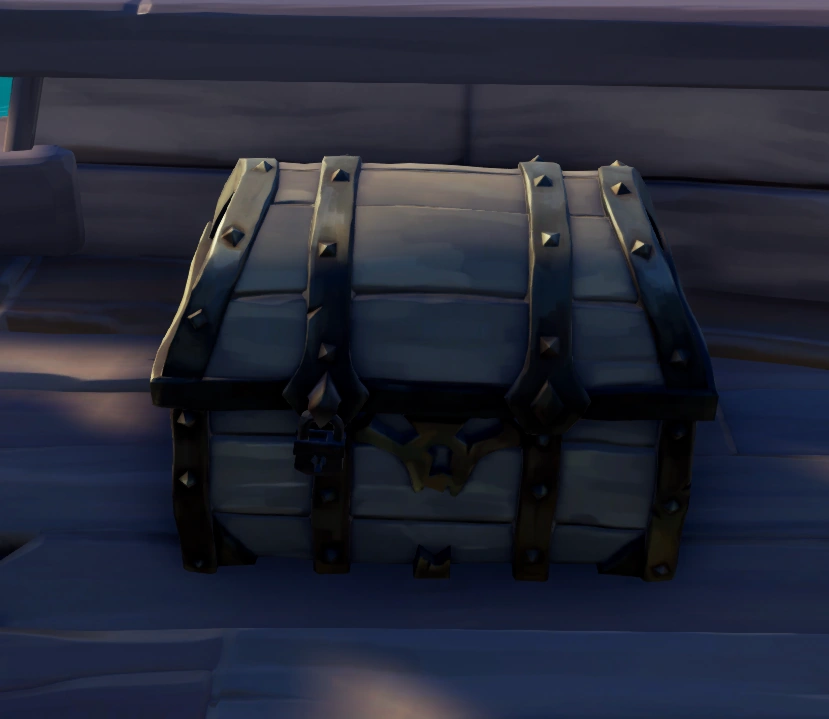
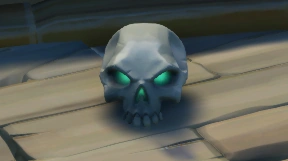
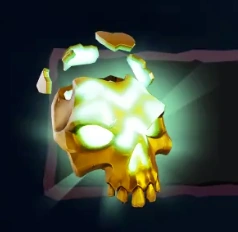
When it comes to that 'Rare magic,' I think the music and sound comes to mind first. But their games have visuals to match; just as each collectible in Rare's classic collectathons had a distinctive sound, it also had a distinctive design. But a major difference between the games of yore and Sea of Thieves is that the items in Sea of Thieves don't have a unique utility (like the ability to fly or become invincible in Banjo); they just have a unique value and are meant for a specific faction. For example, the Gold Hoarders want treasure chests, and the Order of Souls wants skulls.

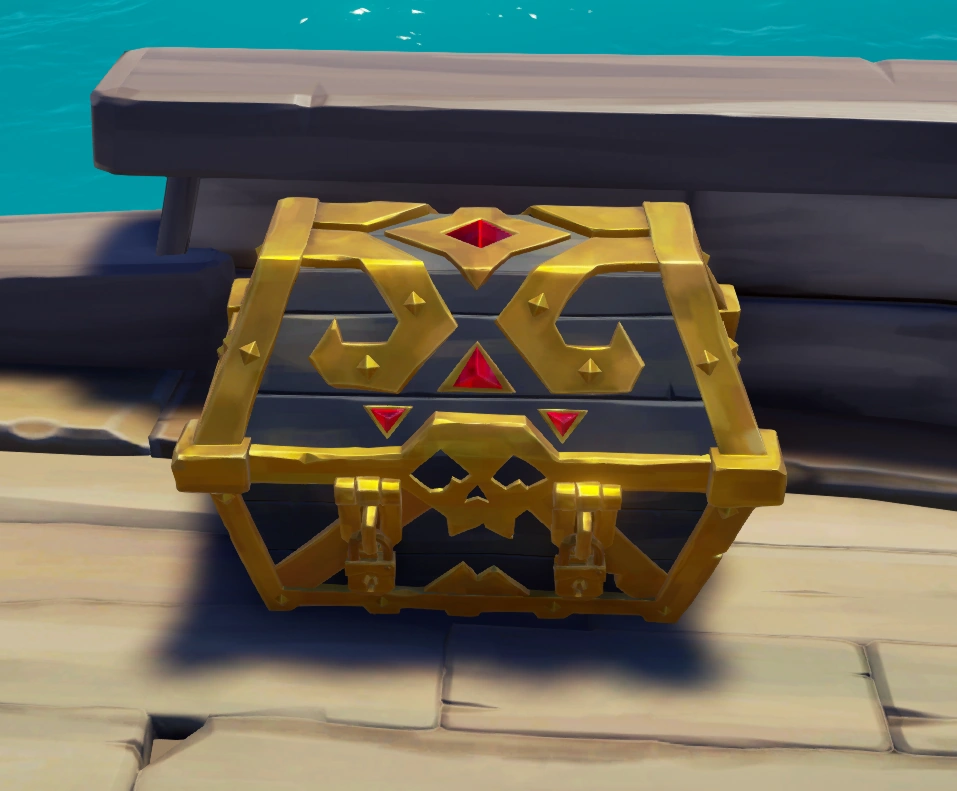
So rather than design the items based on their function, they're designed based on their associated faction and value. You can immediately tell by the look of an item which faction it's for and how valuable it is. Consider these two chests:


You don't need anyone to tell you which of these is more valuable, and that goes for the skulls too:


And this is just barely scratching the service, as each type of treasure has more tiers than I've shown, the Merchant Alliance has its own line of treasure, there are different types of enemies with clear visual cues and colours - the game's presentation is as splendid visually as it is in sound.


Conclusion

No one can deny that Sea of Thieves has had, and still has, its problems. But the Rareware we know and love is still clearly visible in the details. Their flair for giving every little thing its own distinctive sound, music and look has stayed alive to this very day and is one of the main attractions of Sea of Thieves on the whole. And they're still expanding on the game, so the amount of little details will only increase as time goes on.

Have you had any experiences with Sea of Thieves? Did you enjoy it, or did the game's shortcomings get in the way of your enjoyment? Please let me know!

Sunday, October 21, 2018

A Few Thoughts On Pinstripe

It's October, so I decided to take this opportunity to catch up on a few scary games I've been planning to play. These articles won't be full blown reviews - more like rants, really.

So, let's talk about Pinstripe. Pinstripe is a short puzzle platformer about a minister called Ted whose daughter is abducted, and he has to journey through a hellish winter landscape to save her.


Pinstripe's greatest virtue is obvious from the get-go: its presentation. It has a distinctive style with simple shapes like you'd see in a children's book, but the images depicted are disturbing to say the least. You could call it 'Burtonesque.'


The environments are visually powerful, but so are the characters. There are several characters - some of which are voiced by YouTube celebrities like PewDiePie and JackSepticEye. The game's antagonist, Pinstripe, is the standout character - a man with a sophisticated, polite air who seems to fly into random bouts of swearing and aggression when questioned or challenged in any way.


The story itself is another of Pinstripe's strengths. Who Pinstripe is and why he kidnaps Ted's daughter - there's enjoyment to be had in figuring out the clues as you explore the world. I don't want to give away too much beyond that - the game is pretty short, so it's best experienced for yourself.

It's sad to say, but I think Pinstripe's weakest part is probably its gameplay. That isn't to say it's really terrible; it's just rather basic and a bit rough around the edges. It has quite a few puzzles, many of which are rather fun to figure out. The game controls in 2D, but you can examine the clues you find in 3D much like in a detective type game. There's something to be said for finding a note, turning it around and finding a hidden message on the back. The puzzles never get terribly complex, however, usually requiring a simple number code, hitting switches in a certain order or playing a game of 'spot the differences' with two paintings. Complex or not, though, it's entertaining enough thanks to the way the puzzles are presented.

The game also requires you to do some platform challenges - and there is some polish missing there. More than once, Ted got his feet stuck on a small outcropping or nothing. Ted has very little sense of momentum, just starting and stopping instantly. The general issues with collision and physics were pretty minor all in all, but noticeable.

Later in a game, you are asked to backtrack through the world to acquire a large number of the game's signature collectible, frozen oil drops. There are a few new interesting puzzles on this return trip, but in most of the areas you'll be performing the exact same action - fire your slingshot through the fire onto flammable mushrooms so they explode and yield more collectibles for you. Considering it was required to progress the story, I felt this amount of backtracking was a little unnecessary for so short a game - but since the world was also pretty small, I can't say it was a huge bother.

Speaking of the slingshot, it is your primary means of self defense and environmental puzzle solving. It's basic enough, you aim the cursor and release to shoot a pellet where you aimed - and you can do this while moving as well. Beyond using fire to ignite your ammunition, the slingshot wasn't really expanded upon, but perhaps it's unfair to ask when you consider the game's length. You can acquire a better weapon and some neat extras on a second playthrough and some new areas can be accessed, so there is replayability in that regard.

Minor gameplay missteps aside, though, I had a great time with Pinstripe. Minor gameplay problems couldn't stop me from enjoying its story and presentation to the fullest, and I'm not going to lie, the ending made me feel some feelings. My overall impression of the game is positive, in spite of the prior rant - it's just nitpicking, really. So, in conclusion:

Pinstripe is a beautiful, short-and-sweet indie puzzle platformer. Its presentation and writing are excellent and supported by simple but fun puzzle gameplay and serviceable platforming. If you really like what you see, don't hesitate to get it. If you're not sure, wait for a sale and give it a shot then. 

Saturday, June 16, 2018

Rakuen (Review)

I don't usually post 'traditional' reviews on this blog, but I really wanted to share my thoughts on this game with you. I posted this review on Steam first, but felt it would be worth uploading here as well.

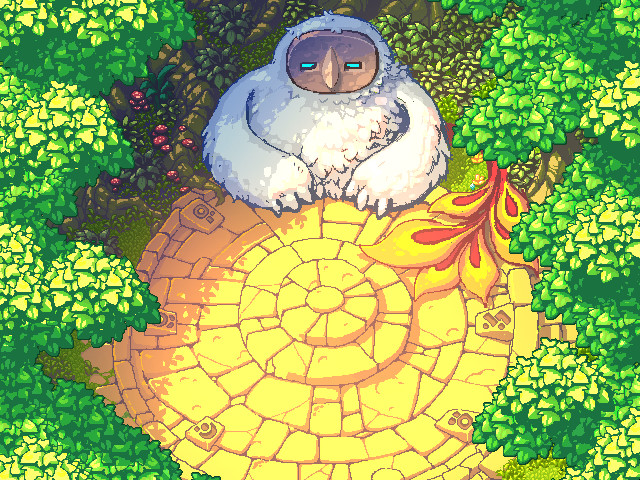
Rakuen is a beautiful adventure/puzzle game about a Boy and his Mom. The Boy has to stay in the hospital, but using a special storybook, his Mom shows him the way into the magical world of Morizora's Forest. This game is played from a top down perspective like an RPG Maker game.


Story:

I don't want to spoil anything, but I will offer a general overview: The hospitalized Boy visits Morizora's Forest in hopes of getting a wish from the forest guardian Morizora. But to get his wish, he needs to help the other patients resolve their problems by going through their history and finding out what led them to where they are. As a result, the story is filled to the brim with charming and interesting characters who you really get to know as you work to help them out. And of course, there are plenty of emotional moments. There are lines that'll make you laugh, and there are lines that'll hit you like a punch in the gut. If you're looking for a story with powerful emotions across the board, look no further.

Presentation:

Having heard Laura Shigihara's work in Plants vs. Zombies and To The Moon, I had lofty expectations for the soundtrack, but even those were surpassed. The soundtrack is filled to the brim with beautiful tracks, from atmospheric pieces to melodies that will get the most stoic people teary eyed. Not only are Laura's amazing vocals present, she has also brought in several guest vocalists who all perform their pieces admirably as well.

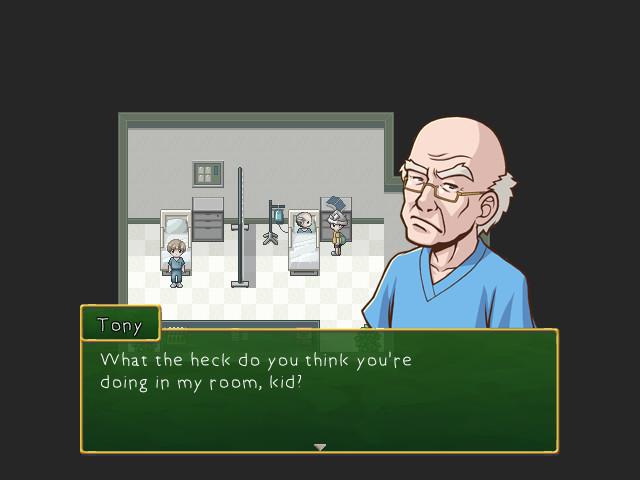
The visuals are also strong, with plenty of recognizable character designs and vibrant areas. The visuals and story work together in smart ways, too; the colors in the hospital are much more desaturated than the bright colors of Morizora's Forest, for example.

My only minor problem, if you can even call it that, is that some characters in Morizora's Forest don't have many character portraits. Tony Bear could have used maybe one more portrait, just to shake it up. Not a completely unique pose, just a few more facial expressions, like his human counterpart.


Gameplay:

Rakuen mostly revolves around exploration with some light puzzle solving. Fortunately, the puzzles generally tie into the story and history of the characters you are helping out. They are usually not very challenging but offer a nice change of pace. Some areas are reminiscent of classic RPG Maker horror games like Ib and The Crooked Man in how they require you to figure out the environment and its interacting pieces.


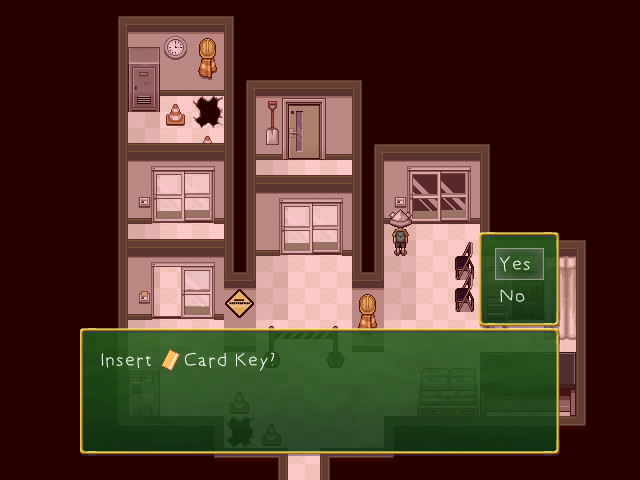
My one minor problem with the gameplay, I would say, is that the game asks if you want to look at or read something a bit too often. Sometimes you'll be looking at an item with two separate 'do you want to read it?' or 'do you want to look?' questions. I understand why this is - there are lots of things to read, and you don't want to accidentally read the same thing twice, but in that case it might have been better to separate it into two interactable items instead.

Conclusion: 


Rakuen is a beautiful game with amazing visuals and music as well as a powerful story, with plenty of fantastical and frightening places to explore. Any complaints I could have are too minor to make a difference. Recommended for everyone.

Try it here: https://store.steampowered.com/app/559210/Rakuen/