Fundamentally, Virtue's Last Reward plays exactly like its predecessor. It consists of alternating visual novel sections with choices and escape rooms full of puzzles, but expands on everything its predecessor did in significant ways. Unfortunately, growth brings growing pains.
Virtues and Vices (Escape Room Gameplay)

Let's start with the central gameplay, the escape rooms. In 999, you could only explore the escape rooms from a set of predetermined angles. While predetermined angles still exist in Virtue's Last Reward, you can actually "move" around the room, albeit on a set path - imagine a track through the room that you can move back and forth along. The increased freedom of movement is appreciated, but it's unfortunately rather slow and restrictive. This becomes a theme and a central part of what's wrong with the game - the game is much larger than 999, but it also has so many extra needless steps. To illustrate: If you solve a puzzle on the opposite side of the room from where the exit is, you'll need to back out from viewing the puzzle and then slowly make your way back along the track, then click the safe to enter the password you've acquired, then grab the key, back out from viewing the safe, click on the door (if it's not near the safe, you'll have to move along the tracks again) and then finally use the key on the lock. It really makes you miss the snappy 'find a key, go to the exit, click the exit' solutions in 999. One of these extra steps is a consequence of one of the game's new additions: the safe. Rather then making you find a key, you find a password that you enter into the safe to get the key. I could be wrong, but I see two main reasons why this was added:
- Even moreso than its predecessor, the game revolves around retracing your steps and trying multiple story branches to learn more about the characters and see many endins. Once you discover a code, you have it in your archive permanently so you don't have to do the escape room again if you decide to revisit a branch; the same couldn't be done with a key like you find in 999.
- You can also find a secret password in each room that lets you get a secret file with lore from the safe.
One way I would suggest to fix this is by having the password interface on the door instead of a safe, and just have it spit out the secret file if you enter the secret code and open if you enter the code that would get you the key. That already takes out a lot of unnecessary steps.
I would address the inventory system, but the system isn't changed too much from its predecessor. I'll say that I appreciate the increased amount of space the items get and that you can see the environment underneath (helps remind you what you were looking for), but having the items rotate around a 3D axis when selecting got a little confusing for me.

Those are my criticisms regarding the escape rooms. There were a few occasions where I couldn't figure out a puzzle, not because I couldn't solve it per se, but because I didn't understand the rules. I'm willing to chalk this up to my own lack of ability, though. I will admit that I binged my way through the game, playing many hours at a time, which may have worsened the tedious feeling I got from navigating the escape rooms.
That was a lot of negativity regarding the escape rooms, so it's time to pay credit where credit is due. The game packs a whopping 16 escape rooms, each filled to the brim with puzzles and mini-games of many kinds. There's enough content here to scratch any enthusiastic puzzle solver's itch. And while the safes might not be the best execution of the concept, giving each escape room two solutions - one for escaping and a harder one for finding the secret file - is brilliant. It allows people who are passionate about puzzles to really challenge themselves, while people who don't want to wrack their brain too much can skip out on the secret password and just find the escape password. You can even switch the difficulty to easy in a room, which will make the NPCs that accompany you give you more clues to help you figure it out. This will give you a silver secret file instead of a gold secret file, but you can always redo it on a higher difficulty afterwards. And of course, when you clear a room you get that safisfying screen and jingle that says it all:

In short: The sheer amount of content and variation compared to 999 is admirable, but some odd design choices make certain parts more slow, repetitive and tedious than they need to be.
Endless Depths (Visual Novel Gameplay)
In the moment to moment experience, the visual novel segments are exactly the same as 999. Where the game truly differs its in its size and amount of branches. When I started Virtue's Last Reward, I thought "999 had about 3 main branches with some offshoots, Virtue's Last Reward will probably have something like that."
Then I opened the in-game flowchart.

I was baffled at the sheer amount of ways the story can go. And of course, you can jump back to any point you've been so you can try other branches.
One major difference between Virtue's Last Reward and 999 is that, on first impressions, it's a lot more clear about its branching points. In 999, you sometimes needed to make a series of seemingly minor choices for the story to branch off in a certain way later. In Virtue, the branches do not reconverge, so such choices do not exist. Instead, there are two major kinds of decisions: Chromatic Doors and the AB Game. I'll get into the story relevance of these later, but to put it simply: Chromatic doors let you pick where to go and with whom, which decides which escape room you'll solve. After an escape room, you play the AB Game where you vote to Ally with or Betray the person or team you solved the room with in a Prisoner's Dilemma situation. This decision then impacts which rooms you can enter, because a person you betrayed won't team up with you again.
Virtue's Last Reward is not exactly the kind of game where you're expected to simply try for an ending and then stop. As a matter of fact, you may well run into one of many 'game overs' based on your decisions, or even a sudden 'To be Continued.' You see, exploring the different outcomes is a fundamental part of the game. If you run into a 'To be Continued,' that means the story branch can only continue after you have witnessed some event or heard some detail from a different story branch. This is a great concept and makes full use of the idea of a branching narrative, which explains why they were to set on making a ton of them.

This massive increase in scale does bring a few new problems, however. First off, the game wants you to understand the movements of each character - which makes sense - but every time you move to a new place, the game switches to a map view and shows you (as represented by a glowing dot) moving to the location. And every time the glowing dot reaches a door, the game shows an animation of it opening. The first time you go through a branch, this will feel natural, but after a few, it feels like a really slow and unnecessary step. If the characters say 'We need to get back to room A,' a fade to black with running sounds is fine; we don't need to be shown the exact route they take. This could be forgiven if it was some kind of loading screen, but this is a visual novel. If it doesn't need loading screens for the puzzle rooms, where stuff actually happens, it shouldn't need any loading screens for text boxes and static backgrounds.
The game fortunately provides a skip button to quickly go through text you've already seen. If this function hadn't been present, I would not have been able to make it through all the story branches. However, sometimes text that you've strictly not seen is still redundant. For instance, characters will find a new door and describe it. Depending on who is with you, different characters describe it, but the information gained is identical. As a result, the skip often stops to let you hear the new dialogue, forcing you to click through it manually if you don't want to hear the same thing again. This is not a flaw of the skip function itself, it's just a "problem" with the script. I put problem in quotation marks because I respect the Herculian effort that was put into making sure each character has something relevant to say in each situation, it just got tedious for me. But just like the puzzle rooms, this might simply be a consequence of me binging the game. Hearing the same door described thrice in one session is annoying, but having it described again in a new session can be a refreshing reminder.
In short: The game represents a massive increase in scale and its story branches out far more than its predecessor, a fact it makes great use of by requiring you to explore multiple branches to open up new ones. However, its insistence on showing the characters moving to each location and shared events and discoveries between the branches might make the experience tedious for some people.
The Leap to 3D (Presentation)
One of the biggest surprises going into Virtue's Last Reward were the visuals. Instead of the expressive and well drawn 2D portraits, the cast of characters is presented as 3D models. It's my opinion that this is a major step down from 999. The characters move, but are much less animated and their lip sync is just strange and uncanny. Characters' mouths will move and then stop halfway through the dialogue, or just not be synched at all. It would actually have been better to just open and shut the mouth at regular intervals until the dialogue stops.
This doesn't mean it's all bad, though. The actual designs of the characters are not bad, I just feel that most of them don't benefit from being simplistic 3D models at all. The only exception might be K, the character I shared in a picture above. He's in a robot suit, and his mechanical looking design works well in 3D while the more organic looking characters suffer a bit from the transition.
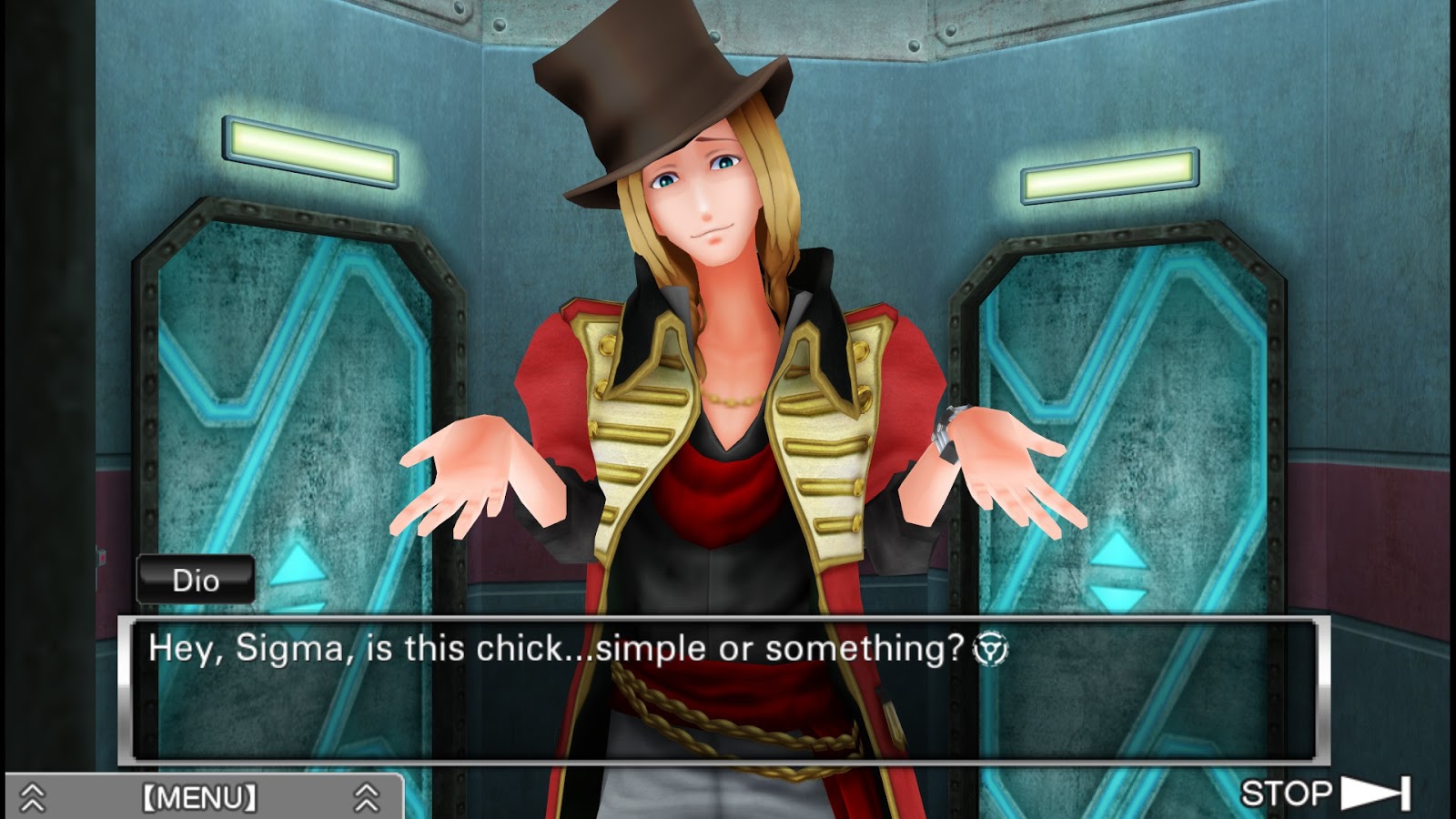


Aside from the disappointing characters, the presentation is still fine. The game is fully voice acted - although unlike in 999, the player character is not - and it has soundtrack full of new, heart pounding tracks. Like before, you can pick the original Japanese or English, and the voice actors have done a great job. Some of the music tracks may get a little too familiar after you've heard them in so many story branches, but the same could likely be said about most music in general.
The puzzle rooms themselves also offer more visual variation and interesting details. Discovering the beautiful green B. Garden puzzle room was such a refreshing change of pace, for example.

In short: The game's presentation is mostly on par with its predecessor with great voice acting and music. The increased visual variation and detail in puzzle rooms is eclipsed by the slightly uncanny 3D characters, which is why I just barely consider 999 to have a better presentation.
As with 999, Virtue's Last Reward's main event is arguably its story. Just like the characters in 999, the cast of this game is involved in a death game called the Nonary Game: Ambidex Edition. While it similarly revolves around a death game where the participants attempt to escape with their lives, there isn't exactly a set time limit. Instead, the object of the game is to gather points which can be acquired slowly by allying with people or quickly by betraying them at the cost of their points. Even moreso than the Nonary Game that preceded it, this game is all about trusting or betraying your fellow players. As a result, there are a truly impressive amount of choices, story branches and endings.
The cast of characters is even more distinct than before. Unlike in 999, they do reveal their true names from the get-go, but that's all the transparency you're getting. This makes the characters more mysterious, but also less likeable from the start. That serves a purpose, though; because the game revolves so strongly about discovering who you can trust, most characters are very cautious and unwilling to reveal a lot. That's where the brilliance of the branching narrative comes in; you get a clear sense of who a character is based on who they Ally with or Betray and how they respond to your different choices. Even though you can explore so many branches, the game still makes you feel the weight of your decisions. I felt really bad about voting to Betray certain characters and really anxious about Allying with others, even if I just did it to explore a certain story branch. And you really do need to explore at least a few story branches to really get a clear picture of the game's story.
In short: Virtue's Last Reward has a similar setting to 999 but the multitude of branches and choices make it much larger and absolutely filled to the brim with content. Its more mysterious and distant cast makes the characters less likeable and relatable but the aforementioned branches provide them an impressive amount of fleshing out. The game makes impressive use of its branching story to tell a larger story, but telling you how exactly would be a spoiler.

Conclusion
Virtue's Last Reward wants to be bigger and better than 999. To that end it is much longer, has many more choices and story branches that don't reconverge. It's packed with more puzzle rooms with more inventive puzzles and an additional optional solution for each. In many ways, it succeeds, but the shared events and observations between branches and the game's habit of slowly demonstrating characters moving from location to location can make it tedious after a while. The puzzle room's innovations add unnecessary steps you need to take after you've already completed the room, slowing down the game further.
The game's leap to full 3D benefits the puzzle rooms a little, but the character designs don't live up to their potential as fairly basic 3D models with weak animations. The voice acting and music are still great, however.
Of course, with a bigger visual novel, you have a bigger story. Small moments of tedium aside, the game pulls off something truly impressive with all the different branches and choices - you'll see each character interact with each character in so many ways. But again, that's something you need to experience in game to truly appreciate it.
I recommend this game to people who love puzzles and branching stories, but only if you really enjoyed 999. If you didn't, you probably shouldn't bother with it.
That's it! It's been a while since I had this much to say about a game, so now I'd be happy to hear your thoughts. If you played Virtue's Last Reward, how did you like it compared to 999? If you did play 999 but not this one, are you planning to? Please join the discussion!


