Pagina's

Showing posts with label story. Show all posts

Saturday, October 3, 2020

Some Thoughts About Final Fantasy 13-2

After finishing Final Fantasy 13, I moved right along to its sequel, Final Fantasy 13-2. Direct sequels aren't very common in the Final Fantasy series and 13 is of particular note because it has two. Considering the ways in which FF13 deviated from the series' conventions I was excited to see how these direct sequels would learn from and iterate upon its predecessor. Today we're talking about Final Fantasy 13-2, a direct sequel that takes place two years after Final Fantasy 13.

Timeless Beauty (Presentation)

The environments in Final Fantasy 13 could really take your breath away, and 13-2 is no different. As a matter of fact, you visit so many locations at so many points in time that it has greater visual variety. You'll be exploring the usual valleys and fields, but highly technologically advanced locations as well - and just about anything in between. I found myself constantly distracted by the dozens of beautiful views this game has to offer.
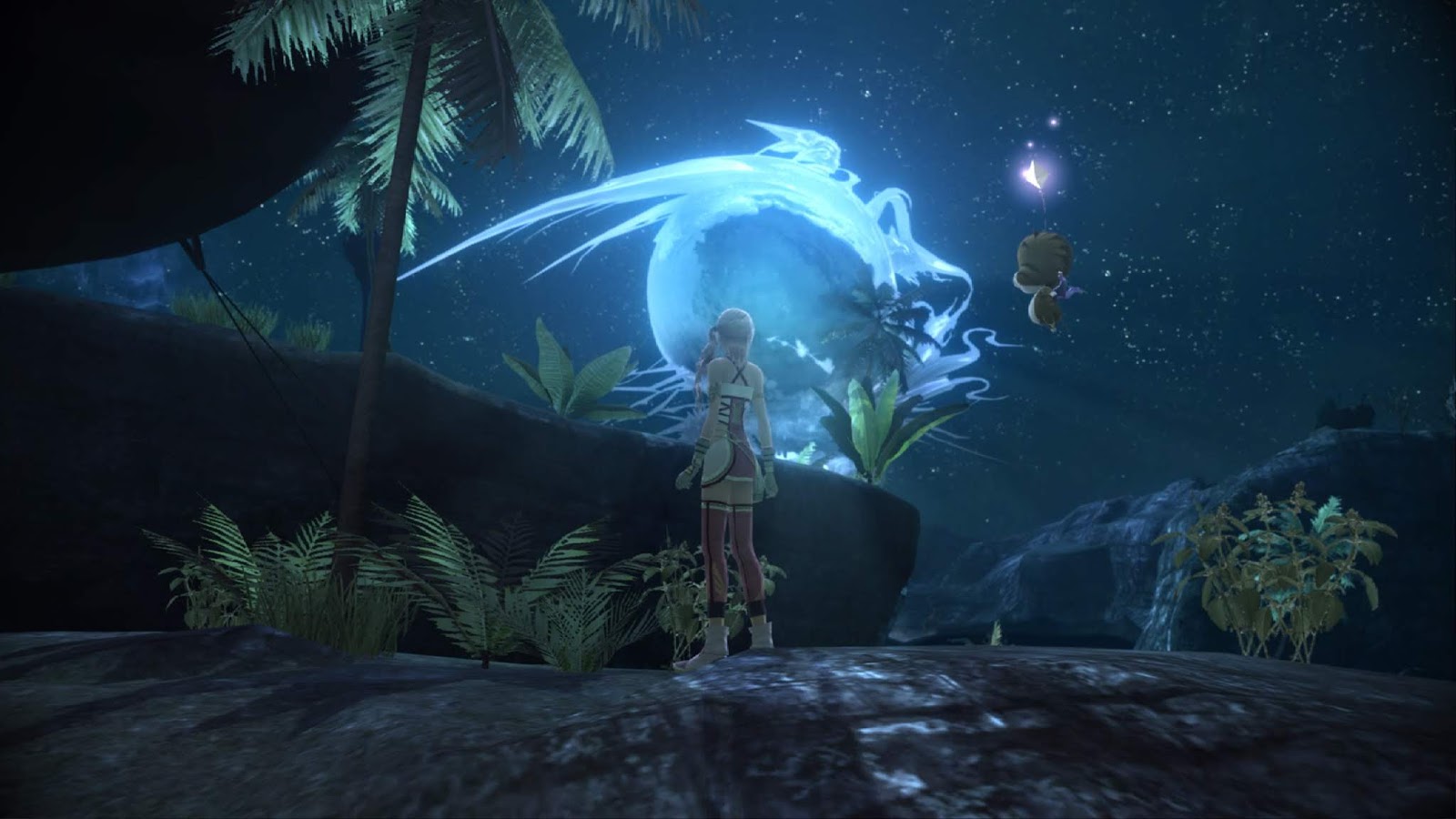


A lot of the enemies and music are re-used from Final Fantasy 13. It makes sense, considering it takes place in the same world, but it's still something to consider. We'll get into the gameplay side of this later, but 13-2 has a lot more optional content and a lot more NPCs to talk to for sidequests. Their voice acting is generally fine, but there's a very limited amount of different models with very limited animation. It can be a little bit grating to watch the repetitive mouth flapping of the same face you've seen a few dozen times after watching the truly gorgeous cutscenes reserved for the game's important characters.

13-2's soundtrack can be described as having higher highs and lower lows than its predecessor. Most of the battle themes you'll hear are excellent, combining synth with orchestra to emphasize the game's journey through different time periods.

https://www.youtube.com/watch?v=wdframgnBVE

But some tracks have an almost 'grunge metal' feel to them, with screaming vocals that absolutely do not fit the beautiful landscapes and emotional story of a Final Fantasy game. The track that plays when you ride a red Chocobo, 'Crazy Chocobo' is infamous at this point. Listen at your own risk:

https://www.youtube.com/watch?v=hEUOOgNzOv4

In short, FF13-2 offers more visual variety, especially in environments, but NPC and enemy designs are still regularly re-used and not particularly impressive in the former's case. The soundtrack recycles some tracks from 13, but the original pieces are mostly excellent. A few of the tracks are bad.

Time's Teachings (Gameplay)

Final Fantasy 13-2 is an evolution of Final Fantasy 13 in many ways. In this segment, I'll focus on the ways 13-2 differentiates itself in its exploration and battle system.

The endless complaints about Final Fantasy 13's overly linear nature were clearly heard and applied to 13-2.  While there are still linear segments, the game opens up almost immediately and many of its environments feature branching paths or are completely wide open. Not only that, there are many optional locations and time periods to visit for players who explore thoroughly. As free and open as the exploration is, though, the areas and time periods can feel a little disjointed because you access them from a somewhat disorganized level select screen referred to as the 'Historia Crux.' This is a small price to pay for the sheer amount of freedom and optional content, however.

Some small things were added to the exploration in 13-2 as well. You can now jump at will, and you can find secret treasures hidden in the environment by using your companion Moogle's special detecting ability or by throwing him to treasures out of your reach, an act that he very much doesn't appreciate. Enemy encounters have also been reworked; FF13 did away with random encounters entirely with enemies simply existing in the overworld. 13-2 partially returns to the traditional system, with enemy encounters appearing at random in the overworld, but not necessarily initiating a battle like the JRPGs of old. Once an enemy appears, the player can choose to try to run away, or deal a first strike on the enemy to gain an advantage in battle. This system allows you to grind certain types of enemy more easily, but can be frustrating in cramped areas when faster enemies that can actually chase you down spawn. 

In FF13's linear environments, there weren't many NPCs you could actually interact with. In 13-2, however, there are a boatload of NPCs with sidequests and lore, although most sidequests boil down to finding an item in the area or killing a specific enemy. The best sidequests play with the game's theme of time travel and have you visit an area in multiple different time periods to figure out what to do. The game even has a lot of dialogue options, but we'll discuss those in more detail under the story segment.

One final thing to mention about the exploration is that sometimes, to progress, you need to resolve a 'paradox' by solving a puzzle. These puzzles offer some welcome variation when done on occasion, but can often overstay their welcome by either being simple and repetitive or frustratingly hard. As an example of the former, there are puzzles where you just connect crystals of the same color over and over again. As an example of the latter, there are complex clock puzzles that would take more time to explain than they're really worth, but basically, you move the arms of a clock to numbers which then decide how many steps you can move the arms of the clock again, and using this method, you need to find a way to have the clock stop at every point without ever landing on the same point again. If that sounds confusing, that's because it is.

So, all in all, the exploration has changed a lot. But what about the battles?

Final Fantasy 13 shifted a lot of the focus in battles from actively choosing options to preparing and switching between 'paradigms,' where you assign each character a role like Commando or Medic. Final Fantasy 13-2 uses the same system but expands upon it in a few ways. For starters, your characters throughout the entire game are Serah and Noel, and you decide which Roles to teach them when as you level them up. This means that you not only need to think about which paradigms to use, you also need to choose between improving your current roles/paradigms or learning new ones. 

It is a little disappointing to only have 2 characters instead of Final Fantasy 13's six, but the other addition to the battle system makes up for it: monster taming. Most monsters you encounter can be tamed and acquired for use in battle. The third party member in any paradigm is a tamed monster of your choice and there are dozens upon dozens of monsters you can tame, level up, combine with each other for powerful passive abilities and even name and equip with cute cosmetics. 

Unlike Noel and Serah, tamed monsters only ever have one Role, but that makes sense considering the sheer amount of tameable monsters you can acquire.

Next to the major additions, there are also minor conveniences. A paradigm shift now happens without a small cutscene demonstrating to which role each character has switched, and if the character the player is controlling gets knocked out, you automatically switch to the other instead of getting an instant game over.

You'll notice that these additions do indeed expand on the system that was present 13, but don't fundamentally change it. I have a lot of respect for the decision to not throw the baby out with the bathwater here. A lot of people complained about the streamlined battle system in 13 because it was different, not because it was actually fundamentally flawed on a game design level. It's very satisfying to plan out some perfect paradigms and then watch your team destroy an enemy with little effort thanks to your thinking ahead, and this game pushes that system even further with added convenience and customization.

I think most of the changes made in 13-2 are for the better, but there are a few bad ideas mixed in. One of those is the quick time events in cutscenes. Usually the finishing blow against a boss is handled by awkwardly performing a series of timed button presses over a cutscene, which feels unnecessary and pretty tedious. It feels completely contradictory to how the battle system works - you've spent all this time planning ahead, setting up your Paradigms and switching between them - now watch an elaborate cutscene where Noel and Serah destroy the boss while you press the buttons it tells you to. Considering this only happens after major boss battles, though, it's not too much of a bother.


All in all, Final Fantasy 13-2 is a shining example of listening to feedback while maintaining your vision. Exploration was massively expanded, with huge open areas and optional content to explore. Random enemy encounters in the overworld generally allow for easier grinding and monster taming, but can be tedious if faster enemies spawn in enclosed areas. The 'paradox' puzzles add nice variety but outstay their welcome if you're trying for full completion.

13-2's battle system is fundamentally like 13's but with more customization. The quality of life improvements and extensive monster taming system make this one of the most fun and addictive JRPGs I've played, though the QTEs tacked at the end of some boss battles can sour the mood a little bit.

Broken Timeline (Story)

As its name implies, Final Fantasy 13-2 is a direct sequel to Final Fantasy 13. As such, there will be Final Fantasy 13 spoilers in this segment.

The Premise

The story of Final Fantasy 13-2 takes place a few years after Final Fantasy 13. It's immediately apparent that something is different from what we remember. Lightning survived the events of FF13, but when the story begins in 13-2, it's believed by everyone that she died in the battle to save Cocoon and disappeared alongside Vanille and Fang. The only person who remembers otherwise is her sister, Serah, who is one of the two main characters in this game. This premise is immediately quite interesting and it's hard not to feel sympathy for Serah. She's spent a few years knowing her sister ought to be alive because she actually remembers it happening, but almost everyone else thinks she's just been in denial all this time, incapable of accepting the simple truth.

She finally sees her memories validated when Lightning, who is now stuck in a place outside time known as Valhalla, sends a person called Noel her way. Noel is the second main character in FF13-2, a hunter from a horrific future where all of humanity has died out and he is the last remaining person. Noel brings Serah a message from Lighting; that the timeline has been messed with, leading to Lightning's disappearance and the existence of this awful future. Noel and Serah set off on a journey through time together to find Lightning and prevent this apocalyptic future from ever taking place. To help, Noel has also brought Mog to help Serah. Mog is a Moogle who can transform into a bowsword and be wielded as a weapon.

After Serah time travels for the first time the story structure goes on a little bit like this: Serah and Noel enter a new area and time period and discover there is a 'paradox' to resolve before they can move on. Paradoxes are things that don't belong in that specific time or location but have ended up there due to the damage the timeline has suffered. They resolve the paradox, open one of the 'time gates' in the area, move on to a new time/location and the cycle repeats. Along the way, they gather clues as to what caused the timeline to change the way it did in hopes of ultimately saving Lightning and the future itself.


The Characters

The protagonists of the story are Serah Farron and Noel Kreiss. Serah is a returning character from FF13, where she played a central role in the story as Lightning's sister and Snow's fiancée. A major goal in the story of FF13 was to save Serah from her crystallized state, which makes it interesting that the roles are reversed in this game, with Serah setting out to save her sister Lightning. Noel Kreiss is a new character, a time traveler from a distant future he wants to prevent from ever happening. They're accompanied by Mog, a Moogle sent by Lightning to help Serah. Serah is a very likeable and sympathetic character and we can empathize with her goal of reuniting with her sister. She does have some character flaws, like a dangerous temper, but this unfortunately doesn't come up very much in the story, which may lead some people to feel she's a bit too perfect as a person. Even though the premise of the story very much makes it look like this is all about Serah, I actually felt Noel was the real 'central' character. The journey to reunite with Lightning often feels like it takes a back seat to the journey to save the future he's from, and most character relations and interactions revolve around him. For example, Caius and Yeul (more on them later) have a connection to Noel, and when returning characters like Snow appear, they mostly clash with Noel while Serah stays in the background. To push this point further, the leitmotif that appears in all the battle themes comes from 'The Last Hunter,' which is Noel's theme. I'm conflicted about this because I think it's great they brought a new, well fleshed out character to the table but it's disappointing to see Serah fall into the background again after she spent most of the last game frozen as well. Mog is a cute character, but he's mostly there for comedy and doesn't have much to learn or achieve in the story outside of an optional quest about his home. But the victory animation where Serah hugs him is heart meltingly adorable, so at least there is that.

The antagonist of the story is a mysterious man called Caius Ballad. He fights with Lightning at the very beginning and follows the protagonists through their time travels, fighting them or hindering them at every opportunity, proclaiming that changing the timeline is a 'sin.' He's accompanied by a mysterious girl called Yeul. Caius is easily the most sympathetic and interesting villain from these three games. I can't fully explain why without getting into spoilers, but to give a brief overview: he's been made immortal to serve as Yeul's guardian, but Yeul is not immortal. She, instead, dies and is reborn as a new person time and time again. Witnessing this girl die over and over and over is what drives Caius to do the things he does in the story and paints his otherwise horrible actions in a sympathetic light. Yeul herself doesn't really have the opportunity to become an established character because every time you encounter Caius, he's with a different Yeul from a different timeline. As a result, who I'm calling 'Yeul' is actually a group of several different characters with the same voice and appearance, none of whom get very much time to be developed. It makes for an interesting character concept, though, and some Yeuls get more screentime than others.

The returning characters from FF13 are a mixed bag. Lightning provides a strong opening for the story but then passes the torch on to Noel and mostly stays in the background for the rest of the game. Characters like Fang, Sazh and Vanille barely appear at all. 


That leaves Snow and Hope, and I have a lot to say about both. I'm very disappointed in the way Snow is, or rather, isn't implemented in this story. After Serah confides in him that she remembers Lightning being alive, he proves himself the worthy fiancé by believing her without hesitation and going off to find Lightning, something that makes me like him even more than I already did. But then he just stayed away for 3 years, never coming back to Serah. When you run into him again, he's gained a stupid haircut and a new fal'Cie brand. Even weirder, there's barely any chemistry or interaction between him and Serah at this point. I really don't understand this, but the best I can think of is that the developers wanted to leave room for a Serah and Noel romance instead. Snow mostly just clashes with Noel and disappears from the story after you fight alongside him in one of the time periods, with much of what he did in the past years relegated to the data logs you can read. Most encounters afterwards are optional. Hope, on the other hand, plays a much better role in the story. He's grown up into a renowned scientist who is playing an important role in the recovery of society now that the fal'Cie are no longer functional. He believes Serah and Noel are indeed time travelers and is very eager to help them for the sake of the friends he fought alongside in FF13. He and his attempts to help facilitate a better future play a major part in the story across multiple time periods, and I only wish other characters from the first game had this kind of presence as well.

Thinking back on FF13-2 made me realize that the game's cast of important characters is pretty small. This might be a consequence of people complaining about how convoluted the story got in FF13. The only other significant side character I can think of is Alyssa, Hope's assistent. Because she's with Hope, she gets a lot of screentime, and she's actually an interesting character. The only other newcomer that sticks out to me is Chocolina, an enthusiastic Chocobo girl and trader, but she only really comments on the story rather than being part of it. Her origins aren't even explained in the main story. 

Pacing & Progression

FF13-2's story can often feel like many smaller stories stringed together. The overarching story has a strong presence near the beginning and end, but sometimes feels like it takes a backseat to the immediate threat or conflict in each given time and place. In a few words, the story feels episodic and disjointed. Many threats and enemies occur simply as a result of "meddling with the timeline," and don't really relate to Caius at all. Other conflicts do relate to Caius, but this is only explained if you happen to come across a specific bit of lore or an alternate ending. This problem only gets worse if you take the time to do all the optional content as it becomes available.

It should be said that just because parts of the story are disjointed, that doesn't mean each individual part is bad. I'll keep it vague to prevent spoilers, but at one point in the story, you enter a city in the future. This city is in a truly awful state, a miserable place to be for you and all its inhabitants. Due to some actions in the past, you then create an alternate 'good future' version of this city. Entering this 'good future' version was one of my favorite moments in the game because it communicates so clearly that the future can be changed. It's a hopeful thought that plays into the overarching story quite nicely and gives a clear sense of progression that most other areas lack. 


Quests & Optional Content

Due to the disjointed nature of the story we established earlier, it can sometimes be hard to follow. Many things are explained in the data logs, and a lot of lore is hidden within optional areas or quests. Some of the best character moments and interactions, especially between the FF13 original cast, are found in worlds that can be completely skipped over if you simply want to go straight to the end. This could've been a cool extra if the main story wasn't so starved of good interactions between the original FF13 cast to begin with. But with the caveat that some of the optional content probably should've been integrated in the main story, there is a lot of good optional content. Each unique location in the Historia Crux has its own story and its own problem to solve.

The Ending

This segment and article have already run on for much too long, so I can't fully do the discussion about FF13-2's ending justice here. But if you've heard anything about the game, you'll know that the way it ends is controversial and my opinion on it is very mixed as well. If people are interested, I may write an article just about the ending.

In Summary

FF13-2s story starts with a strong premise and characters with understandable and believable motivations, but the overarching story often falls into the background and ends up feeling disjointed in the middle. It may be disappointing to FF13 fans just how meager the presence of the original FF13 cast is and how few their interactions are. There are many highlights, however, like the antagonist Caius and several very compelling optional locations and quests.


After All (Conclusion)


Final Fantasy XIII-2 is, in most ways, a perfect example of how to make a sequel. It takes FF13's attempt at streamlining JRPG combat and makes it more involved, faster, more customizable and all-around more fun. The QTEs are a mistake, but they're rare enough that they don't ruin the experience. It allows for much more open exploration and has many hours of optional content to offer that doesn't just involve talking to a stone that asks you to kill some enemy.  Its presentation expands and experiments, and this is generally a success as well - I come back to its battle themes almost every day when I need something exciting to listen to. 

The only major disappointments the game presents are in its story. While its opening and arguably ending are strong, the main quest often falls into the background of only tangentially related conflicts. The cast from FF13 has a limited presence and many things are not well explained in actual dialogue and scenes, being resigned to data logs instead. That's not to say that the separate fragments of story are not good, but that they sometimes lack a proper connection to each other, and rarely ever connect back to Final Fantasy 13.

All in all, a great sequel - the story just wasn't what I hoped it would be.

_

Wow! It's been a few months since I wrote any articles. I've been stuck on this one for a while because I wanted to articulate how good 13-2 is, but also how many frustrations I have with the story. I hope it was a good read and I hope my next article won't take as long. Stayed tuned, and all feedback is appreciated!


Saturday, December 14, 2019

Silent Hill 2's Best Ending

Spoiler warning. Silent Hill 2 is well worth experiencing for yourself, and reading this article before playing it could really damage your experience. I strongly recommend playing it first.


Silent Hill 2 is considered one of the finest horror games ever made, and some would argue, one of the best videogames in general. A lot of this can be attributed to its engrossing story and characters. Like so many games with a strong narrative, Silent Hill 2 has multiple endings, and there are many strong opinions about which ending is the best. I'm going to share my own opinion on this matter.

All Consuming Guilt


Silent Hill 2 tells the story of James Sunderland. He receives a letter from his wife Mary asking him to meet her in the town of Silent Hill, but she supposedly died of an illness three years ago. Even so, James comes to Silent Hill to find out for himself. 

As we find out near the very end, Mary did not die of an illness three years ago, but rather, James killed her just three days ago and has been in complete denial of this reality through the entire game. Everything that happened in Silent Hill was a manifestation of his own guilt.

So why did James do it? Silent Hill called to him, so it's clear he feels guilty about it. Was it mercy? Mary was suffering after all, and outright stated she wanted to die. Was it revenge or an escape? In the late stages of her illness, Mary became angry and verbally abusive and taking care of her consumed James' life. Or was it desire? The feminine figures that haunt Silent Hill imply that James was sexually frustrated, so did he simply remove Mary so he could himself a new relationship?

Means and Ends

The powerful thing about Silent Hill 2 is that each of its endings puts James' motivations in a different light. The 'Maria' ending, for example, has James escaping Silent Hill with the Mary lookalike 'Maria' he met there. Maria is almost identical to Mary, but more seductive. She seems to be a creation of Silent Hill designed to tempt and torture James. This ending probably puts James in the most negative light, as it seems to prove that he simply wanted to move on from Mary. During the ending, Maria starts coughing, implying that she's also ill and James will be punished for his mistakes by experiencing the exact same thing he experienced with Mary once again. Powerful and tragic, as James has already been forced to see her die multiple times throughout the story.

The next ending is the one I've seen a very vocal part of the fanbase call the best. It is simply called 'In Water.' In this ending, James and Mary have a final talk, and James admits that 'part of him hated her for taking away his life.' Mary concedes that this may be true, but that he's suffered enough. She dies again, for the last time, and James comes to the conclusion that he cannot live without her. Taking her body with him, he drives his car into the lake, thus committing suicide.


This ending is powerful and tragic and certainly feels natural. Silent Hill 2 is James' journey to face his guilt, and then act upon it accordingly. After all, the others who were called to Silent Hill, Eddie and Angela, passed away as well. 

But in my opinion, the best ending is the "good" ending, 'Leave.' I admit I'm biased in favor of happy endings, although Silent Hill 2 has no truly "happy" conclusions, but I have a few valid narrative reasons why this ending is the best conclusion to this story.

In Leave, James and Mary have their talk just like 'In Water', but when Mary throws James a bone and justifies his actions by saying 'She wanted to die,' James doesn't take it and fully faces down his own guilt. He doesn't say that "part of him hated her" this time, he comes out and - in an anguished voice - says:


The difference is subtle but important. And Mary's response to this always makes me teary-eyed.


"James... if that were true, then why do you look so sad?" 

This ending paints James in the most positive light. In all of the endings, that impulse, that desire to get his life back was present, but him admitting it clearly - in spite of how much it hurts him and how wrong he knows it is - redeems him. That's why he can overcome his guilt and move on in 'Leave,' with Mary's blessing.

On top of the perfect way it finishes James' arc, Leave is also the only ending that wraps up Laura's story. Laura is a little girl James meets around Silent Hill several times, and she was friends with Mary before she died. In Leave, you appropriately see James leave Silent Hill with Laura, taking her with him and thus carrying on Mary's wish that they be friends. Her fate is left ambiguous in the other endings, which I think makes them feel a bit incomplete.

At the Core of Silent Hill (Conclusion)

The monsters of Silent Hill are never just simple monsters with a thirst for blood, and neither is the town itself. Silent Hill 2 is the story of James facing his guilt - that's why Silent Hill called to him - and the reason why the 'Leave' ending speaks to me the most is because it is the only ending where he truly faces it. In 'Maria', he runs from his guilt and the 'In Water' ending concludes with James ending his own life because he is unable to life with his guilt. In 'Leave', James fully sheds light on the darkest parts of his psyche and starts on a path towards redemption, with his penance being a responsibility to take care of Laura as Mary once did. And it ends beautifully with those final words in Mary's letter:


_

Hey, thank you for taking the time to read another one of my articles. This one was a bit shorter, but definitely on a subject I'm passionate about. I've been thinking about why I love the 'Leave' ending for much of the past year and I finally got to put it into words here. Please let me know which ending you liked the best and why! 


Sunday, September 15, 2019

He Who Fights Spoilers

Instead of talking about a specific game, today I want to talk about a 'trend' that's been hitting gaming YouTubers in particular - accidental minor spoilers turning into major spoilers due to well meaning audience members - and the people who make those spoilers even worse by trying to fight them. Since I didn't want to post actual spoiler images, most of the screenshots are just random.

Nobody likes spoilers. Every good story has a flow, a structure, it builds towards something with all its twists and turns. Learning any of that in advance can disrupt that flow or even ruin the entire build-up. But in spite of that, some people intentionally reveal important plot details to people just to ruin it for them, just to get a rise out of them.


Spoilers can hurt for videogames in particular because you play an active part in discovering where the story goes; in some games, your choices can even change the story altogether. This is why people who watch Let's Plays tend to like blind playthroughs of videogames - so they get to experience that sense of discovery again, vicariously, through another person. However, playing games with an audience exposes you to many responses, and sharply increases the risk of being spoiled on the game. Trolls revel in ruining the experience for a public figure, and by extension, their audience. But sometimes the well intentioned fans can be just as bad, albeit unintentionally. I'm going to talk about two kinds of situations where well intentioned people can ruin a game and both of them hinge on underestimating the power of hindsight.

Secret Meanings


In well written stories, there will often be a few lines of dialogue that have an impact. Maybe a character suddenly reveals their true motivations in just three words that change everything, or maybe simple comment flips everything you thought you knew about the story around. The power of these lines is often the context in which they're said, or the build up, so the line doesn't mean a lot by itself in theory.


If an iconic line occurs in a videogame, fans will often say the line to a content creator playing it by posting it in the comments or chat, depending on the platform. This isn't done maliciously, these people probably believe that the line won't mean anything to the person playing the game. But the problem is that several people will be thinking the same, causing the phrase to be posted multiple times, which will inevitably make the player think about its meaning. And depending on the line and the times at which people say it, said player might figure out way more than they should know at the time. Games that depend heavily on their story, like Undertale and Doki Doki Literature Club, suffer from this in particular. I want to use the latter to give a clear example, but skip this next part if you don't want spoilers.

[Doki Doki Literature Club spoilers start here] - - -

The big twist in Doki Doki Literature Club is that the club president, Monika, is self aware and knows that she's in a videogame. She begins to interfere with the player's attempts to interact with the other girls, which eventually culminates in a scene where the phrase 'Just Monika' pops up - it's Monika's demand that you focus on her and no one else. The phrase quickly became an in-joke among the fans, many of whom love posting 'Just Monika' under the comments of any video and in the chat of any livestream. When confronted, they'll usually be coy and proclaim they said it because Monika is their favorite character. But because the phrase will come up so often, the player will inevitably suspect Monika of being behind the game's events - which she is.

[Doki Doki Literature Club spoilers end here] - - -

So, all in all, just because the line doesn't make sense out of context, that doesn't mean it won't spoil things if it's sent to a content creator playing the game blind. Particularly when combined with the kind of well meaning audience member I want to talk about next

Just Making It Worse


This particular trend is why I wanted to write this article. Sometimes the response by well meaning fans can turn what wouldn't have been a spoiler into a major spoiler. To illustrate, imagine the following two scenarios:

1. Fans are making comments like I mentioned in the previous part, removing a line of dialogue from its context and posting it in the comments of a video or the chat of a livestream.

2. The content creator makes an oversight, and uses material from future events in the game as a thumbnail or social media post (for example, there's a unique shot of the main character with a shocked expression - this expression happens when a major character in the story dies, but the content creator doesn't know and cannot tell from the expression).

These things risk spoiling parts of the game for the content creator, but some fans are so zealous in wanting to point that out that they cause the spoiler. Even just responding with "shut up, that's a spoiler" or "there's a spoiler in the thumbnail, just letting you know" makes the situation worse. This guarantees that the content creator will start to speculate on what the line of dialogue or the content of the thumbnail actually means, creating the situation that the well-meaning commenter was most likely trying to prevent.


I saw this trend come up a few times for YouTubers like Lucahjin and NicoB, who regularly play story-heavy games. They both had some occasions where a certain character portrait was used for a thumbnail in one of the videos, and instead of letting it go, fans had to unleash a flood of comments on the video criticizing the "spoilers" in the thumbnail - that no one unaware of future events, including the content creator - would have even known about.

When you see something that could potentially be a spoiler, the only winning move is not to play. It would be best if a moderator was informed in private, who can then decide if the comment or message should be edited or removed. And when it comes to a thumbnail, it's best to let the player know after the game is done; if no one says anything, no one would be the wiser anyway.


In Conclusion

It's better to be safe than sorry when it comes to any information about future events in media, especially when addressing to content creators playing games in a public space. Vague references to future events, as well as quotes, are risky business, especially because they're never said in a vacuum - the content creator will likely get the same quote or reference from many people. But people who are vigilant about pointing out these spoilers can make things worse, because they turn possible spoilers into certain spoilers.

I hope this is something young audiences learn as we and the Internet continue to grow, but until then, the only real solution is to not respond publically and to have moderators take care of it.


_

So, that was another article! Instead of focusing on a specific game, I tackled a trend surrounding games this time. What did you think? Was it a worthwhile topic, or should I stick to specific games and series? Have you ever been in a situation where people spoiled a game for you, even though they didn't mean to? All comments welcomed!

Monday, October 15, 2018

A Few Thoughts on Oxenfree

It's October, so I decided to take this opportunity to catch up on a few scary games I've been planning to play. These articles won't be full blown reviews - more like rants, really.

We discussed SOMA earlier, so now I'd like to talk a bit about Oxenfree. Because my overall impression is basically completely positive, I don't have that much to say, but let's see if I can get my thoughts out.

Oxenfree is a game about a few teenagers who visit an island they're really not supposed to be after dark. The protagonist is a girl called Alex. By tuning into radio signals, Alex and her friends end up encountering supernatural phenomena that I don't want to elaborate on in case you're planning to play the game.

The developers wanted to make a 'walking and talking' game, and in that regard, they succeeded. The sheer amount of dialogue options is baffling, and the voice acting is stellar across the board. Most of the plot progression and consequences don't depend on binary choice, either, but an accumulation of how you treat certain people. It also has good music and gorgeous visuals.


That's really about all I have to say about the game's quality. If you're into narrative games, give it a go. The reason I personally felt it necessary to write an article about it does get into spoiler territory, so...

SPOILERS START HERE 

I don't usually "like" my own articles, but if I had to pick a favorite in terms of theme, I really enjoyed writing the one about "meta narrative" after experiencing Doki Doki Literature Club. The reason I'm bringing it up here is because I would've included Oxenfree in that article if I had played it at that point. You see, at three key points in the story, a mirror image of the main character speaks to you and chooses one of three dialogue options outside your control. This mirror image will have the name of a person from your Steam friendlist above its head and the reason becomes apparent at the very end. You yourself become the mirror image in those scenes and offer advice to a friend who will play the game in the future. The mirror image will actually pick the dialogue option that the person in your friend list picked, so their playthrough "echoes" into yours.

I think it's genuinely brilliant that the game doesn't just break the fourth wall, it also involves the choices other players made in your playthrough. And then you get to make those choices, which will consequently impact another player's playthrough in the future.

So, that's all I had to say. I'm not sure if I'll get to finish another scary game this month, but we'll see. If I don't write anything else, happy Halloween! 

Saturday, June 16, 2018

Rakuen (Review)

I don't usually post 'traditional' reviews on this blog, but I really wanted to share my thoughts on this game with you. I posted this review on Steam first, but felt it would be worth uploading here as well.

Rakuen is a beautiful adventure/puzzle game about a Boy and his Mom. The Boy has to stay in the hospital, but using a special storybook, his Mom shows him the way into the magical world of Morizora's Forest. This game is played from a top down perspective like an RPG Maker game.


Story:

I don't want to spoil anything, but I will offer a general overview: The hospitalized Boy visits Morizora's Forest in hopes of getting a wish from the forest guardian Morizora. But to get his wish, he needs to help the other patients resolve their problems by going through their history and finding out what led them to where they are. As a result, the story is filled to the brim with charming and interesting characters who you really get to know as you work to help them out. And of course, there are plenty of emotional moments. There are lines that'll make you laugh, and there are lines that'll hit you like a punch in the gut. If you're looking for a story with powerful emotions across the board, look no further.

Presentation:

Having heard Laura Shigihara's work in Plants vs. Zombies and To The Moon, I had lofty expectations for the soundtrack, but even those were surpassed. The soundtrack is filled to the brim with beautiful tracks, from atmospheric pieces to melodies that will get the most stoic people teary eyed. Not only are Laura's amazing vocals present, she has also brought in several guest vocalists who all perform their pieces admirably as well.

The visuals are also strong, with plenty of recognizable character designs and vibrant areas. The visuals and story work together in smart ways, too; the colors in the hospital are much more desaturated than the bright colors of Morizora's Forest, for example.

My only minor problem, if you can even call it that, is that some characters in Morizora's Forest don't have many character portraits. Tony Bear could have used maybe one more portrait, just to shake it up. Not a completely unique pose, just a few more facial expressions, like his human counterpart.


Gameplay:

Rakuen mostly revolves around exploration with some light puzzle solving. Fortunately, the puzzles generally tie into the story and history of the characters you are helping out. They are usually not very challenging but offer a nice change of pace. Some areas are reminiscent of classic RPG Maker horror games like Ib and The Crooked Man in how they require you to figure out the environment and its interacting pieces.


My one minor problem with the gameplay, I would say, is that the game asks if you want to look at or read something a bit too often. Sometimes you'll be looking at an item with two separate 'do you want to read it?' or 'do you want to look?' questions. I understand why this is - there are lots of things to read, and you don't want to accidentally read the same thing twice, but in that case it might have been better to separate it into two interactable items instead.

Conclusion: 


Rakuen is a beautiful game with amazing visuals and music as well as a powerful story, with plenty of fantastical and frightening places to explore. Any complaints I could have are too minor to make a difference. Recommended for everyone.

Try it here: https://store.steampowered.com/app/559210/Rakuen/

Thursday, January 12, 2017

Choosing Through Gameplay in Undertale, Part 2

In part 1, we discussed the implementation of player choice in Undertale. I argued that the battle system was a great vehicle for organic choices, but that the impact of choices in the overworld left something to be desired. At the end, I conceded that there are certain choices in the overworld that do have a major impact. In this article, I'd like to have a closer look at those choices, how exactly they do affect the game and what I think about them. 

Let's get right into it. The most important choices in the overworld concern three story-critical characters.

First up, there's Papyrus. None of the dialogue choices with Papyrus matter at any point. All that matters is that, after Sparing him in battle, the player visits him at his home and agrees to have a "date." This date consists of more dialogue and choices without consequence, though it is a very charming scene. It is a shame, though, because the 'date' switches to a perspective and style similar to the game's battles; it would've been great to forge a more specific relationship with Papyrus through it.


Once the player has "dated" Papyrus, he is seen as befriended, a fact that will contribute to getting the 'true pacifist' ending. This will also allow the player to later befriend Undyne, but let's start at the beginning with her.

The first meaningful choice concerning Undyne starts with Monster Kid, who follows the player around Waterfall for some time. Near the end of the area, Monster Kid trips and hangs from a ledge, pleading for the player to save them. The player can choose to walk away, approach Undyne, simply stand and watch or save the Monster Kid - a real choice using the overworld's mechanics. If the player does not approach and interact with Monster Kid, they will fall and Undyne will jump after them to save them. This doesn't have any effect on the ending, but it does change some of Undyne and Monster Kid's dialogue. The really interesting part, though, is that it decreases Undyne's health if she had to jump down. The dialogue in the scene actually hints at this fact.


The effect of this choice is minor but I really respect its inclusion. The fact that such a clever and natural way for a choice in the overworld to affect the subsequent battle is included really makes me wonder why it isn't more common in the game.

But the interesting choices and interactions with the overworld involving Undyne don't stop there. If the player follows the Pacifist route, the only way to Spare Undyne is to run away from her and run away to the next area. This area, aptly named Hotland, causes Undyne's armor to heat up, after which she collapses. A convenient water cooler is the only thing in sight, clearly instructing the player what should be done.


Though I appreciate having another meaningful choice in the overworld, this choice is notable because it's the only choice that can outright lock you out of acquiring the 'true pacifist' ending. If the player ignores Undyne, or worse, pours all of the water on the ground, Undyne will spend the rest of the game in her house because she's suffering from heatstroke. Thus, she is impossible to befriend, and as a result, the player cannot befriend Alpys either. This means the True Lab will not be discovered and the player's friends will not interfere with the battle against Asgore, making the true pacifist ending impossible to acquire on this run.

So, arguably, this moment is exactly what I was asking for in my previous article. However, the problem presents itself when we consider the following facts:

1. Unlike the "dates," this interaction can be missed permanently if the player moves on without giving Undyne the water.
2. It's the only choice of its kind, meaning an explorative or comedically inclined player may intentionally pour all the water out or ignore Undyne as a joke or to see what happens, without realizing what they missed, because prior choices in the overworld never had any permanent consequences - including calling Papyrus a 'loser' and answering negatively to each and every one of this questions in the "date." 
3. It's only barely a choice, due to how obvious the 'right solution' is.

A sensible counterargument to point 2 would be that the choice is also unique in the sense that someone is obviously in danger, which only ever happens with Monster Kid and Undyne. I agree that there is some precedent for the kind of choice it is, but not necessarily for the kind of consequences it implies. Monster Kid gets saved regardless, and Undyne doesn't even die, but you're still locked out of the true pacifist ending.

On point 3, it's easy to argue that the obviousness of the solution also invalidates my critique of its consequences - but in that case, why is it a choice at all?

It may sound like I'm contradicting myself on what I think about this choice, so I'll summarize how I would've preferred it to be. Either...
- The context of the choice is more serious and presented more like a choice, or
- The impact of the choice is diminished.
Essentially, I don't have a problem with this kind of choice, nor with that kind of consequence. I just find attaching such a particularly serious consequence to such a simple and almost funny choice to be a bit out of place, especially because it happens nowhere else at any point. But I'll be the first to admit that this is a nitpicky complaint; it is a choice with consequences and it is in the overworld, so I'm still glad that it exists.

Once Undyne is properly Spared and watered, she can be met and "dated" much like Papyrus. And exactly like in Papyrus' date, nothing you choose makes a difference. You can explicitly state you do not want to be her friend, but you will end up as her friend regardless.


It's still good that the player has to go out of their way to visit Undyne after reaching Hotland, making the "date" a very conscious choice, but I still would've liked some variation within the the date itself and the player's relationship with Undyne.

After Papyrus and Undyne have been dated, the player must first see the Neutral Ending before they can befriend Alphys. I've already overanalyzed this odd requirement to pieces in another article, which you can read by clicking here. If the player dates Undyne before seeing the Neutral Ending, she will call them upon their return from the Core, asking to visit her in Snowdin so she can hand over a letter to Alphys. If the player dates Undyne after seeing the Neutral Ending, she'll give the letter immediately after the date, provided the player has passed through Hotland already.

Giving the letter to Alphys will initiate the third and final date, which is once again filled with many entertaining choices but nothing that'll ultimately impact the ending or overworld.


After Papyrus, Undyne and Alphys have been befriended, the player will gain access to the 'True Lab,' where much of the game's backstory is revealed. Successfully completing the True Lab and facing Asgore at LV1 with 0 EXP will then lead the player to the true final battle and the true pacifist ending.

That about does it for the story critical decisions in the overworld. Before I move onto my conclusion, there's one tool for connecting the overworld and battles that I haven't yet covered and which is used to great effect: Items. The reason I haven't featured them prominently is because they are almost exclusively used in battle, but it would be a shame not to mention some of the clever hidden interactions:
- If the player saves the butterscotch-cinnamon pie they get from Toriel in the Ruins all the way until they reach the fight with Asgore and eat it then, it will decrease Asgore's attack and defense. 
- If the player saves an item purchased from the Spider Bakesale in the Ruins and eats in front of Muffet, she will Spare the player immediately. 


As cool as these easter eggs are, however, they don't influence the story or ending.

What all this amounts to is that there are 4 choices in the overworld, outside of battle, that influence the player's ability to get to the true pacifist ending. To summarize them once more:
Dating Papyrus, giving Undyne water, dating Undyne and dating Alphys. The inclusion of such choices is, in my opinion, a positive - but I would've liked there to be more choices, or for the choices to have more options than a single date per character that decides whether or not you were a 'good enough' friend. However, credit where credit is due: Undertale's overworld is not a place without consequence, and the overworld and battle system aren't always completely disconnected.

If I missed any important choices or if there's something I got wrong, please feel free to post your feedback!


Friday, January 6, 2017

Choosing Through Gameplay In Undertale, Part 1

In many RPGs, the overworld holds the story while the battle system holds the gameplay. The result is choices are made outside of the game's primary game mechanics, through something like a dialogue system or choice-based menu.  Undertale approaches its choices a little differently, and I'd like to discuss the successes and failures of that approach in this piece.

It's been over a year since Undertale was released. Its story, characters and music have made a permanent mark on the Internet and pop culture. A year ago, I joined in on the conversation and wrote a piece about Undertale's design and narrative. I argued that, based on Undertale's design, Toby Fox had intended the player to kill Toriel on their initial playthrough.

Looking back on the article now, I discussed how the game's mechanics were explained, but I spent very little time on the actual mechanics themselves - and how they reflect on the game's choice based narrative. I'd like to shed some light on that particular facet of Undertale now.

The fact of the matter is really quite simple: Undertale's choices are almost exclusively presented through its battle system. Each monster you encounter can be approached in several ways - by simply fighting them until they die, by convincing them to spare you and surprise attacking them, by befriending them and sparing them or simply by running away. All of these possibilities are presented through the game's battle system, with its four-option menu of FIGHT, ACT, ITEM and MERCY.


Such a system should be commended for the way it allows players to make their choice organically. But where does that leave the overworld and all the scenes that occur outside battles?

Like many RPGs of its kind, Undertale has a lot of text to read. There are hundreds of dialogues and descriptions, some of which change based on the player's prior choices. For an impatient player, it could quickly become cumbersome to have to read so much uninterrupted text. This is why Undertale smartly breaks up many of its conversations with choices as well.


But these choices ultimately don't influence the gameplay. All you'll get for your choice is a unique few lines of dialogue, with perhaps a wink back to your earlier decision later down the line. But a choice made during dialogue never influences the game's overarching story or the game's ending.

Is that a negative? I feel that it is, but it'll ultimately depend on the person playing the game. I would've liked it if your choices had a greater impact on the flow of the story, or even just the dialogue, since most dialogues return to a set path shortly after a unique choice has been made. To take it one step further, I feel like there could've been more nuance; characters are simply spared or not spared, and befriended or not befriended. What if the sum of your behaviour could form a unique type of friendship or relationship with the characters? However, I realize that this hypothetical demands a lot, and perhaps isn't fair. After all, we must not forget that the game was developed by a single person. Regardless, I would've liked to see just a bit more consequence in the choices made during dialogues or in the overworld.

Perceptive readers may have two complaints about my assessment so far;
1. I commended the battle system for allowing organic choices.
2. I stated only most of the choices in the overworld do not affect the story.

To address the first point: that is true. And I wouldn't have anything more to say about choices in the overworld if Undertale was a bog standard JRPG where the overworld served only as a pathway to new battles - however, Undertale's overworld itself also holds gameplay in the form of various puzzles (like Papyrus') and even mini-games (like Mettaton's). Not to mention, the dialogue in the overworld is almost consistently important to understand the characters' history and motivations, and for this reason, it regularly interrupts the gameplay. For those reasons, I really would've liked it if the player's choices in the dialogue and overworld had more of an impact.

About point 2: I hinted at this before, but there are a few choices in the overworld that do make a difference, specifically by influencing the ending. The choices concerning Undyne are particularly interesting in this regard. 

To summarize what we've discussed so far, Undertale allows for the player to make organic choices in its battle system, but the choices in the overworld lack impact, even though a significant chunk of the game's story and mechanics do take place outside of battle. Please join me in part 2 as we delve deeper into Undertale's significant overworld choices and how they reflect on the game in general.

Feedback is appreciated! 


Sunday, January 17, 2016

Life is Strange's Ending: A Meeting With Fate & Contrivance #1 (SPOILERS)

I recently took some time to complete Life is Strange, a narrative game not unlike those developed by TellTale. I was generally quite impressed with the game, but the ending left me a little disappointed. In this piece, I'll explain my problems with the finale to Dontnod's successful narrative project.

To establish the most important details, in Life is Strange the player takes on the role of Max Caulfield, a photography student who somehow gains the power to reverse time. This power manifests itself when Max witnesses an old friend get shot, and she uses it to save her from this fate.

From this point onwards, Max uses her power almost constantly in the story. Personally, I rather liked the concept; being a student in photography, her passion was always capturing the moment in a way she envisioned, and limited time reversal added to that in an interesting way. To me, it didn't matter so much that the game never properly explained where this power came from; but it also made it very hard to swallow how the game decided to resolve the ending.

Throughout the story, Max and her friend Chloe - the person she saved - are on the trail of a missing student called Rachel Amber. Her disappearance is suspicious, to say the least, and ties in with repeated hints that there is a darkness, a storm brooding within Arcadia Bay, and the Blackwell Academy where Max studies. A conspiracy between certain students, teachers and influential families. This concept is further supported by repeated visions Max has of a huge tornado seemingly consuming Arcadia Bay. 

All of this reaches its peak when all the player's preconceptions are overturned, and the identity of the darkness lurking in Arcadia Bay is revealed as Mr. Jefferson, a teacher at Blackwell. As it turns out, he's been kidnapping students, involving them in bizarre photoshoots and then murdering them. So consider my surprise when Mr. Jefferson was caught very early in Episode 5, and an actual real tornado then shows up to wreak havoc on Arcadia Bay. So, all of the dialogue about the Prescott family, the students that went missing, the 'lurking darkness,' the brooding storm - it all boils down to an actual tornado just appearing out of nowhere. And not just that, but according to the game, it's Max's fault. 

Even though Max had her first vision of the storm and tornado before she even discovered her power, in the final minutes of Episode 5 you're told that averting Chloe's fate is the cause of all this. Because Max saved her, the powers-that-be decided that Arcadia Bay should be destroyed by a tornado.

To be fair, the game takes several moments to demonstrate that Max's powers may have an adverse effect on the world. Starting with out of season snow and dead birds, moving on to dead whales and a double moon, it can't be said that the eventual tornado came out of nowhere. But with that said, several characters in the story can live or die - Kate and Frank, for example. But regardless of whether they live or not, nature still gets messed up. Why is it that rescuing Chloe was seemingly all it took to completely unbalance nature? It's completely contrived, and for one specific reason: the final choice.

You either go back to the moment Max saved Chloe, and let her die to prevent the tornado from happening, or watch the tornado tear Arcadia Bay apart killing who-knows-how-many people. Outside its context, the choice is actually incredibly powerful; save the few you know, or the many you don't? But the fact that it all boils down to a tornado you supposedly caused using your unexplained power - that really took the emotion out of the choice for me. The game essentially used a Diabolus Ex Machina, and then said 'Look at this. This contrived conflict is your fault.' I sacrificed Arcadia Bay in favor of Chloe because I felt that choice best reflected my defiance of this supposed "responsibility."

So, to summarize; the game hints at an underlying mystery or conflict you're solving - a conspiracy between unknown powers - along with strange occurences in the natural world. You wouldn't be foolish for thinking the two were related, but as soon as the story's major conflict - the disappearance of Rachel Amber and the masterminds behind it - is resolved, an actual tornado shows up to wreck the city for no real reason - just because you saved someone at the start of the game. Since your power is not properly explained, it can also not resolve this plot hole. 

In my next piece, I'm going to write what I initially expected the final choice to be and why I feel that would've suited the story better.

As always, nothing I've written here is fact or truth. Please feel free to respond if there's something I've overlooked. Feedback is always appreciated, even if it's harsh! See you in the next one!

Correction (23-01-16): It was pointed out that Life is Strange is not Dontnod's first project, so I changed the opening line a bit to reflect the facts.