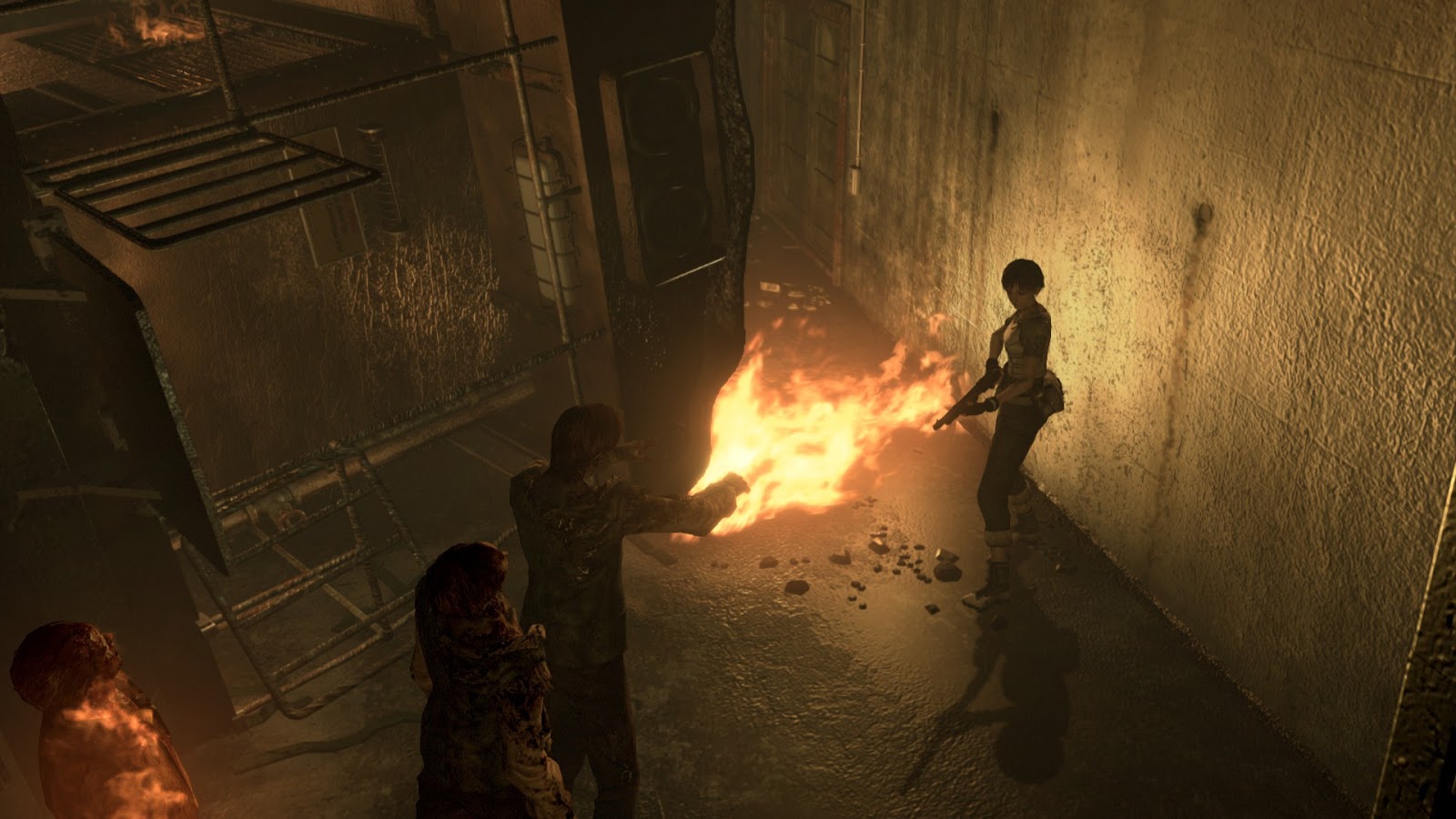
I've been making steady progress in my Resident Evil marathon and recently finished a lesser known installment in the RE series, Resident Evil: Code Veronica. This classic-style survival horror adventure combines the static camera angles with some camera movement and focuses on Claire Redfield's journey to find her brother Chris. I've dedicated a few articles about interesting and frustrating parts of the Resident Evil series and I'd like to highlight an especially odd design choice in this one.
Up to Code
Code Veronica plays much the same as other Resident Evil games of its time, requiring you to navigate various locations with tank controls and managing your resources while dealing with the undead and solving puzzles. The moment-to-moment gameplay is identical to other RE games in that regard, but there are a few differences in the presentation and structure.
Like I mentioned in the intro, Code Veronica mostly uses static camera angles, but sometimes the camera moves with the character. On a few occasion, it's used effectively to build tension in a hallway where the camera slowly moves further away from you, or zooms in on a point of interest, but it usually feels unnecessary and unnatural. It doesn't add or detract much when it really comes down to it. The presentation itself is passable. It's clear what everything is supposed to be, but the colors are generally muddy and muted, with a fog hanging over almost everything. It's saved from being poor by some great music, character designs and a handful of interesting areas - the Private Residence comes to mind.
In terms of structure, there are larger separate areas like in Resident Evil 3 or 0, but the game makes you backtrack through earlier areas a lot like in Resident Evil 1. This is not too big of a problem if you know what you're doing, but increases the frustration tenfold if you're not sure where to go or what to do because the solution could be anywhere you've been up to this point.
With the exception of a very shoe-horned in Albert Wesker, the story is quite interesting. In her search for her brother, Claire Redfield is captured and brought to mysterious island that she has to escape from. The antagonist is an interesting and somewhat tragic character and the twists and turns along the path of this game's narrative might surprise you.
All in all, RE: Code Veronica is similar to other Resident Evil games, with some odd design choices in its structure and visuals.
From Claire to Chris
Some time after the midway point, the perspective switches and you take control of Chris, Claire's brother. He starts with his own resources, but I immediately noticed that he could access the items I put into the item box as Claire. This is a departure from the character switch in Resident Evil 3 where Carlos has his own item box and cannot access Jill's items. This gave me a headstart as Chris, but at the same time, I felt a little worried about carrying Claire's items around as Chris. If this character switch segment worked like any of the Resident Evil games so far, we would finish Chris' segment and switch back over to Claire for the finale.
To prevent a situation where Claire wouldn't have the necessary resources, I went out of my way to put all of Chris' items into the item box when the switch was about to happen - and I felt pretty smart about it when we did indeed switch back to Claire and she was fully equipped with enough firepower to knock down three final bosses and then some. So you can imagine my surprise when, after a brief segment as Claire, the game switched right back to Chris - instantly putting me in a boss fight with zero resources. To prevent an unwinnable situation like in Resident Evil 0, I had put myself in an unwinnable situation.
It required me to redo a segment, but I decided it was fair enough - this situation occurred because I overprepared for something that ultimately didn't happen. I let Chris keep most of his resources, went through Claire's segment again and defeated the boss when we switched to Chris. I was satisfied that I had given Chris enough to make it through the boss, while still leaving Claire with the most firepower. So imagine my surprise, again, when we never switched back to Claire and all her weapons were permanently out of my reach. For some reason, the entire finale is played as Chris, even though the game started out as a story about Claire. Story-wise, I thought it was a bit disappointing that Chris robbed the finale instead of letting Claire do it. Design-wise, it's just deeply flawed. To get the most out of all your resources, you need to put them in the box before switching characters, but doing that can get you locked into an unwinnable boss battle (both Claire and Chris have to fight a powerful boss in their segments). It's also just natural to assume that you'll finish the game with the character you started as, but that doesn't happen either - so if you gave up Chris' resources for Claire, too bad! You'll have to do the final boss with your knife and some scraps.
This problem was so easy to prevent, too. They could've just given you a prompt that you would not be playing as Claire again, or they could've automatically put everything in her pockets in the item box. Yes, it would reveal ahead of time that you're going to end the game as Chris, so I understand why you wouldn't want to do it for narrative reasons, but this is a situation where good game design should be valued over keeping secrets. A good compromise might be to put all of Claire's items in the item box if you die to the final boss a few times - at that point, there's nothing left to hide.
With all that said, the final boss was still manageable. It took me a few attempts, but it wasn't a brick wall like Resident Evil 0 - and if my resources had really proven completely inadequate to complete the final boss, I would've had to redo a far smaller segment than Resident Evil 0 made me redo.
Closing Thoughts
I enjoyed Resident Evil: Code Veronica. It's a lot longer than other Resident Evil games, to the point that its original release required two disks, and tries a few new things to varying degrees of success. Aside from the fatal design flaw I discussed in this article, I'd say it's a challenging but fine installment in the Resident Evil series. I'll remember the challenging bosses, story and music for a long time to come, but I've already forgotten the visuals.
https://www.youtube.com/watch?v=mxq5ymqPAsQ
_
It feels nice to be getting my thoughts out about some of the classics I've experienced lately. Thank you for reading! I hope you'll join me for whatever's next, and of course, your suggestions and feedback are always welcome.
A blog for discussing the art and design of games, popular and obscure, triple A and indie.
Showing posts with label evil. Show all posts
Sunday, March 8, 2020
Monday, December 9, 2019
Resident Evil 0: The Horror of Saving Yourself Into a Corner
I recently finished Resident Evil 0, the prequel to the classic Resident Evil. Unlike its more popular predecessor, Resident Evil 0 had a lukewarm reception and is usually considered "just alright." In light of the article I wrote about Resident Evil and the limited Ink Ribbons, I wanted to discuss the ways in which this game is both kinder and more cruel. This is going to be a bit more anecdotal than my usual article, because I want to describe my personal experience with the game as well as analyze it.
On the Right Track
Resident Evil 0 brings a few new ideas to the table. You're playing as two characters, Rebecca and Billy, which presents new possibilities and challenges alike. Each has their own inventory space, so you can hold more, but who needs to hold what? You have two people who can fight, but also two people who you need to protect and keep in good health. While I thought puzzles using the two characters separately were underutilized, I did really appreciate this concept. There's a unique terror to controlling your two characters separately, focusing on one of them for too long and then hearing the other character call for help on your walkie talkie. Can you rush over there? Or will you switch and deal with the problem on your own? The few moments after you realize one of your characters is in danger are always tense.
Written in Ink and Blood
The main point of my article about Resident Evil was discussing the Ink Ribbons, which effectively turn saving into a limited resource. I felt this was a daring design choice with great potential payoff, but great risk as well. I think Resident Evil HD ultimately came out on top with it, but Resident Evil 0 much less so. The Ink Ribbons return here, and strangely, they're actually a bit more common - further compounded by the game's shorter length. I found myself having an overabundance of them and kicking myself for not saving after certain deaths because I was so used to them being rare after the first Resident Evil.
But the abundance of Ink Ribbons combined with another of the game's quirks quickly led to major frustrations - namely, the layout or structure of where the game takes place. Resident Evil takes place in a mansion first and foremost, with each of the separate areas being an offshoot of that. Resident Evil 0 is a bit more linear in that regard - the first area, the train, is actually closed off permanently after you leave it, and each area after that becomes mostly irrelevant after you move on to the next. This means there is less room for exploration and fewer paths to take at any one time. Combine that with some really mean enemies and enemy placements, the fact that health items are still as rare as ever, and you've got a situation where you can quite easily save yourself into a corner.
Right from the start, the game felt a lot more challenging than Resident Evil 1, but I was able to make my way through at a slow and steady pace... until I hit a solid brick wall, the Giant Bat. I had just barely made my way to the third area after finishing the Training Facility, saved in the church area and was then immediately thrown into a boss battle. Both playable characters were at low health but I had a decent amount of ammunition, so I assumed it would be possible to overcome the battle regardless. Unfortunately, the bat has a lot of health and is surrounded by many smaller bats that continuously fly at you, dealing chip damage. After dozens of attempts where the smaller bats killed me or my ammunition simply ran out, I realized I had saved myself into an unwinnable position. I lacked the ammunition to kill the boss, but getting more ammunition - if there was any left - would require backtracking through rooms with many enemies, wasting more health and ammunition.
After a few more stubborn attempts, I was ultimately forced to do something that hadn't happened even a single time in Resident Evil 1 - return to an earlier save, redo a few hours of progress and make it back to the same spot with more resources. This really took the fun out of the game for me for a while, but after I finally got back and made it past the boss, I was willing to give the game another fair chance. And for a while, that worked out fine - I made it through the next few areas without much trouble, and started to really enjoy myself again. And then, at the very end, I hit another solid brick wall: The first phase of the final boss. The situation was much the same as with the bat - not only did I have low health, I simply didn't have enough bullets left to take it down. And returning to a slightly earlier save didn't help the situation much at all, either, so I was in yet another situation where I would have to go back to a save of several hours ago to even be able to make it through this boss. After trying many more times, my patience had unfortunately run out, and I did something unprecedented for my streams: I loaded up CheatEngine and gave myself infinite ammunition to make it through the boss, then beat the rest of the final boss legitimately. I prefer not to resort to illegitimate methods to complete games, but if a game can create a situation where an obstacle becomes impassable, I consider that cheating as well. I described the frustrated feeling in my streams something like this: "You've made it to this point with the resources you have fair and quare, saved, and the game just wags its finger at you and calls your progress invalid because you don't have enough bullets or health." That's how it felt, and that's why I didn't feel particularly bad about cheating in this one segment.
In short, the game's abundance of Ink Ribbons but lack of other resources, combined with its highly linear structure, easily allows you to save yourself into an unwinnable position, particularly before boss encounters - many of which require a lot of ammunition to take down, especially on harder difficulty settings. The first time this happened, I played ball with the game's limits and re-did a two hour segment. The second time it happened, my patience ran out and I cheated for a few minutes to overcome the otherwise insurmountable obstacle. It is my personal opinion that this was perfectly fair, as I consider it a game design flaw that you can so easily save yourself in a bad position. I admit that this is mostly subjective, however, and high skill players will likely not run into this problem.
Not With Zero Merits
There were many frustrations in my experience with Resident Evil 0, but except for the 'brick walls' I encountered, the game was still solid. Its presentation is beautiful, and its areas - while derivative - are a joy to explore. I particularly liked areas that really capitalized on the two-character system like the Train and the Lab. And while the narrative was rather bare bones in its execution, I really liked the concept of a special agent and a death row criminal being forced to work together and having to learn to trust each other.
Because of all its qualities, I can still recommend the game to fans of the genre or series, although it is a cautious recommendation. If you play the game, play it on an easy difficulty to breeze through and enjoy the atmosphere and locations. If you do feel brave enough to tackle the hard difficulty, remember to be stingy with your Ink Ribbons and make sure you're keeping as many resources as you can.
And that's all I had to say! I'm aware that this article was more negative and anecdotal than usual, but I just wanted to share my experiences with this game. Any feedback would be appreciated!
Monday, November 4, 2019
Resident Evil - Saving as a Limited Resource
I recently started playing the Resident Evil games, starting with the HD Remake of the first installment in the series. The game is often discussed as a great example of survival horror, and most of its qualities have been thoroughly discussed. That's why I want to take the approach I did for my Mario Odyssey article and focus on something specific I thought was interesting about the game: The fact that there is a cost to saving, that keeping your progress is a finite resource.
Running out of Ink
Resident Evil is possibly the biggest horror franchise in all of videogames. The first game didn't just define what the rest of the franchise would look like, but had an effect on the genre as a whole. One of the cornerstones of this survival horror classic is limited resources. There are only a finite amount of healing items and bullets, and only a few spots of inventory space to keep them in. I was aware of that, but I wasn't aware of one other resource the game limited.
In their journey to escape the zombie-infested mansion, Jill or Chris - depending on who you picked to play as - need to use typewriters to save their progress. But it's not as simple as approaching a typewriter and hitting the button; you actually need to use an Ink Ribbon to use the typewriter. And Ink Ribbons are a resource you need to find, put in your inventory and take with you just like bullets and healing items. And once you've used them, they're gone.
This idea really caught me off guard. I've seen games that reduce your ranking if you save, or games that have a super hard mode with finite save points like LISA: The Painful, but never a game that requires you to use a specific finite item for each time you save.
Inky Black Horror
Limited resources have a way of building the tension. You don't want to waste all your bullets, but being too stingy will just get you injured or slow you down a lot. It's the same for healing items, and in this case, for the Ink Ribbons as well. Waste too many Ink Ribbons and you'll have to go long periods of time without saving until you find more... but if you're too stingy and wait a long time before you save, you'll lose significant progress if you run into trouble and die. I both loved and hated this idea.
People with a passion for videogames often declare that the best games communicate their atmosphere or aesthetic with their mechanics, not just their presentation. To clarify, for example, a horror game shouldn't just be scary because it looks and sounds frightening - playing it should be a frightening experience in and of itself due to how the game actually works. The limited Ink Ribbons definitely made playing the game a lot scarier because every enemy was now a huge threat to my progress. In one of my streams of the game I ended up stuck for a few hours and wasted too many Ink Ribbons on small bits of progress - I ended up having to cross two new areas filled with new enemies before I could finally save, and that hour of excitement was one of the scariest experiences I've ever had with a videogame. Because your progress hangs in the balance, you need to be twice as careful about your other resources and be intimately familiar with the layout of each area - and even that won't protect you entirely, because some rooms in the mansion change over time.
Good ideas and effective scares, however, can eventually turn into mere frustrations when you're exposed to them too often. We saw a bit of this in Silence of the Sleep, where a certain frightening monster appeared so often and reset your progress so often that it lost its impact and turned into an annoyance. The situation with the Ink Ribbons eventually became similar, though not quite as bad. You see, the fear that comes from limited Ink Ribbons is at its strongest when you haven't lost your progress yet. The true brilliance of the idea shines in those moments of tension where you decide to bite off just a bit more and see if it pays off, or when you're desperately going from room to room with zombies on your case. But once you've actually died and lost your progress, the tension is released and replaced with frustration and disappointment. Now you have to retrace your steps, and though you're more efficient about it, it gets old fast if it happens multiple times.
The Ink Ribbons really are a double edged sword in this regard. Ideally you'd have a situation with the same tension, but not the resulting frustration, but there's no way to change the Ink Ribbons that would make that a reality. The fear of losing your progress and the frustration of losing your progress are two sides of the same coin. If you died and you didn't lose your progress, then the tension wouldn't be there, but the fact that you do lose your progress inevitably leads to frustration and repetition. As a designer, a possible middle ground I could suggest is that the Ink Ribbons are required to save major story progress, but minor things like killing zombies and gaining resources are preserved. Of course, this could easily be exploited and break the game, so I understand why they didn't go for that.
All in all, Ink Ribbons really increase the tension and really put the survival AND horror in "survival horror." But having something as necessary and usually taken for granted as saving depend on a finite resource could be very frustrating for some people. The threat of losing progress is great for horror, but actually losing your progress can lead to repetition. I think how you feel about Ink Ribbons will ultimately come down to preference, but while it's a love-hate relationship for me, I love it more than I hate it because of the exciting experience it gave me. I'm excited to experience the rest of the Resident Evil franchise and see if the way resources are handled changes much throughout.
_
October's over, but I couldn't resist writing another article about a spooky game! Since I'm planning to do the whole franchise, you can probably expect more Resident Evil articles in the next few months. I hope you'll stick with me as I experience another series I missed out on. I want to thank the people on Steem again for all their support; you've made writing a lot more fun for me.
What do you think? Is it fair to have a function like saving your game depend on a finite in-game resource? Is that brilliant horror design or irritating artificial difficulty? Would love to hear your thoughts.
Running out of Ink
Resident Evil is possibly the biggest horror franchise in all of videogames. The first game didn't just define what the rest of the franchise would look like, but had an effect on the genre as a whole. One of the cornerstones of this survival horror classic is limited resources. There are only a finite amount of healing items and bullets, and only a few spots of inventory space to keep them in. I was aware of that, but I wasn't aware of one other resource the game limited.
In their journey to escape the zombie-infested mansion, Jill or Chris - depending on who you picked to play as - need to use typewriters to save their progress. But it's not as simple as approaching a typewriter and hitting the button; you actually need to use an Ink Ribbon to use the typewriter. And Ink Ribbons are a resource you need to find, put in your inventory and take with you just like bullets and healing items. And once you've used them, they're gone.
This idea really caught me off guard. I've seen games that reduce your ranking if you save, or games that have a super hard mode with finite save points like LISA: The Painful, but never a game that requires you to use a specific finite item for each time you save.
Inky Black Horror
Limited resources have a way of building the tension. You don't want to waste all your bullets, but being too stingy will just get you injured or slow you down a lot. It's the same for healing items, and in this case, for the Ink Ribbons as well. Waste too many Ink Ribbons and you'll have to go long periods of time without saving until you find more... but if you're too stingy and wait a long time before you save, you'll lose significant progress if you run into trouble and die. I both loved and hated this idea.
People with a passion for videogames often declare that the best games communicate their atmosphere or aesthetic with their mechanics, not just their presentation. To clarify, for example, a horror game shouldn't just be scary because it looks and sounds frightening - playing it should be a frightening experience in and of itself due to how the game actually works. The limited Ink Ribbons definitely made playing the game a lot scarier because every enemy was now a huge threat to my progress. In one of my streams of the game I ended up stuck for a few hours and wasted too many Ink Ribbons on small bits of progress - I ended up having to cross two new areas filled with new enemies before I could finally save, and that hour of excitement was one of the scariest experiences I've ever had with a videogame. Because your progress hangs in the balance, you need to be twice as careful about your other resources and be intimately familiar with the layout of each area - and even that won't protect you entirely, because some rooms in the mansion change over time.
Good ideas and effective scares, however, can eventually turn into mere frustrations when you're exposed to them too often. We saw a bit of this in Silence of the Sleep, where a certain frightening monster appeared so often and reset your progress so often that it lost its impact and turned into an annoyance. The situation with the Ink Ribbons eventually became similar, though not quite as bad. You see, the fear that comes from limited Ink Ribbons is at its strongest when you haven't lost your progress yet. The true brilliance of the idea shines in those moments of tension where you decide to bite off just a bit more and see if it pays off, or when you're desperately going from room to room with zombies on your case. But once you've actually died and lost your progress, the tension is released and replaced with frustration and disappointment. Now you have to retrace your steps, and though you're more efficient about it, it gets old fast if it happens multiple times.
The Ink Ribbons really are a double edged sword in this regard. Ideally you'd have a situation with the same tension, but not the resulting frustration, but there's no way to change the Ink Ribbons that would make that a reality. The fear of losing your progress and the frustration of losing your progress are two sides of the same coin. If you died and you didn't lose your progress, then the tension wouldn't be there, but the fact that you do lose your progress inevitably leads to frustration and repetition. As a designer, a possible middle ground I could suggest is that the Ink Ribbons are required to save major story progress, but minor things like killing zombies and gaining resources are preserved. Of course, this could easily be exploited and break the game, so I understand why they didn't go for that.
All in all, Ink Ribbons really increase the tension and really put the survival AND horror in "survival horror." But having something as necessary and usually taken for granted as saving depend on a finite resource could be very frustrating for some people. The threat of losing progress is great for horror, but actually losing your progress can lead to repetition. I think how you feel about Ink Ribbons will ultimately come down to preference, but while it's a love-hate relationship for me, I love it more than I hate it because of the exciting experience it gave me. I'm excited to experience the rest of the Resident Evil franchise and see if the way resources are handled changes much throughout.
_
October's over, but I couldn't resist writing another article about a spooky game! Since I'm planning to do the whole franchise, you can probably expect more Resident Evil articles in the next few months. I hope you'll stick with me as I experience another series I missed out on. I want to thank the people on Steem again for all their support; you've made writing a lot more fun for me.
What do you think? Is it fair to have a function like saving your game depend on a finite in-game resource? Is that brilliant horror design or irritating artificial difficulty? Would love to hear your thoughts.
Subscribe to:
Comments (Atom)