Pagina's

Monday, September 24, 2018

Ace Attorney and the Lion Lilies: Parental Bonds #2

In the last article, we examined the theme of 'the bond between parents and their children' as it has been presented throughout the Ace Attorney series. This all served as a build up to Ace Attorney Investigations 2, which revolves more strongly around this theme than any other game in the series. In this article, we're going through the game's third, fourth and fifth case and examining all the ways in which the theme presents itself. Just like in the last article, we'll be spoiling just about everything. To the yet unspoiled: Turn back!


Birth of a Theme (The Inherited Turnabout)

Though the full impact of its theme is only brought home in the final episode, it actually becomes a clear part of the story long before that. While the theme is a secret in episodes 1 and 2, it gains a clear presence in episode 3, 'The Inherited Turnabout.' I will examine that episode first, as it is chronologically the first to take place.

The Inherited Turnabout revolves around Gregory Edgeworth's final case, a case which Miles "inherits" as the title suggests. Using the clues his father gathered in the past, Miles finally solves the case in the present 18 years later. But a lot more things from this past case are inherited in the president day than just one case. This case sets all the events of this game, and arguably the whole series, in motion. 

First, the obvious connections: This is the case ultimately leading to the trial where Gregory Edgeworth revealed Manfred von Karma's shady practises to the court and earning him his first penalty - after which Von Karma murdered Gregory Edgeworth and put his son Miles on the prosecutor's path. For a game revolving around Edgeworth's doubts about his role as a prosecutor, including the case that caused him to switch to this path was a brilliant decision. Miles' switch to the prosecutor's path is what pushes Phoenix to become a lawyer, so you could say the whole series has its origins in this case.

But the case isn't just a neat starting point for the series, it also has many important connections within the context of AAI2's own story and heavily involves the theme of parenthood, not just for Miles Edgeworth. There are a few parental figures aside from Gregory that are isolated to this case, so let's briefly addres them: First there is the defendant, Jeff Masters, who took in Katherine Hall as an adopted daughter. She, in turn, loves him enough to set a potentially fatal trap for the murderer who committed the crime Masters was accused of. Manfred von Karma also plays an important role. His bond with Franziska isn't really relevant to the case, but it is important to the story that we see a clash between the two people who raised Miles.

The parental figures that really tie into the game's own overarching story are Dane Gustavia and Isaac Dover, two chefs who compete in the contest. They both have a son - both of which later become a critical part of the story, or to be more precise, already are a critical part of the story - you just find that out much later. Gustavia's son is Simon Keyes and Dover's son is Horace Knightley.

Dover and Gustavia with their sons. Source: Ace Attorney Wiki

The two chefs cooperate in the dessert baking contest, as Dover is really a sculptor and Gustavia has a weak sense of design, but Dover betrays Gustavia at the last moment. Not only does he let Gustavia help him with the finale in advance before refusing to help, he also forces his son Horace to restrain Simon, preventing him from helping his aguesiac father by tasting the desserts. Gustavia, in turn, murders Dover. He proceeds to abandon his own son, completely indifferent to his fate - although his breakdown might be implying that he actually hates himself because of what he's done.



Though his memories of the event are muddled, Simon begrudges Knightley for his role in the murder that led to his father abandoning him and orchestrates Horace's murder in the second case by convincing Patricia Roland that he is one of Sirhan Dogen's men, something he knew she was extremely paranoid about for reasons revealed in later cases.

Severed Bonds (The Forgotten Turnabout)


Simon's vengeful plans reach their final stage in the fourth and fifth cases of Investigations 2. In the fourth case, The Forgotten Turnabout, Simon kidnaps Kay. He then plants her at a location where another murder is about to occur by his design - and ensures that the murderer, Blaise Debeste, tries to frame Kay by planting letters indicating she and the victim Jill Crane were working together. Though this cooperation turns out to be false, it's interesting what Kay's supposed motive for cooperating with Jill was - namely, to retrieve the Promise Notebook she and her father made.


The Promise Notebook ends up being an important part of the care later on, as it gives Kay the final push to regaining her lost memories. The notebook as well as the Yatagarasu's Badge are two pieces of evidence relating to Kay's father, Byrne, so it can be said that the case starts with her losing that bond - and then regaining it at the end thanks to Edgeworth and Courtney.

To get to that point, however, Edgeworth first gives up his Prosecutor's Badge in one of the series' most shocking moments. He realizes that, as it is now,  his badge and role as a prosecutor is only holding him back from following the truth as his father did, and from saving Kay. This is a critical moment in the story, as Edgeworth does not recover his badge until the very end of the game.

But while Kay's bond with her father is recovered, it's quite the opposite for Sebastian. His father, Blaise, has committed the murder and Sebastian ends up realizing it before everyone else (because he knows Blaise's beard is fake). His conscience makes him question whether or not he should bring it up, but his father rebuffs him quite harshly and reveals that Sebastian only ever had any success because everyone along the way - from his schoolteachers to his employers - are in Blaise's pocket. He closes this shocking relevation by stating in no uncertain terms that Sebastian isn't worthy of being called his son.


Before we move onto how these important steps lead to what ultimately transpires in the finale, let's take a quick step back and also examine how the minor characters tie into the theme. Two important witnesses in the case are Bonnie Young and Karin Jenson, the former of which does the victim's autopsy, which the latter then manipulates. It comes out that Karin helped out the Conductor, Blaise, by replacing the victim's seat at the auction after her murder. She was coerced into becoming an accomplice because if she didn't, her grandmother Bonnie would be charged with forging the autopsy of the IS-7 incident, something Blaise also forced her to do in the past. It's interesting how much the grandmother and granddaughter were forced to help Blaise cover up his dirty deeds.

A less striking example would be Lotta. It's revealed that she's Nicole's mentor, so you could argue she has a "parental" bond with Nicole. It's not an especially meaningful example, though.

With those minor examples out of the way, let's move to the grand finale.

All Connected (The Grand Turnabout)


The aptly named Grand Turnabout finally reveals just how deep the theme of parental bonds runs through Ace Attorney Investigations 2. At the very start of the case, we find that the president of Zheng-Fa (or rather, his body double) has been murdered. Soon after the investigation starts, the game introduces John Marsh to us - he is Judge Courtney's adopted son. In the case's opening act her bond with John is used against her by the world's worst father and general scumbag, Blaise DeBeste. This causes her to genuinely lose her cool for the first time in the game.


But the bombshell that Judge Courtney has a son is just the first of many twists this case has to offer. As it turns out, Blaise's henchmen failed to capture John and took Sebastian hostage instead, while the mastermind ran off with John. The event is very traumatic for Sebastian, who was already distraught because of what his father said in the prior case. When Edgeworth and Kay finally save him, the game's most difficult Logic Chess session begins, as it is as much an interrogation as it is a therapy session for the broken Sebastian. It's one of my favorite scenes in the game because it shows how far Edgeworth has come as a prosecutor and as person.


With his father, the person who he respected most, dismissing him and committing crimes left and right, Sebastian loses faith in himself and everything he has ever known. At this moment, Edgeworth - a man who has lost his own father - steps in to help Sebastian find his way, almost like a surrogate father.


Edgeworth's kind words and guidance pay off later in the case, when Sebastian returns to prosecute the case against Patricia Roland with some of the evidence Blaise tried to get rid of.


Even Franziska shows how much she's grown since her debut, empathizing with Sebastian's situation and freely giving the prosecutor's bench back to him with words of support. It's obvious she feels a connection with Sebastian because of the expectations her own father set for her.


To further emphasize Sebastian's own development, his old theme song gets replaced with a much more serious and dramatic sounding theme. Detective Gumshoe saves John, allowing Sebastian and Edgeworth to take down Blaise together. Blaise does his best to put down Sebastian even more, but thanks to Edgeworth's support, his words fall flat.


Sebastian surpasses Blaise, who I hesitate to call his father at this point, and thanks to him both Blaise and Patricia lose their cases. In spite of how often he called his son as such, Blaise is revealed as the real idiot between the two, having his men kidnap the wrong child and losing his case as a result. Patricia goes so far as to call him 'useless,' a term he himself liked to describe Sebastian with.
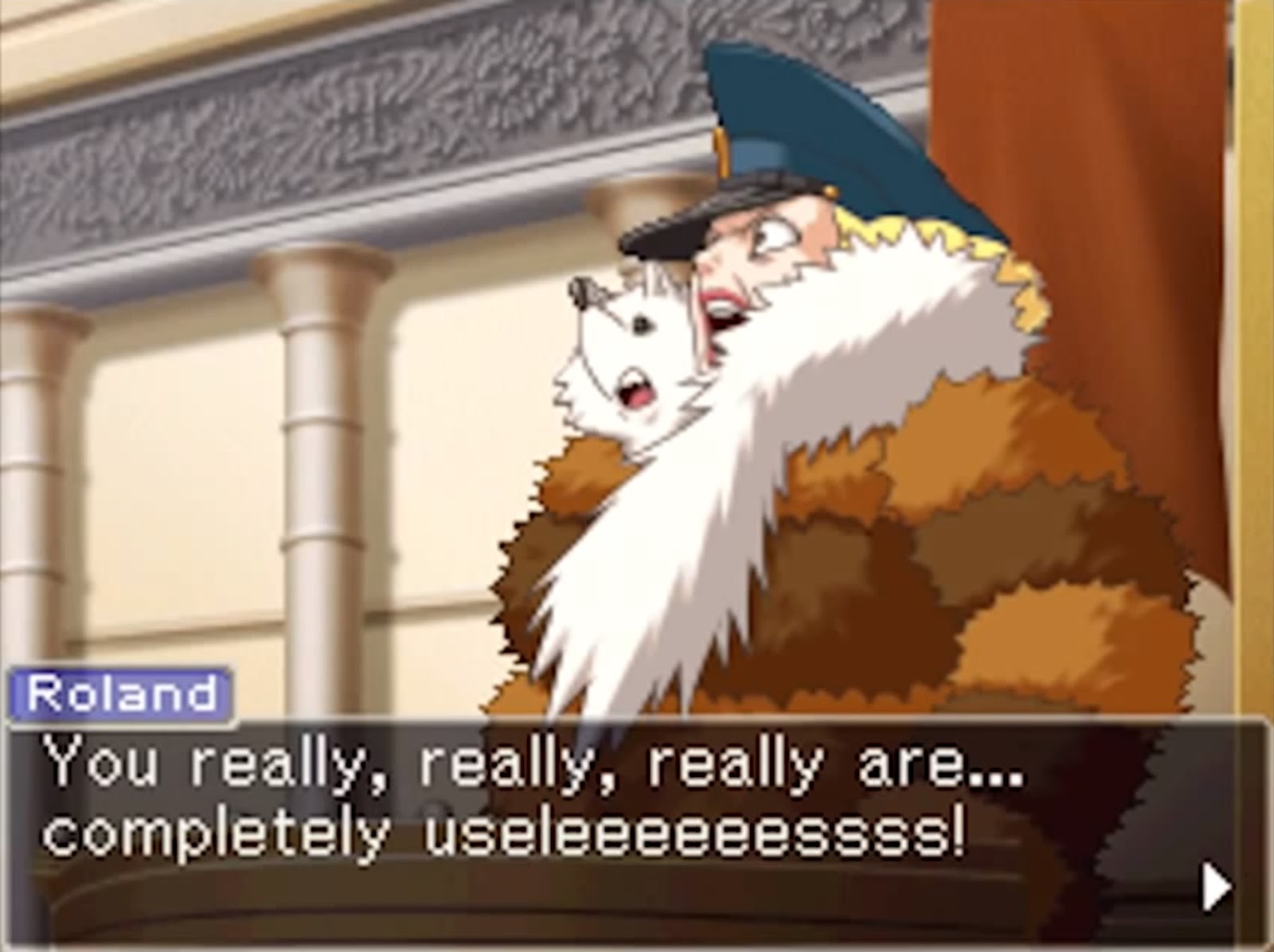
Patricia speaks the truth for once. Source: ZSlyer on YouTube

Though the trial ends on a high note, the case is far from over. Shi-Long Lang steps in and formally accuses Judge Courtney of murdering President Huang, and the mastermind is still on the loose. As the case progresses, Shi-Long Lang finally reveals why his family lost their credibility as law enforcers in Zheng-Fa: The president was kidnapped for ransom and a journalist photographing the event was murdered. Not just that, the event happened at an orphanage that used to be where the Grand Tower is built now. From that point onward, his father's bond with the president was gone. Just like Edgeworth, Lang inherited an unresolved case from his father.

Through investigation, Edgeworth uncovers a truly shocking fact: There was no kidnapping at the orphanage. President Huang was murdered by the assassin Dogen, and subsequently replaced by his body double - and Patricia Roland, Blaise Debeste and the body double himself were the people who made it happen. And it gets worse: The reason president Huang had even come to this orphanage unprotected was to meet his son, the existence of whom he was keeping a secret. It's finally revealed that John Marsh is President Huang's son, but the president was assassinated before ever meeting him. Dai-Long Lang, Shi-Long's father, knew that the president had been replaced but kept that secret locked up to prevent the country from descending into even worse chaos. He took it to his grave but thanks to his son Lang, the secret comes out at last.

It is at this time that Judge Courtney reveals she had intended to speak with President Huang to finally tell him about his son, and she brought the Lion Lilies - representing the bond between parent and child - to explain this to him.


To make the situation at the orphanage even more confusing, the treacherous trio had hoped to kill the assassin Dogen to ensure there were no witnesses. But Dogen was guided to safety by Simon, who was staying at the orphanage at that time. This leads to the relevation that Sirhan Dogen saved Horace Knighley and Simon Keyes after the IS-7 Incident.

Simon and Horace, stuck in a car and freezing. Source: ZSlyer

Not only does this relevation complete the puzzle, revealing Simon as the mastermind, but it also unveils another connection. Simon became Dogen's acolyte and idolized him enough to save him after the presidential assassination. He continued corresponding with him even during his stay in Patricia Roland's prison. It's not a stretch to say they had a twisted kind of father-son relationship as well.

But though he probably saw Sirhan Dogen as more of a father than Dane Gustavia, he can't rid himself of the connection between him and his biological father. During the final confrontation, he tries to make the point that he feels nothing for his father and is nothing like him. It's very clear that Simon is a tragic figure in a way, still hoping years after his abandonment that his father would return and blaming himself for it.

Source: ZSlyer

He claims that he doesn't care anymore, and that he has no connection with his father whatsoever. That claim falls apart when Edgeworth points out that he committed a murder and threw off the time of death by keeping the body in cold storage, exactly as his father did.

Source: ZSlyer

Not only that, but Raymond brings up that Simon doesn't like sweets - most likely a result of losing his father, who he always tasted sweet desserts for.

Source: ZSlyer

In the end, the decisive proof against Simon ends up being the pollen of the Lion Lilies. Because Simon had killed the body double by crushing him under the weight of his hot air balloon, the pollen from the flowers that Courtney had given him ended up sticking to the bottom of the balloon's basket.  The Bouquet of Lion Lilies is, quite fittingly, the final piece of evidence. 


Local mastermind defeated by pollen. Source: ZSlyer

Using the power of John and Courtney's bond, Edgeworth and his friends prove beyond a doubt that Simon killed the President's body double. The case doesn't end there - what follows is an incredibly powerful scene where the theme is emphasized once more. Shelly de Killer, who had been observing the case from the shadows, finally steps in to kill Simon Keyes because he asked him to kill 'President Huang', not revealing that the target was actually a body double. However, Sirhan Dogen steps in to save Simon, once again indebting the latter to the former.


Source: ZSlyer

It's clear that Dogen cares deeply about Simon, the only person whose death he prevented rather than caused. His willingness to die for Simon proves him a better father than Dane Gustavia ever was. Even De Killer himself seems touched by the gesture, and decides there is no merit in fighting Dogen just to end Simon's life.

Dogen and Simon prepare to leave for prison, but John Marsh stops them. He confronts Dogen with the fact that he murdered his father, President Huang - so Dogen presents him with a simple choice. He gives him his knife and tells him, in no uncertain terms, to end his life, to take revenge for his father. Simon himself even seems to approve of the idea, having lived his life planning and executing vengeful plots.


Source: ZSlyer

But John shows a wisdom beyond his years, realizing that while revenge might make him feel better, it would cause great pain to the people he loves - especially Courtney, his mother. He expresses his faith in the courts - entirely opposite to Simon - because he has faith that his mother and Edgeworth will serve justice.


Wisest words ever said by a kid wearing cow horns. Source: ZSlyer

Dogen and Simon finally return to prison together, and the case finally comes to a satisfying conclusion. But there are a few arcs that still need to be wrapped up, most notably Edgeworth's. Edgeworth ultimately decides to stay as a prosecutor, explaining to Raymond Shields that he believes he can save people on the Prosecutor's Path, just as his father and Phoenix Wright do as defense attorneys.


Talk about taking a third option. Source: ZSlyer

In spite of the fact that they may have different jobs and titles, Edgeworth chooses to save people and pursue the truth as his father did. Ray is truly impressed with how much Edgeworth has grown, and how much he has become like his father.

Source: ZSlyer

After Edgeworth clarifies his reasons for returning to the position of prosecutor, Judge Courney returns his badge to him. Edgeworth reassures her that she had every reason to act as she did during the trial of Patricia Roland, considering her son was in danger, and Judge Courtney expresses great optimism for Edgeworth's future as a prosecutor. She reveals that, just as with so many people in this story, it was her bond with John that helped her through the tough battle against the corruption in the P.I.C.

Source: ZSlyer

The credits give us a quick look at how everyone is doing, and we return to Edgeworth and friends, discussing what comes next. Gumshoe finally gets a raise, which isn't necessarily related to this subject but I wanted to point it out anyway. At the very end, Edgeworth sums up the conclusion of his arc quite beautifully. I won't even try to paraphrase it. Here:


Powerful. Source: ZSlyer

_

And that brings Ace Attorney Investigations 2, and its strong themes of the bond between parents and children, to its conclusion. I noticed that the game focused strongly on the theme of parents and their children on my first playthrough, but I didn't realize just how universally present it is. I hope I helped you see the Ace Attorney series and Ace Attorney Investigations 2 in a different light!

Family is a major overarching theme in Ace Attorney, and I've actually considered writing an article about siblings in Ace Attorney as well. There are obvious examples like Maya and Mia, as well as Apollo and Trucy, but just like the theme of parenthood it might just be even more prevalent than you think. 

Feel free to share your thoughts about this article in the comments, or by reaching out to me. Thank you for taking the time to read this article, which I have sporadically worked on over a period of many months. Let's meet again soon to discuss more art and design!

Monday, August 13, 2018

"Games are Political"

I don't usually dip into controversial topics, but this has been on my mind, so... feel free to skip this one if you're not in the mood for this particular discussion. The topic of today is the entire debate surrounding videogames and whether or not they are political. Not so much the subject in and of itself, although I'll address it briefly, but the discussion around it. There are going to be a lot of anecdotes and tangents, but bear with me if you've come this far already.

For an industry revolving around entertainment, the games industry seems to ignite a lot of controversies and what I hesitate to call 'discussions.' One of the more frustrating topics to me is the idea that games either are or aren't political.

One thing that immediately jumped out to me in this discussion is that the sides aren't exactly mirrored. Rather than having one side proclaim the negatives of political messages in games and the other proclaiming the positives, one side of the debate exists mostly to invalidate the other by default. Rather than arguing why games can be a useful tool to make you think about certain political perspectives, people will dismiss the topic altogether by saying (all) games are political, or all art, or everything period.
_

If you don't care about my opinion, you can skip this bit, but I'll take a moment to explain my own views before I move on. Taken by its dictionary definition, political is defined as:

1. Of or relating to government, a government, or the conduct of government.
2. Of, relating to, involving, or involved in politics and especially party politics

Based on its definition, the answer is apparent to me: Games can be political, but are not inherently so. There are a lot of games - the majority, I would say - that have no message or intent relating to the government or its conduct. Once the fact that most games do not have such a message is presented, the goalpost usually shifts - I've received counterarguments along the lines of:

"People are political and their lives are always influenced by politics in some way, so politics will always be reflected in their art."

This is debatable, but let's assume in good faith that this is true; that no matter our agency as individuals, our political beliefs will always be reflected in our every action and expression in some way. The simple question that follows is 'so what?' The claim is that games are political, period. The quite possibly true notion that 'politics will always have some kind of impact on what we do' does not make our every action political in and of itself. If a religious person paints a still life without any religious content, is that painting of itself still religious? Plenty of great artists over the years had their eccentricities and even bigotries. Can a painting of a flower made by an artist who held some form of bigotry be labeled as being bigoted as well? I may be wrong about this, but I think that's a very reductionist way of thinking about art and even people in general.

Adrian Chmielarz, developer of The Vanishing of Ethan Carter, argues that it's not a simple yes or no question, but rather, that we should think about it in degrees - think of the phrase 'the dose makes the poison.' He wrote an excellent article a few years ago that you can read by clicking here. 

Anyway, those are my two cents on the topic, but I'm willing to hear arguments to the contrary. Feel free to post a comment or send me a message.
_

What frustrates me is that the 'games are political' perspective is often presented as a foregone conclusion, requiring little to no argument. Even though the discussion isn't that old, people with the view that games are political seem tired of arguing for it, even though most people have probably never heard their arguments. They are so convinced of the obvious nature of this belief that they often end up presenting it in an angry or smug way.

The way this debate is going, I genuinely wonder if either side even really understands the other. When someone says 'I don't want politics in my games,' the phrase will often be countered with the correct statement that a beloved game or franchise (like Bioshock) has strong political themes or content. In this regard, I think both sides of the debate aren't quite thinking about 'politics' by its dictionary definition. This is my personal interpretation, but when people say they don't want 'politics' in their entertainment, I believe they are mainly talking about contemporary politics. They don't want to see the same talking points people repeat on social media right now in their entertainment media. I've come to this conclusion because a lot of people who hold this view express that they play games for escapism, among other things. It only makes sense that you don't want to be faced with the fears and frustrations of real life in your entertainment media if you specifically consume said media to escape those fears and frustrations.

But instead of reaching out with empathy and understanding that there may be very good reasons why a person wouldn't want recent political topics to come up in their entertainment media, the 'games are political' side tends to resort to a frustrating kind of Bulverism. C.S. Lewis' words are especially relevant here, particularly how he reflects on the way we don't address whether a person is right or wrong, but rather, how their supposed secret wishes or thought processes led them to this wrong conclusion. In the context of this subject, you'll often see people proclaim the following:

"When people say they don't want politics in their games, they only mean politics they don't agree with."

I think this statement does hold a grain of truth. Considering the sheer size of the industry and its audience, it's statistically likely that there are people who are frustrated with the politics present in certain games not because they are politics, but because they themselves hold opposing political views. But it isn't logical to attribute this 'secret wish' to all people who have expressed a distaste for politics appearing in their entertainment media. Until you've found a significant amount of people who specifically dislike the notion of politics in games for that reason, you're just making up a reason for why these people are wrong without even addressing their concerns. The best course of action to take when a perspective seems confusing or contradictory to us, is to ask questions, not make sweeping assumptions about the speaker's intentions.

I've mostly addressed the attitudes and behaviors I find frustrating on one side of the debate, namely the side that argues that all games are political. If you've read my personal view on the topic as well, you've probably noticed that I lean further the other way. My view remains that games can be political but aren't political, but I find myself sympathizing more with people who want to avoid politics than those who claim they are universal. It's mainly because expressing a distaste for politics is simply expressing a preference, a desire, an opinion. On the other side, proclaiming that games are political by nature is a statement intended to be factual, and in many cases, obvious. It is my personal view that there is a lot of arrogance to proclaiming games are political. It's perfectly fine if that is what you believe, but it is just that - a belief. An opinion.

I think the discussion would move forward a lot quicker if either side dropped the snappy sounding but ultimately divisive statements they so often use. Instead of 'keep politics out of videogames,' why not say that you 'prefer that videogames not be used to present a stance on contemporary political issues in a hamfisted way.' It takes more effort to say, but it's also a lot more reasonable and closer to the truth. Similarly, instead of 'games are political,' why not explain that you 'believe our political beliefs always have some impact on our self expression.' That's just what I think, but the Twitter character limits have probably pushed people to simplify their statements - and perhaps even their views - more and more.

In any case, that's where I'll leave it for now. It's hard to summarize the raving rant I just wrote, but I'll try: The discussion surrounding games being political is stagnant, mainly because neither side really understands the other. I personally find the side that argues games are inherently political to be the more arrogant side, as it proclaims to know an objective truth rather than expressing a subjective preference (like not wanting politics in your entertainment media). I don't condemn any specific individual, but those are the general trends I've observed, perhaps through my own biased lens. 

If you have any thoughts, feel free to share them!

Thursday, July 12, 2018

Jelly Jellies

Hey, everyone! This blog is usually reserved for analytical and critical posts about videogames, but today I wanted to share a bit of an update concerning my career as a game developer.

A project I've been working on for a long time, Jelly Jellies, was finally released. The team and I have put a lot into this project - hours and hours of work from design to production. I was the animator for the project, giving motion to the amazing artwork of our visual designer Kate.

I'll continue to provide support to the project, but this is a very big moment for all of us. If you happen to be reading this, do you think you could give the game a try?

Click here for the Android version.

Click here for the iOS version.

_

I'd like this article to have a bit more substance than just being some self advertising, so I'll talk a little bit about the way the project went for me as an animator.

We started out the project by making the animations in Adobe Animate if you can believe that - it was the tool I was most comfortable with at that time. But it became pretty clear in just a few months that Flash and Unity, our engine of choice, were not going to play nice. We needed a way to get my animations into Unity with 100 % quality while taking as little space as possible. The program to do just that presented itself: Esoteric Software's Spine. It was painful to scrap a lot of the prior work I had made in Animate, but fortunately, most of the animations could easily be remade thanks to Spine's flexible tools.

So, in just a few short weeks, I picked up and mastered Spine and not only animated a ton for this project, but also picked up a skill I've been able to use for many other projects. The best projects are definitely the ones that teach you useful new skills!

Since then, I've animated a truly baffling amount of things in Spine, from characters to environments and even special effects. I'm currently compiling a showreel to show off just how much I've learned and might share it with you when it's done - let me know if you'd be up for that.

Anyway, just some things I thought I'd share about this amazing project. The team and I really would appreciate it if you gave the game a shot and maybe left a review. Regardless, though, thank you so much for your time. When I post again, it'll hopefully be the follow-up to the Ace Attorney article I wrote - but we'll see. Have a good day!


Saturday, June 16, 2018

Rakuen (Review)

I don't usually post 'traditional' reviews on this blog, but I really wanted to share my thoughts on this game with you. I posted this review on Steam first, but felt it would be worth uploading here as well.

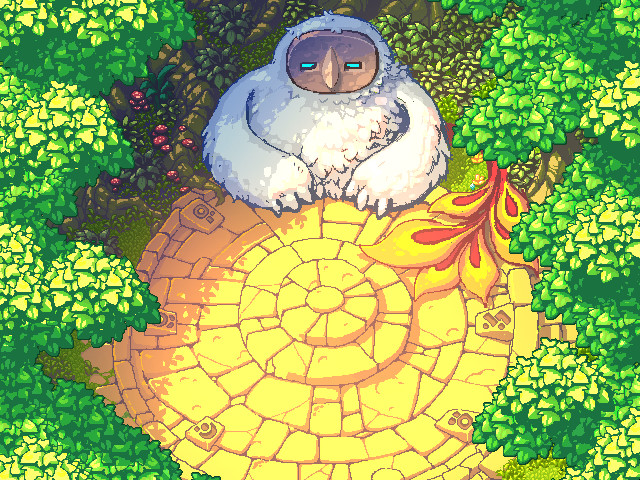
Rakuen is a beautiful adventure/puzzle game about a Boy and his Mom. The Boy has to stay in the hospital, but using a special storybook, his Mom shows him the way into the magical world of Morizora's Forest. This game is played from a top down perspective like an RPG Maker game.


Story:

I don't want to spoil anything, but I will offer a general overview: The hospitalized Boy visits Morizora's Forest in hopes of getting a wish from the forest guardian Morizora. But to get his wish, he needs to help the other patients resolve their problems by going through their history and finding out what led them to where they are. As a result, the story is filled to the brim with charming and interesting characters who you really get to know as you work to help them out. And of course, there are plenty of emotional moments. There are lines that'll make you laugh, and there are lines that'll hit you like a punch in the gut. If you're looking for a story with powerful emotions across the board, look no further.

Presentation:

Having heard Laura Shigihara's work in Plants vs. Zombies and To The Moon, I had lofty expectations for the soundtrack, but even those were surpassed. The soundtrack is filled to the brim with beautiful tracks, from atmospheric pieces to melodies that will get the most stoic people teary eyed. Not only are Laura's amazing vocals present, she has also brought in several guest vocalists who all perform their pieces admirably as well.

The visuals are also strong, with plenty of recognizable character designs and vibrant areas. The visuals and story work together in smart ways, too; the colors in the hospital are much more desaturated than the bright colors of Morizora's Forest, for example.

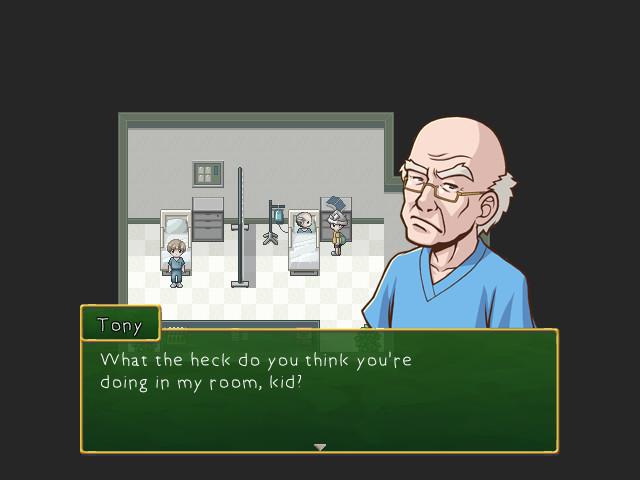
My only minor problem, if you can even call it that, is that some characters in Morizora's Forest don't have many character portraits. Tony Bear could have used maybe one more portrait, just to shake it up. Not a completely unique pose, just a few more facial expressions, like his human counterpart.


Gameplay:

Rakuen mostly revolves around exploration with some light puzzle solving. Fortunately, the puzzles generally tie into the story and history of the characters you are helping out. They are usually not very challenging but offer a nice change of pace. Some areas are reminiscent of classic RPG Maker horror games like Ib and The Crooked Man in how they require you to figure out the environment and its interacting pieces.


My one minor problem with the gameplay, I would say, is that the game asks if you want to look at or read something a bit too often. Sometimes you'll be looking at an item with two separate 'do you want to read it?' or 'do you want to look?' questions. I understand why this is - there are lots of things to read, and you don't want to accidentally read the same thing twice, but in that case it might have been better to separate it into two interactable items instead.

Conclusion: 


Rakuen is a beautiful game with amazing visuals and music as well as a powerful story, with plenty of fantastical and frightening places to explore. Any complaints I could have are too minor to make a difference. Recommended for everyone.

Try it here: https://store.steampowered.com/app/559210/Rakuen/

Thursday, May 10, 2018

Ace Attorney and the Lion Lilies: Parental Bonds #1

This article will spoil just about everything there is to spoil about the Ace Attorney series, including Ace Attorney Investigations 2. If you haven't played them yet, I strongly recommend that you do so first. I will be using names from AAI2's unofficial fan translation for this article.


Back in 2011, Capcom released Gyakuten Kenji 2, also known as Ace Attorney Investigations 2: Prosecutor's Path. Though it never got an official English release, people who played the game or its fan translation quickly came to agree that it was one of the series' best. 

The bond between parents and their children was a prevalent theme in Ace Attorney Investigations 2. This inspired me to look into just how present the theme really is in the game as well as the games that came before it. I'm going to start with the latter and build towards AAI2. Let's go on a quick journey through the series and pay homage to the moms and dads of Ace Attorney.

The Misty Circumstances of DL-6

The DL-6 incident is a pivotal moment for the Ace Attorney series, the ramifications of which are felt throughout the entire series. The theme of parental bonds is strongly present in this case, most obviously because it is the case in which Miles Edgeworth's father, Gregory Edgeworth, was killed. The killer, Manfred von Karma, then takes Miles under his wing and raises him to stray from his father's path. Gregory Edgeworth was a righteous defense attorney who sought the truth, but Manfred von Karma raises Miles to be a prosecutor whose main goal is to achieve 'guilty' verdicts.

This part of Miles Edgeworth's story is a very important factor in understanding the brilliance of AAI2, but another part of DL-6 isn't talked about as much: The involvement of Misty Fey, Maya's mother. Just as Miles inherits his father's final case in The Inherited Turnabout, Maya - in a sense - inherits DL-6 from her mother.


Misty Fey channeled Gregory Edgeworth, but the person she then accused of his murder turned out to be innocent. This failure is what caused the Fey family to lose much its reputation and caused Misty to go into hiding, leaving Maya to pick up the pieces. And she does indeed, getting herself held in contempt of court just to save Edgeworth and stealing the final piece of evidence back from Von Karma.


In supporting Phoenix, she succeeds where her mother failed. Maya's support is so impactful that, according to Gumshoe, it made Edgeworth's lip tremble.


I think it's very powerful that Maya gets to finish what her mother once started by wrapping up DL-6 for the better.

Morgan Fey, Worst Mother Ever 

The Fey family is shown to be quite dysfunctional, and Morgan Fey the clearest example. She tries to frame Maya for a murder to establish her daugher, Pearl, as the new Master of the Kurain Channeling Technique. If we did top 10 lists on this blog, Morgan Fey would easily earn the top spot in a 'top 10 bad parents.' One of her children ends up as a serial killer and is executed, another becomes an accomplice to murder and is arrested and she very nearly makes a murderer of Pearl as well. Her attempt to use Pearl as a tool to get back at Misty is what sets the events of Bridge to the Turnabout in motion and leads to the untimely death of Maya's mother. 

The difference between Morgan and Misty is quite apparent. Misty came out of hiding to protect her daughter and her niece, and ends up dying to achieve that end. Morgan used her daughter as tool to channel her other deceased daughter in an effort to kill her niece for completely selfish reasons. 

Maya and her mother had become estranged, but at the very end, it's revealed that the talisman Misty always carried - the thing that gave her strength - was a picture of her two daughters when they were young.


And the Rest

The Fey family plays an important part in the series' overarching storyline, but there are many more parental figures on a smaller scale. They don't impact Ace Attorney Investigations 2, so I'll keep this short and sweet.

- Turnabout Big Top's Russell Berry is Regina Berry's father as well as a father figure to Acro and Bat. He dies by walking into a trap intended for his daughter.

- Viola Cadaverini, a minor character in Recipe for Turnabout, is considered a threat by Furio Tigre due to her doting grandfather Bruto. Her grandfather throwing his weight around is the only reason Furio pays for her life saving surgery.

- Zak Gramarye is Trucy's father and an all around terrible person. He abandons her, leaving Phoenix to raise her instead.

- Lamiroir is Apollo and Trucy's mother, but she has lost her memory. As of yet, Phoenix still hasn't revealed this fact to Apollo and Trucy.

- Drew and Vera Misham are forgers, though Vera does most of the work. They are both poisoned, but only Vera survives. 

- Similarly, Wocky Kitaki's parents from Turnabout Corner ask Apollo to defend him. Interestingly, Wocky also needs life saving surgery.

Hidden in Plain View

And that ultimately brings us to Ace Attorney Investigations 2.

Ace Attorney Investigations 2's theme of the bond between parent and child is presented in an interesting way. To those who have finished the game, it should be obvious that such a theme was prevalent throughout the whole game, yet someone experiencing the game for the first time might not realize it until they reach the final case. The story focuses mainly on Edgeworth's struggle on the Prosecutor's Path, which his father's position as a defense attorney plays a major role in, but other characters' bonds between their children or parents are only discussed later.

In Ace Attorney Investigations 2's fifth and final case, 'The Grand Turnabout,' all unsolved affairs and out-of-place elements from past cases are suddenly revealed to be significant. This is in no small part because it reveals many parent-child relationships that had been hidden thus far, like Justine's adopted son John. It really solidifies the presence of this theme by introducing a flower, the Lion Lilies, which are explicitly stated to represent the bond between parent and child.

source: ZSlyzer on YouTube

But I want to start from the beginning of the game to really explain just how well AAI2 plays with this theme that has long been present in the series. Please join me in the next part when we examine the theme of parental bond in Ace Attorney Investigations 2, case by case.

Thinking about helping me in my journey analysing and writing about games? Please consider supporting me on Patreon!

Saturday, November 4, 2017

Doki Doki Literature Club - Narrative Empowered By Its Genre

In my last article, I shared my summary and thoughts on Doki Doki Literature Club. In this article,  I'll examine in-depth how Doki Doki Literature Club's approach to a 'meta narrative' is something only a visual novel could do.

This article was written with the assumption that the reader knows and understands Doki Doki Literature Club. There will be many spoilers past this point, so please consider playing the game for free on Steam before reading this. There are also spoilers for EarthBound, Undertale and OneShot.

_

Allow me to get straight to the point: Doki Doki Literature Club is a dating sim wherein one of the characters, who is not a romantic option to the player, becomes aware she's in a game and that her role is simply that of a supporting character. This realization frustrates her to the point of manipulating and eventually deleting the other characters from the game's folder, just so she can have an "ending" with the player. Her manipulation of the characters leads to many glitches, disturbing situations and horrific imagery, such as Sayori and Yuri ending their own lives. To me, this represents the best 'meta narrative' I've seen in a game as of yet. To explain why, please allow me to discuss a few other examples.

Games acknowledging the fact that they are indeed games, being played by a player, have existed for some time.

The Onett police force offers some quality advice.

Many games over the years have made a point of breaking the fourth wall, generally for the sake of comedy, but sometimes as a part of their story as well. EarthBound is a good example of a game that does both, and its finale includes a special moment where the player is acknowledged as separate from the game. Please be aware that this is a spoiler, but you can view this particular moment here. EarthBound was extraordinary in how it reached out to the player, but it was limited by its technology. It had to ask for the player's real name at some point in the story, even if it did so in a subtle way and never mentioned it again until the end.

As technology marched on, so too did games find new ways to reach out to the player, or to acknowledge and make use of the medium they were part of. To name two good examples, Eternal Darkness: Sanity's Requiem and Metal Gear Solid: The Twin Snakes.

Eternal Darkness is a horror game, and one of - if not the - first game to employ a sanity mechanic. Eternal Darkness had the usual tricks we associate with a sanity mechanic up its sleeve, such as whispers and distorting visuals, but it also messed with the player directly by pretending to lower the volume, unplugging the controller or switching the channel.

Unfortunately, this hasn't aged very well.

Metal Gear Solid: The Twin Snakes is a stealth game starring Solid Snake. There are a lot of strange characters in the game, but Psycho Mantis is one a lot of people will remember, mostly because he activates the rumble on your controller and tells you about the contents of your memory card. He does this on top of also pretending to change the channel and requiring you to move your controller to a different port to defeat him.

Psycho Mantis is judgmental about your taste in games.

The Metal Gear Solid example is particularly strong because the game uses the controller and memory card to its advantage, just to mess with the player. There have been other examples of games using the technology at their disposal to acknowledge or mess with the player, but these have usually been less explicit.

In recent years, we've also seen more and more indie games find creative ways to use the medium and its technology. A particularly popular example was 2015's Undertale, which parodied and questioned the conventions of RPGs and remembered certain player decisions, even if they hadn't been saved explicitly.

Flowey will know if you took a life, whether you saved or not.

Undertale's is a world where it actually means something to SAVE and LOAD. These aren't merely game functions, separate from the story, but a very real power that the player - not the main character - has as a part of the story.

Lesser known but even more appropriate to mention is OneShot. Much more explicitly than in most other games, the player and protagonist are acknowledged as separate entities. You, the player, are considered God, and Niko, the protagonist, is seen as your chosen Messiah. Niko will even talk to the player and ask him or her questions. OneShot sometimes communicates to you through error messages, and to solve some of its puzzles, you will need to actually look for files on your PC or do something with the game window. That's just scratching the surface of what OneShot has to offer, as it included some of the most inventive puzzles I've ever seen.

OneShot isn't afraid to poke fun at you if you try to solve puzzles without thinking them through.

So, what does all of this have to do with Doki Doki Literature Club? To explain that, I'll go over my examples one more time. EarthBound and Undertale reached out to the player to enhance their narrative. Eternal Darkness and Metal Gear Solid used the technology at their disposal to startle or poke fun at the player. Lastly, OneShot spoke to the player and used technology because both its story and puzzles were entirely centered around this concept of the game being a game running on the player's computer.

Though they almost couldn't be more different, in my mind OneShot and Doki Doki Literature Club are closest together when it comes to their use of a 'meta narrative.' Both games feature an entity within the game that becomes aware and begins to interfere with the player and other characters. Both games end on a sour note but can then be replayed with a radically different story. In both games, glitches occur as part of the story. Both games feature a pivotal moment where the player must interact with the characters' files on their computer. Now, these are shallow parallels, but those are simply the reasons why I associate the games in my mind.

So why did I state that I find Doki Doki Literature Club to have the best implementation of a meta narrative? It's finally time to bring up the topic of genre. Breaking the fourth wall or calling the player by name is great, but any game can be self aware or self referential. What I was personally looking for in games that used some kind of meta narrative was:

1. The meta narrative plays a critical part in the story or makes up the entirety.
2. The meta narrative interacts with the gameplay in a meaningful way.

OneShot met these standards, but I felt like there was something missing. OneShot's moment to moment gameplay very much feels like a canvas for its meta narrative. The actual game has little gameplay beyond top down exploration. This, of course, is perfectly fine, but it also means that the game has no genre or genre conventions to play with. The complexity and novelty of its meta elements surpassed Undertale's, but the way said elements tied into the story and particularly the gameplay did not.

confused cat noises


This is where Doki Doki Literature Club picks up the slack. The game is very explicitly a dating sim, a fact it smartly uses to set expectations in the first act which it then proceeds to break later. In fact, you're probably not even aware that Doki Doki Literature Club has any kind of meta narrative until you reach the end of act 1 and witness Sayori's suicide and subsequent deletion.  

In other words, the meta narrative plays a critical part in the story, but the game only reveals this once you're in deep. 

For this reason, tt's a treat to replay the first act of Doki Doki Literature Club. Many of the things you see pushed to their extremes in Act 2 are hinted at in Act 1. Sayori and Monika's poems are particularly good examples, with the former demonstrating her depression and the latter showing her awareness that she's part of a game.

Of course, defying expectations is one thing, but it's the content of the narrative itself that truly elevates Doki Doki Literature Club. Many of the aforementioned meta narratives or puzzles could feasibly be tacked onto other games without too many changes, but DDLC's narrative cannot. Monika's frustration is a direct result of the fact that she's a supporting character in a dating sim, without a route for the player to pursue her. It is for this reason that she ends up changing the other characters to make the player dislike them and even taking away the player's options. At the very end, she even hijacks the poem creation mechanic so you can write a poem all about her.

In other words, the meta narrative interacts with the gameplay in a meaningful way that could only work with this specific genre. 

In conclusion, a lot of games have had a lot of great ideas about having their story or gameplay reach outside the boundaries of their software, but none did it in a way that had its genre cleverly tie into the meta part of its narrative and gameplay. None, that is, until Dan Salvato created Doki Doki Literature Club, where all the fourth wall breaking events are a consequence of an in-game character's frustration with the game and its genre conventions. Because the game establishes the formula of its gameplay and story in the first act, the changes in act 2 are all the more frightening and interesting. 

_

Thanks for taking the time to read my personal thoughts on the meta narrative of Doki Doki Literature Club and various other games. Did I articulate my point well? Or wasn't I making much sense? Please feel free to post your own thoughts in the comments.


_

MONIKA:
"You know..."
"This is just some kind of tacky romance game, right?"
"I kinda have to ask..."
"...What made you consider even playing in the first place?"
"Were you that lonely?"
"I feel a little bad for you..."
"But I guess everything worked out perfectly in the end, for both of us."
"I got to meet you, and you're not lonely anymore..."
"I can't help but feel like this was fate."
"Don't you feel that way too?"
"I'm so happy we have this ending together."

(source)

Saturday, October 28, 2017

Some Thoughts on 'Doki Doki Literature Club!'

I generally use this blog to write longer articles analyzing certain details I like about games, but I'd like to change it up a bit and just offer my general thoughts on this remarkable visual novel. I may follow up with a more in-depth article in the future. I strongly recommend that you play it before reading this or any other material, since it is completely free:

http://store.steampowered.com/app/698780/Doki_Doki_Literature_Club/

Even if you don't mind the spoilers, we will be discussing a few disturbing topics. 

With that out of way, let's get started!

Doki Doki Literature Club! appears, on the surface, to be a pretty normal dating sim. Your only clue that something isn't right - if no one spoiled it for you - is a content warning near the start. Once you pass it, nothing could make you believe you're playing anything but a sweet little dating sim. Of course, you'll remember that content warning and the rumors you've heard and won't trust the game at first. But Doki Doki has a lot of tricks up its sleave to catch you off guard, no matter how well prepared you believe yourself to be.

Doki Doki sets up its story like any dating sim might, starting with a schoolday that our featureless protagonist begins with his childhood friend. She coaxes him into joining the literature club, causing him to be surrounded by 4 girls, 3 of which are romantic options in the game. Sayori is the aforementioned childhood friend, Natsuki is a rude and passionate girl who secretly loves cute things and Yuri is a shy and polite girl who not-so-secretly loves horror and dark subject matter. Monika is the friendly but somewhat passive leader of the literature club. You may notice that these girls generally fit into common anime and manga tropes. Natsuki, for instance, is a very clear example of a tsundere and the game even acknowledges this fact. Pointing out these tropes is not intended as a condemnation, as tropes are merely tools and how they're used, not if they're used, is decisive.

From left to right: Sayori, Natsuki, Yuri.

The skeptical player may expect the tropes to quickly give way to a horror experience of some kind, but as the story progresses the characters are fleshed out properly with unique illustrations for each character's 'route.' The game even has a unique system whereby, at the end of an in-game day, the player has to "write" a poem by selecting 20 words or subjects. Each word or subject appeals to a different girl, so your word choice will affect which of the girls will be most impressed with your work. Having well established characters and a distinctive mechanic very effectively sells Doki Doki as the cute dating sim it always seemed to be.


Doki Doki Literature Club continues its harmless streak for a long time. Even for a fast reader who isn't skipping anything, it may still take about an hour to reach the game's 'turning point.' It would, however, be unfair to claim that it takes an hour for the game to give you any clues. The girls' poems say a lot upon reflection, and Sayori's poems in particular. Depending on how much you read into her words, her eventual suicide will be more or less expected.

So, what started out as a sweet dating sim about poetry ended up taking a very dark turn where a character who had been struggling with depression commits suicide. It's a powerful twist and quite thought provoking, but skeptical players probably weren't too surprised. The game's presentation and mechanics may have lulled them into a sense of security, but as soon as the topic of depression came up, one could guess what might happen next.

Except, while Sayori's suicide marks the turning point, it's only the beginning of what lurks beyond the surface of Doki Doki Literature Club. As the player sees Sayori's hanging body, the game shows visual glitches and even programming errors before abruptly announcing 'END' and kicking you back to the title screen. Not only have all the player's files now been deleted, Sayori's picture on the title screen has been replaced with a glitchy mess and the 'new game' button is similarly unreadable. It's very obvious now that a lot more is going on in this game than just a dating sim with a dark twist at the end.

Unsettling glitches.

If the player gathers his or her courage and starts a new game, they'll start the story again... but in this version, Sayori never existed and the player character is directly invited to the literature club by Monika. The story seems quite similar, but it would be a mistake to simply skip through the text. The new playthrough is riddled with strange visual glitches and some of the character dialogue has been replaced with "interesting" lines that exaggerate the character's quirks.

Yuri's dark perspective becomes a lot more explicit.

Yuri and Natsuki, who had a passionate but friendly rivalry in the initial playthrough, interact in a much more aggressive way. This is notably the first time the game actually begins to use foul language; on a first playthrough the game's language is squeaky clean.


The tonal shift from the entire first playthrough is shocking and very effective.

And it's not just the character's tone or dialogue - many expectations that were set with the initial playthrough are turned on their head. On top of visual glitches, there are unusual zooms, distortions and filters. The text box can get interrupted mid-line and the player even receives unsettling "tutorial" messages. This contrasts strongly with the more static, traditional presentation the game maintains during the initial playthrough.


But what does all that amount to? To put it one way, meta horror or horror that breaks the fourth wall. Doki Doki Literature Club breaks your expectation of a visual novel by adding a dark twist. But then it breaks your expectation of the twist by adding a meta layer to it where the dead character is now deleted from the game and it's up to you to discover why, how and by who.

Recently, games like Undertale and Oneshot have used the world outside the confines of the game to strengthen their story and gameplay. Many games have broken the fourth wall over the years, often in the name of comedy, and the cult hit Eternal Darkness even used the fourth wall as its canvas for horror. But Doki Doki Literature Club's 'meta narrative' could only work for a visual novel, and in fact, could only ever work for a dating sim specifically. 

CONCLUSION (kind of):

Doki Doki Literature Club subverts your expectations not once, not twice, but many times. Its initial fun and charm make way for a depressing twist, followed by a terrifying mystery as you replay the game with one fewer character and completely different rules for the writing, visuals and tone. Clean writing becomes rough, with much more swearing and lots of glitched text. Static visuals with only subtle animations are replaced with unsettling zooms, filters and little animations. Some parts fast forward and some rewind, completely outside your control. The way it sets its expectations and then subverts them could only ever happen in a visual novel, and its 'meta narrative' where characters are changed or even deleted ties into this.

In a follow up article, I'll explain just why Doki Doki's 'meta horror' and 'meta narrative' is so well designed and so perfectly suited to a visual novel. I hope you'll join me for that one, but until then... I hope you have a great day!