Pagina's

Thursday, January 3, 2019

The Games I Played in 2018

Happy new year! Thanks to the influx of articles in October, this blog has had a relatively productive year. I'm going to continue to write about the games I love in 2019, but first, how about we look back on the games I've played this past year? 

Danganronpa V3

I was introduced to the Danganronpa series in 2017 and have loved this series of crazy visual novel murder mysteries ever since. I finished the series' third installment, Danganronpa V3, at the very start of 2018. It's got the best presentation by far and I loved it, but I prefer SDR2's characters and story overall. 


Spyro the Dragon 2: Ripto's Rage

I never played the Spyro games as a kid, what with my unbreakable loyalty to Nintendo, but finally decided to catch up. I finished Spyro 2 on stream in early 2018, making it the first game I finished on stream! It's my personal favorite of the original trilogy for sure.


Spyro: Year of the Dragon

After finishing Spyro 2, I went straight on to the third installment. I had a good time with it, but wasn't motivated to fully complete it.


Mario 74 (Super Mario 64 ROM Hack)

An impressive Mario 64 rom hack I played on stream. I was aware that Super Mario 64 has a very active and talented hacking community, so I decided to try the popular Mario 74. I had a great time, but the game's difficulty was clearly out of my league, especially in the later stages.


Psychonauts

After starting it up and giving up on it due to lacking a proper gamepad, I finally returned to Psychonauts - and I streamed my playthrough! It was a very creative, more story focused take on the 3D platformer and I loved it.


Slay the Spire

After hitting a particularly rough patch in early 2018, a dear friend gave me Slay the Spire, a roguelite turnbased RPG where you build up a deck as you progress. It was a welcome distraction, and I quickly became addicted, wanting to try again and again even after suffering shameful defeats. 


Pokémon FireRed RANDOMIZED

I enjoyed the old Pokémon games, but mostly gave up on the series after gen 2. I thought it might be fun to relive my old Pokémon memories while adding some gen 2 and gen 3 Pokémon into the mix, so I played a randomized version of Pokémon FireRed. It was very challenging but a lot of fun!


fault - milestone two side:above

After having experienced the first part in this visual (kinetic?) novel series by watching Dodger's videos many years ago, I finally played it and its sequel for myself. I enjoyed the story, though the game invested a lot of time and space into building up the world around the characters. I also had a regular chuckle at how differently the male and female characters are designed.


Karakara

I got Karakara from a visual novel bundle and decided to give it a look. The setting of a post-apocalyptic desert was pretty interesting, but most of the game was spent on, uh, this. And it was pretty fun really, but don't tell anyone I thought that.


Abzû

A vibrant underwater interpretation of what Journey did before it. I played through it in one sitting and it was a beautiful and therapeutic experience.


The First Tree

Perhaps I wasn't fair to the First Tree, but I gave up on it when what I perceived as sloppy and tedious gameplay (involving a lot of collectibles) and physics got in the way of its otherwise nice environments and storytelling. Perhaps I will return to it one day.


Root Double -Before Crime * After Days- Xtend Edition

Another one from the visual novel bundle. A group of characters get trapped in a nuclear power plant in the middle of a terrorist attack. This game had a neat idea: You aren't in direct control of the protagonist himself, so you don't get to make choices for him, but you do decide how much he trusts each character at various points in the story and he makes his choices based on that. I still want to write an article about it some day! The amount of (voice acted) content in this one was staggering; I spent 30 + hours doing all the campaigns and getting the endings I wanted.


Secrets of Rætikon

Secrets of Rætikon's beautiful style drew me in, but it didn't hold my attention for long. The fault is more with me than it; the game is all about exploring its world, but I just felt lost and confused. Like The First Tree, I may return to it one day under better circumstances.


A Hat in Time

3D platformers haven't been the number 1 genre for some time, but A Hat in Time promised to be a return to the glory days of the N64 and GameCube - and it delivered. I was all smiles while playing this game, enjoying its great visuals and music, sharp controls and adorable sense of humor.


Cuphead

It's hard to say anything original about Cuphead; it's beautiful, it's fun and it's tough as nails! I loved every second of it, except perhaps a few of the seconds when I was fighting King Dice. 


Ape Escape

Another PlayStation classic I missed as a kid and decided to stream. It took me a lot of effort to get used to the controls (and the long breaks between streams didn't help), but I ended up really appreciating all the intricacies of Ape Escape.


Just Desserts

A strange dating sim set in a military camp fighting an alien invasion. It's hard to really comment on it; some of the art and voice acting was pretty good, and some of it wasn't. There was also some very basic turn based combat involved. I cared about it enough to clear at least one character's route, so I guess it's alright.


This is the Police

A management game of sorts where you play the role of a police chief who is about to retire. You manage the police work day by day and try not to get killed or fired by being just corrupt enough. It was interesting enough for me to play for a few hours, but repetition set in pretty quickly and I gave up after the story took a strange turn. Another game I might return to one day - or maybe I'll just play the sequel.


Dropsy

A point and click adventure with no written dialogue whatsoever. Dropsy is a scary looking clown who just wants to give everyone a hug. Like the game's namesake, the game looks strange and disturbing but hides a gentle and kind core. I still wouldn't recommend it for kids, though, because it has some very disturing imagery.


Stardew Valley

I played the heck out of Stardew Valley when it came out, but I streamed the co-op with my friend Back2Murder this year. I hope we can pick that up again, because the game's just perfect for playing with friends.


Pyre

Pyre is hard to describe in simple terms; it's some kind of sports RPG with visual novel elements made by the geniuses at Supergiant Games. Got hooked on the story and characters from the second I started it and binged through the whole game in just two sessions. Beautiful music and visuals, exciting competitive gameplay and meaningful choices make Pyre a contender for the best game I played this year. It's truly incredible.


Hollow Knight

A beautiful metroidvania about a Knight coming to a decaying kingdom for purpose you'll discover as you play. And every character in the game is a bug of some kind. Hollow Knight is an excellent game in every way, but it also hits just the right spot in terms of atmosphere. It's very dark and somber, but not scared of having some charming characters, some heartwarming moments and some laughs. I enjoyed every second of it and it's also a contender for the best game I played this year.


Alicemare

An RPG Maker horror game like Crooked Man or Ib. The player takes on the role of an orphan in an orphanage and travels through the other orphans' dreams. It was competent, with some decent atmosphere, story and puzzles, but I'd only recommend it to fans of the genre.


Human Resource Machine

A fun puzzle game from the mind behind World of Goo and Little Inferno. In this game, you use a basic programming language to direct a little character and use him to solve simple problems. I got stuck in the later stages, but I'm sure a good programmer could get through the whole thing easily. I think this game could be really useful as a teaching tool for kids, since the logic is pretty universally applicable.


SOMA

One of the games I played for Halloween. I actually wrote a whole article about SOMA, which you can check out here:


Oxenfree

One of the games I played for Halloween. Just like SOMA, I wrote an article about Oxenfree which you can check out here:


Orwell and Whispering Willows

I thought Orwell was great and Whispering Willows was alright. You can read my thoughts on them here: 


Pinstripe

A game I played for Halloween, although it wasn't really that scary. I mostly enjoyed the game but felt it had a few minor gameplay problems. You can read my full thoughts here:


Castlevania: Symphony of the Night

I enjoyed the Castlevania games on the NES and SNES, but forgot about the series when it moved over to Sony consoles and became more focused on exploring a huge interconnected environment. I finally rectified that this past October when I streamed the beloved little pile of secrets, and I had a blast all the way through. In terms of blind streams, this might be my favorite yet.


Deltarune

The mad genius known as Toby Fox finally gave us a glance at what he's been working on: An episodic follow-up to Undertale called Deltarune, which seems to be set in an alternate universe. With better visuals, (even) better music and a more involved combat system, it did not disappoint the towering standards Undertale set before it. If you want to read my own speculation about the game's story so far, you can click here to read the article I wrote right after playing it.


Ape Escape 2

The first PlayStation 2 game I streamed, and in my opinion, it was a success. I enjoyed it a lot more than the first game and thought it was pretty much a textbook sequel, improving on everything. Why'd they have to nerf the Sky Flyer, though?


Rayman Legends

For some reason, it took me several years to finally play the sequel to the acclaimed Rayman Origins. It's basically an improvement over its predecessor in every way (even including revamped versions of Rayman Origins stages), but I did feel the sense of progression was less strong since you start with the full moveset and never really learn anything new. The game instead derives its variation from the level design and single stage gimmicks. What I'm basically saying is: bring back the cute nymphs, Ubisoft.


VA-11 Hall-A: Cyberpunk Bartender Action

A visual novel where you mix drinks and change lives. In VA-11 Hall-A, you play as a bartender called Jill in a dystopian future. People come to your bar to drink their drinks away, and it's up to you to serve them the drinks they want... or sometimes, the drinks they actually need. The overall narrative doesn't branch, but you can unlock several characters' unique endings by paying close attention to their needs instead of just serving the most obvious drink. I enjoyed it, especially the humor and music.


Whew, that was a lot more than I thought! It's been a really great year in terms of games, and I'm looking forward to all the games I'll be playing in 2019. This article probably missed a few games I played, as I'm only focusing on games I played on PC that I made screenshots of, but this was most of it.

Feel free to share the games you've played in 2018 in the comments. Thanks for being here and reading my articles!

Saturday, November 17, 2018

Halloween Leftovers: Orwell & Whispering Willows

Halloween's over and I managed to write about most of the games I played in October. There are two games I couldn't really justify a full article about, so I've decided to discuss them both in brief: Orwell and Whispering Willows

Orwell

I don't have many negative things to say about Orwell. The game is very simple, with the gameplay mostly involving you browsing webpages and dragging useful information about persons of interest into Orwell. The artstyle is simple and cohesive, and the minimalist soundtrack stays in the background until the moment your eyes fall on some shocking information that completely changes how you see a person or even the entire story thus far. There are musical changes for both dramatic twists and tragic realizations.


I was impressed how a game that essentially works like a browser managed to tell such a compelling story about the information we share online and how it could be used against us, and forces the player to make choices. The Orwell system can't take contradicting information, even if the contradiction would be cleared up by simple common sense like "They changed their mind" or "They misspoke." Say a person has a certain view of the government; if a person changed their opinion on or lied about their opinion at one point, you can only choose to submit one single piece of information to define what Orwell thinks his or her opinion is.

I'd go more in-depth about the profoundly disturbing implications of Orwell, but I went in with certain expectations and the game managed to shock, surprise and delight me in its own way; I don't want to take that from you, so I'll just recommend that you play it yourself:
https://store.steampowered.com/app/491950/Orwell_Keeping_an_Eye_On_You/

Whispering Willows

Whispering Willows mostly involves 2D exploration and plays a lot like an adventure game or point & click, where you are expected to find items to use in the appropriate places and make progress; the gimmick is that the main character can separate her spirit from her body to explore different areas and possess objects like levers.

The game had good visuals and music - the main character's animations, especially her body language when enemies are nearby or the flowing hair of her spirit form - are impressive. I didn't mind the exploration and some of the puzzles were quite fun, but there were scenarios were the main character could get hurt. In these situations, the character's slow movement and lack of other mobility options meant that you simply had to wait for enemies to patrol by and then move with little other strategy or thought. I also got stuck at one point in a maze, because I had to turn into a ghost to speak to a ghost dog elsewhere in the maze. The problem is that ghosts only appear to you in your spirit form, and your only clue to their presence in your normal, non-spirit state is a whispering sound. Missing this was partially my fault, but the dog's presence could have been a bit more clear if it was going to be so vital to progress. At the very least, I would've appreciated a guarantee from the game that the solution was in the maze with me, as it still let me explore every prior area.
Aside from talking to spirits, the spirit form also has little else going for it beyond being a door opener. You occasionally get to fly items over to your body, but I was disappointed that it didn't really get more interesting than that.

The story mainly revolves around the protagonist saving her father, but the mansion where he disappeared has a history of its own that reveals itself through diaries and journals, as many games like to do. I thought both the backstory and the protagonist's own quest were interesting enough, but the way they were brought together in the end seemed a little clunky to me.

All in all, though, Whispering Willows was still fun and its flaws were less impactful because the game was short and sweet. If you're looking for a short, spooky adventure with some decent puzzles and story, you can do a lot worse. Buy it on sale:
https://store.steampowered.com/app/288060/Whispering_Willows/

_

And that's it for the Halloween leftovers! Halloween might be done, but there's still plenty on my list. I'm happy to be updating this blog more regularly again, I'll try to keep up the pace and publish at least one article per month.

Thursday, November 1, 2018

Deltarune

We've finally had our first look at the successor to Undertale, Deltarune. I played through the first 'episode.' It'll take some time for me to form coherent opinions, so here's some ranting and wild speculation. I'll update this post as more thoughts and facts come up. I'm also going to include unmarked, HEAVY SPOILERS for Undertale and episode one of Deltarune. Beware!

Timeline Woes
Due to the characters involved and their relationship(s), this game cannot exist in the same "timeline" as Undertale. There are monsters living on the surface, yet our protagonist Kris seems to be the only human. To complicate matters further, his facial features and skin tone are reminiscent of Frisk (also note the name similarity), but his shirt and position in the timeline (recognizes both Toriel and Asgore as parental figures, has a sibling type relationship with Asriel) adds up more for Chara.

My current speculation is that we are in an alternate universe where humans were forced underground and the monsters stayed up above. Kris seems to be the only human around, a fact that is further emphasized by the fact that Susie initially keeps calling him freak.

To make matters even more complicated, there's our adorable and peace-loving companion throughout this adventure. Ralsei is a self-proclaimed PRINCE FROM THE DARK, explicitly establishing himself as separate from the Humans and Monsters in the prophecy, and yet...
... he's Asriel. it makes sense in a way, because he was also the prince of the underground in Undertale... and yet! This makes matters even stranger because Asriel is explicitly known to the world above and is supposedly enrolled in a university elsewhere. I speculate that Ralsei is Asriel from a different timeline, since this entire game seems to be playing with the idea of an alternate universe. It's still very strange that Kris doesn't really react, while Susie actually seems shocked. If my theory is true, that leaves two possibilities: Either Kris knew all along, or this Asriel doesn't look like his brother, the 'other' Asriel.


Every time I dig into the game, things seem to raise more questions than they answer, but I'm very excited to see where this is going.

One more thing, the game distinguishes the creatures from the underground as a separate 'class' of beings, referring to both monsters and humans as Lighteners. This sets the game's theme as being a typical light vs dark story, though it's up to the player whether they want to conquer dark (by being violent) or recovering the balance (by being peaceful).

Or is it? One more thing the game emphasized is that your choices don't matter. It says this several times, especially near the start. It makes me wonder if the outcome of the story will vary as much as it could in Undertale, or if it won't; Toby Fox likes to play with the conventions of the genre, so perhaps this is a play on the illusion of choice? I actually wrote an article about the way Undertale handles choices if you're interested, you can read it if you click here.

UPDATE 2-11-18: Toby Fox posted a Q&A, which you can check here:

http://www.twitlonger.com/show/n_1sqn3p9

He answered quite a few questions. Among other things, he confirmed that Delta Rune exists in a separate "universe" from Undertale and seems to imply one does not impact the other. I'm sceptical, though, because it is my belief that Kris and Susie entered another world or timeline through the closet in their school. Being a "separate" universe or timeline does not actually separate it from the story in Undertale.

Furthermore, and this puzzles me even more, he says the ending will be the same regardless of your choices. Undertale, I feel, had something profound to say about finding peaceful resolutions; it seems Delta Rune's outcome is ultimately always the same. I find it strange that Ralsei clearly states the contrary, however. It makes me wonder if this is a bit of deception on Toby's part. Perhaps the outcome will be the same in some ways, and not in others? We'll have to wait and see.
_

UPDATE 2-11-18: After reviewing some gameplay footage, I have a few thoughts about the Lightners and Darkners.

After the adventure Kris and Susie wake up in an abandoned room in the school surrounded by many things they encountered on their adventure (poker cards, etc). It could all have been a dream, but both Kris and Susie remember the adventure and Susie still has her injury from the final battle.


All this got me thinking about what the Darkners really are.


Seam describes the Lightners as being Gods, but not just that - the Lightners are specifically named as the creators of Darkners and those who gave them purpose. And all the Darkners are based on manmade objects; the shopkeeper above is a plushy toy, Rudin and Hathy are poker cards, there are statues and poker chips, Lancer is a spade... It got me thinking that perhaps, the underground in Delta Rune is a place of lost toys.

Gameplay Joys
The battle system is basically an evolution of its predecessor, removing random encounters and introducing multiple party members. The interface buttons are a little small, though, which might be troublesome for people with impaired vision. I have little to say about it, beyond that I think it's great. Any excuse to hear more of Toby's musical talent is fine with me, and the added animations and in-battle dialogues add even more flavour.

_

Also,


That is all.

I'll share more thoughts as more gets revealed and I take more time to do research.

Sunday, October 21, 2018

A Few Thoughts On Pinstripe

It's October, so I decided to take this opportunity to catch up on a few scary games I've been planning to play. These articles won't be full blown reviews - more like rants, really.

So, let's talk about Pinstripe. Pinstripe is a short puzzle platformer about a minister called Ted whose daughter is abducted, and he has to journey through a hellish winter landscape to save her.


Pinstripe's greatest virtue is obvious from the get-go: its presentation. It has a distinctive style with simple shapes like you'd see in a children's book, but the images depicted are disturbing to say the least. You could call it 'Burtonesque.'


The environments are visually powerful, but so are the characters. There are several characters - some of which are voiced by YouTube celebrities like PewDiePie and JackSepticEye. The game's antagonist, Pinstripe, is the standout character - a man with a sophisticated, polite air who seems to fly into random bouts of swearing and aggression when questioned or challenged in any way.


The story itself is another of Pinstripe's strengths. Who Pinstripe is and why he kidnaps Ted's daughter - there's enjoyment to be had in figuring out the clues as you explore the world. I don't want to give away too much beyond that - the game is pretty short, so it's best experienced for yourself.

It's sad to say, but I think Pinstripe's weakest part is probably its gameplay. That isn't to say it's really terrible; it's just rather basic and a bit rough around the edges. It has quite a few puzzles, many of which are rather fun to figure out. The game controls in 2D, but you can examine the clues you find in 3D much like in a detective type game. There's something to be said for finding a note, turning it around and finding a hidden message on the back. The puzzles never get terribly complex, however, usually requiring a simple number code, hitting switches in a certain order or playing a game of 'spot the differences' with two paintings. Complex or not, though, it's entertaining enough thanks to the way the puzzles are presented.

The game also requires you to do some platform challenges - and there is some polish missing there. More than once, Ted got his feet stuck on a small outcropping or nothing. Ted has very little sense of momentum, just starting and stopping instantly. The general issues with collision and physics were pretty minor all in all, but noticeable.

Later in a game, you are asked to backtrack through the world to acquire a large number of the game's signature collectible, frozen oil drops. There are a few new interesting puzzles on this return trip, but in most of the areas you'll be performing the exact same action - fire your slingshot through the fire onto flammable mushrooms so they explode and yield more collectibles for you. Considering it was required to progress the story, I felt this amount of backtracking was a little unnecessary for so short a game - but since the world was also pretty small, I can't say it was a huge bother.

Speaking of the slingshot, it is your primary means of self defense and environmental puzzle solving. It's basic enough, you aim the cursor and release to shoot a pellet where you aimed - and you can do this while moving as well. Beyond using fire to ignite your ammunition, the slingshot wasn't really expanded upon, but perhaps it's unfair to ask when you consider the game's length. You can acquire a better weapon and some neat extras on a second playthrough and some new areas can be accessed, so there is replayability in that regard.

Minor gameplay missteps aside, though, I had a great time with Pinstripe. Minor gameplay problems couldn't stop me from enjoying its story and presentation to the fullest, and I'm not going to lie, the ending made me feel some feelings. My overall impression of the game is positive, in spite of the prior rant - it's just nitpicking, really. So, in conclusion:

Pinstripe is a beautiful, short-and-sweet indie puzzle platformer. Its presentation and writing are excellent and supported by simple but fun puzzle gameplay and serviceable platforming. If you really like what you see, don't hesitate to get it. If you're not sure, wait for a sale and give it a shot then. 

Monday, October 15, 2018

A Few Thoughts on Oxenfree

It's October, so I decided to take this opportunity to catch up on a few scary games I've been planning to play. These articles won't be full blown reviews - more like rants, really.

We discussed SOMA earlier, so now I'd like to talk a bit about Oxenfree. Because my overall impression is basically completely positive, I don't have that much to say, but let's see if I can get my thoughts out.

Oxenfree is a game about a few teenagers who visit an island they're really not supposed to be after dark. The protagonist is a girl called Alex. By tuning into radio signals, Alex and her friends end up encountering supernatural phenomena that I don't want to elaborate on in case you're planning to play the game.

The developers wanted to make a 'walking and talking' game, and in that regard, they succeeded. The sheer amount of dialogue options is baffling, and the voice acting is stellar across the board. Most of the plot progression and consequences don't depend on binary choice, either, but an accumulation of how you treat certain people. It also has good music and gorgeous visuals.


That's really about all I have to say about the game's quality. If you're into narrative games, give it a go. The reason I personally felt it necessary to write an article about it does get into spoiler territory, so...

SPOILERS START HERE 

I don't usually "like" my own articles, but if I had to pick a favorite in terms of theme, I really enjoyed writing the one about "meta narrative" after experiencing Doki Doki Literature Club. The reason I'm bringing it up here is because I would've included Oxenfree in that article if I had played it at that point. You see, at three key points in the story, a mirror image of the main character speaks to you and chooses one of three dialogue options outside your control. This mirror image will have the name of a person from your Steam friendlist above its head and the reason becomes apparent at the very end. You yourself become the mirror image in those scenes and offer advice to a friend who will play the game in the future. The mirror image will actually pick the dialogue option that the person in your friend list picked, so their playthrough "echoes" into yours.

I think it's genuinely brilliant that the game doesn't just break the fourth wall, it also involves the choices other players made in your playthrough. And then you get to make those choices, which will consequently impact another player's playthrough in the future.

So, that's all I had to say. I'm not sure if I'll get to finish another scary game this month, but we'll see. If I don't write anything else, happy Halloween! 

A Few Thoughts on SOMA

It's October, so I decided to take this opportunity to catch up on a few scary games I've been planning to play. These articles won't be full blown reviews - more like rants, really.

First up is SOMA by Frictional Games, the creators of the famous Amnesia: The Dark Descent. Amnesia played a major role in bringing horror games back into the scene but its sequel, developed by The Chinese Room, disappointed a lot of fans. Now that Frictional itself has taken the reigns again, can they measure up to their prior achievement? 


I won't leave you in suspense - the answer's no.

I don't always agree with the general consensus, but in SOMA's case, I think the critics' and audience's overall impressions are pretty spot-on: The game has great writing and visuals and deals with some powerful uncomfortable themes, but it's bogged down by problems with its gameplay. 

I won't get too deep into spoiler territory, but as its marketing material shows, SOMA is set in a more futuristic time era. In your journey, you'll be met with robots and AIs, some of which believe they are human, and others were human once. As the border between an AI and a human being becomes more and more blurred, you're presented with the notion of copying someone's "brain" leading to two "instances" of a person. Is the copy a real person? Is it the same person? For the questions and uncomfortable scenarios it presents, SOMA is well worth checking out. It also has varied and beautiful setpieces, with a lot of time spent on the ocean floor to my surprise. In those regards, I'd say it's ahead of Amnesia.

But that's about the only thing it has over Amnesia.

Amnesia and SOMA both include large areas to explore with the threat of monsters, but the exploration in SOMA is endlessly more frustrating and less rewarding. It all starts with the mechanics. Amnesia and SOMA both have a 'sanity' mechanic, but only Amnesia has real 'health.' You could check out your menu at any time to observe both in Amnesia. Additionally, you had much more influence on your sanity in Amnesia as well. How? The answer is light. To contextualize, standing in the dark slowly drained your sanity and the game offered tools to combat this:
Tinderboxes and lamp oil. A tinderbox would allow you to ignite a light source like a candle permanently, but it was fixed in place. Lamp oil gave you a mobile light, but the oil would run out eventually. This added a dynamic where light would protect you from the dark, but it would also allow monsters to see you more easily.

Not only did the sanity mechanic allow for many interesting risk/reward considerations, it also made the exploration more rewarding. Exploring the sprawling, huge areas before making progress could improve your chances of survival by finding precious medicine, tinderboxes or lamp oil. To bring it back to SOMA, there's none of that. You have a flashlight which never runs out, and although you can suffer some kind of sanity damage, you can only repair it by single use interactable objects placed in significant areas. This also takes away the elegant logic of Daniel (from Amnesia) recovering his sanity because he solved a puzzle or made significant progress, though I can't get into exactly how SOMA justifies it without spoilers. But the point here is that there's only one reward for thorough exploration: more story. It's not an insignificant reward if you're hooked on the world of SOMA, but the lack of immediate connection with the gameplay made it less impactful than finding a few tinderboxes and a note detailing Daniel's backstory.

But having just story as a reward for exploration isn't necessarily a flaw, if only the exploration itself wasn't so frustrating. Where SOMA really falls flat on its face is the monsters. Though their designs are cool and they'll certainly give you a fright the first few times you see them, the means to avoid them will soon turn them into nuisances. The rules for the monsters are generally:

1. Don't look at them.
2. Don't make any noise around them.

That's really scary at first, but the monsters are mobile enough - some of them teleport - that you'll encounter them very often. The charm of hiding in a corner for a minute until a monster passes wears off really fast. SOMA doesn't offer dedicated hiding spots or doors that need to be broken down like Amnesia, and most monsters will catch you if they're after you, so it feels like there's little to no room for strategy beyond just quietly waiting. This turns a thorough search of a complex area from a tense rewarding experience into a frustrating waiting game. Additionally, when you're caught, the monster usually leaves you for dead, giving you a second chance to escape. You only die if you're caught twice in a short time or at certain story moments. This might remove even more of the tension for some players, though it was ironically probably implemented to prevent frustration.

That about sums it up, I think! Ignoring the frustrating monsters, the game has plenty of interesting puzzles and cool areas to explore. The game actually has a version that excludes the monsters, which you may want to try. That doesn't really solve the problem, though; with no looming threat at all, the tension is completely gone. SOMA does need monsters, it just needs better ones.

To summarize this incoherent rant, SOMA is a horror game with interesting themes, beautiful setpieces and interesting puzzles, but the experience is ruined in part by obnoxious monsters who will initially scare you but eventually do nothing but slow you down and block your progress. The monsters and exploration are a huge step down from its predecessor Amnesia: The Dark Descent, even if it is the latter's superior in terms of story and themes.


Monday, September 24, 2018

Ace Attorney and the Lion Lilies: Parental Bonds #2

In the last article, we examined the theme of 'the bond between parents and their children' as it has been presented throughout the Ace Attorney series. This all served as a build up to Ace Attorney Investigations 2, which revolves more strongly around this theme than any other game in the series. In this article, we're going through the game's third, fourth and fifth case and examining all the ways in which the theme presents itself. Just like in the last article, we'll be spoiling just about everything. To the yet unspoiled: Turn back!


Birth of a Theme (The Inherited Turnabout)

Though the full impact of its theme is only brought home in the final episode, it actually becomes a clear part of the story long before that. While the theme is a secret in episodes 1 and 2, it gains a clear presence in episode 3, 'The Inherited Turnabout.' I will examine that episode first, as it is chronologically the first to take place.

The Inherited Turnabout revolves around Gregory Edgeworth's final case, a case which Miles "inherits" as the title suggests. Using the clues his father gathered in the past, Miles finally solves the case in the present 18 years later. But a lot more things from this past case are inherited in the president day than just one case. This case sets all the events of this game, and arguably the whole series, in motion. 

First, the obvious connections: This is the case ultimately leading to the trial where Gregory Edgeworth revealed Manfred von Karma's shady practises to the court and earning him his first penalty - after which Von Karma murdered Gregory Edgeworth and put his son Miles on the prosecutor's path. For a game revolving around Edgeworth's doubts about his role as a prosecutor, including the case that caused him to switch to this path was a brilliant decision. Miles' switch to the prosecutor's path is what pushes Phoenix to become a lawyer, so you could say the whole series has its origins in this case.

But the case isn't just a neat starting point for the series, it also has many important connections within the context of AAI2's own story and heavily involves the theme of parenthood, not just for Miles Edgeworth. There are a few parental figures aside from Gregory that are isolated to this case, so let's briefly addres them: First there is the defendant, Jeff Masters, who took in Katherine Hall as an adopted daughter. She, in turn, loves him enough to set a potentially fatal trap for the murderer who committed the crime Masters was accused of. Manfred von Karma also plays an important role. His bond with Franziska isn't really relevant to the case, but it is important to the story that we see a clash between the two people who raised Miles.

The parental figures that really tie into the game's own overarching story are Dane Gustavia and Isaac Dover, two chefs who compete in the contest. They both have a son - both of which later become a critical part of the story, or to be more precise, already are a critical part of the story - you just find that out much later. Gustavia's son is Simon Keyes and Dover's son is Horace Knightley.

Dover and Gustavia with their sons. Source: Ace Attorney Wiki

The two chefs cooperate in the dessert baking contest, as Dover is really a sculptor and Gustavia has a weak sense of design, but Dover betrays Gustavia at the last moment. Not only does he let Gustavia help him with the finale in advance before refusing to help, he also forces his son Horace to restrain Simon, preventing him from helping his aguesiac father by tasting the desserts. Gustavia, in turn, murders Dover. He proceeds to abandon his own son, completely indifferent to his fate - although his breakdown might be implying that he actually hates himself because of what he's done.


Though his memories of the event are muddled, Simon begrudges Knightley for his role in the murder that led to his father abandoning him and orchestrates Horace's murder in the second case by convincing Patricia Roland that he is one of Sirhan Dogen's men, something he knew she was extremely paranoid about for reasons revealed in later cases.

Severed Bonds (The Forgotten Turnabout)


Simon's vengeful plans reach their final stage in the fourth and fifth cases of Investigations 2. In the fourth case, The Forgotten Turnabout, Simon kidnaps Kay. He then plants her at a location where another murder is about to occur by his design - and ensures that the murderer, Blaise Debeste, tries to frame Kay by planting letters indicating she and the victim Jill Crane were working together. Though this cooperation turns out to be false, it's interesting what Kay's supposed motive for cooperating with Jill was - namely, to retrieve the Promise Notebook she and her father made.


The Promise Notebook ends up being an important part of the care later on, as it gives Kay the final push to regaining her lost memories. The notebook as well as the Yatagarasu's Badge are two pieces of evidence relating to Kay's father, Byrne, so it can be said that the case starts with her losing that bond - and then regaining it at the end thanks to Edgeworth and Courtney.

To get to that point, however, Edgeworth first gives up his Prosecutor's Badge in one of the series' most shocking moments. He realizes that, as it is now,  his badge and role as a prosecutor is only holding him back from following the truth as his father did, and from saving Kay. This is a critical moment in the story, as Edgeworth does not recover his badge until the very end of the game.

But while Kay's bond with her father is recovered, it's quite the opposite for Sebastian. His father, Blaise, has committed the murder and Sebastian ends up realizing it before everyone else (because he knows Blaise's beard is fake). His conscience makes him question whether or not he should bring it up, but his father rebuffs him quite harshly and reveals that Sebastian only ever had any success because everyone along the way - from his schoolteachers to his employers - are in Blaise's pocket. He closes this shocking relevation by stating in no uncertain terms that Sebastian isn't worthy of being called his son.


Before we move onto how these important steps lead to what ultimately transpires in the finale, let's take a quick step back and also examine how the minor characters tie into the theme. Two important witnesses in the case are Bonnie Young and Karin Jenson, the former of which does the victim's autopsy, which the latter then manipulates. It comes out that Karin helped out the Conductor, Blaise, by replacing the victim's seat at the auction after her murder. She was coerced into becoming an accomplice because if she didn't, her grandmother Bonnie would be charged with forging the autopsy of the IS-7 incident, something Blaise also forced her to do in the past. It's interesting how much the grandmother and granddaughter were forced to help Blaise cover up his dirty deeds.

A less striking example would be Lotta. It's revealed that she's Nicole's mentor, so you could argue she has a "parental" bond with Nicole. It's not an especially meaningful example, though.

With those minor examples out of the way, let's move to the grand finale.

All Connected (The Grand Turnabout)


The aptly named Grand Turnabout finally reveals just how deep the theme of parental bonds runs through Ace Attorney Investigations 2. At the very start of the case, we find that the president of Zheng-Fa (or rather, his body double) has been murdered. Soon after the investigation starts, the game introduces John Marsh to us - he is Judge Courtney's adopted son. In the case's opening act her bond with John is used against her by the world's worst father and general scumbag, Blaise DeBeste. This causes her to genuinely lose her cool for the first time in the game.


But the bombshell that Judge Courtney has a son is just the first of many twists this case has to offer. As it turns out, Blaise's henchmen failed to capture John and took Sebastian hostage instead, while the mastermind ran off with John. The event is very traumatic for Sebastian, who was already distraught because of what his father said in the prior case. When Edgeworth and Kay finally save him, the game's most difficult Logic Chess session begins, as it is as much an interrogation as it is a therapy session for the broken Sebastian. It's one of my favorite scenes in the game because it shows how far Edgeworth has come as a prosecutor and as person.


With his father, the person who he respected most, dismissing him and committing crimes left and right, Sebastian loses faith in himself and everything he has ever known. At this moment, Edgeworth - a man who has lost his own father - steps in to help Sebastian find his way, almost like a surrogate father.


Edgeworth's kind words and guidance pay off later in the case, when Sebastian returns to prosecute the case against Patricia Roland with some of the evidence Blaise tried to get rid of.


Even Franziska shows how much she's grown since her debut, empathizing with Sebastian's situation and freely giving the prosecutor's bench back to him with words of support. It's obvious she feels a connection with Sebastian because of the expectations her own father set for her.


To further emphasize Sebastian's own development, his old theme song gets replaced with a much more serious and dramatic sounding theme. Detective Gumshoe saves John, allowing Sebastian and Edgeworth to take down Blaise together. Blaise does his best to put down Sebastian even more, but thanks to Edgeworth's support, his words fall flat.


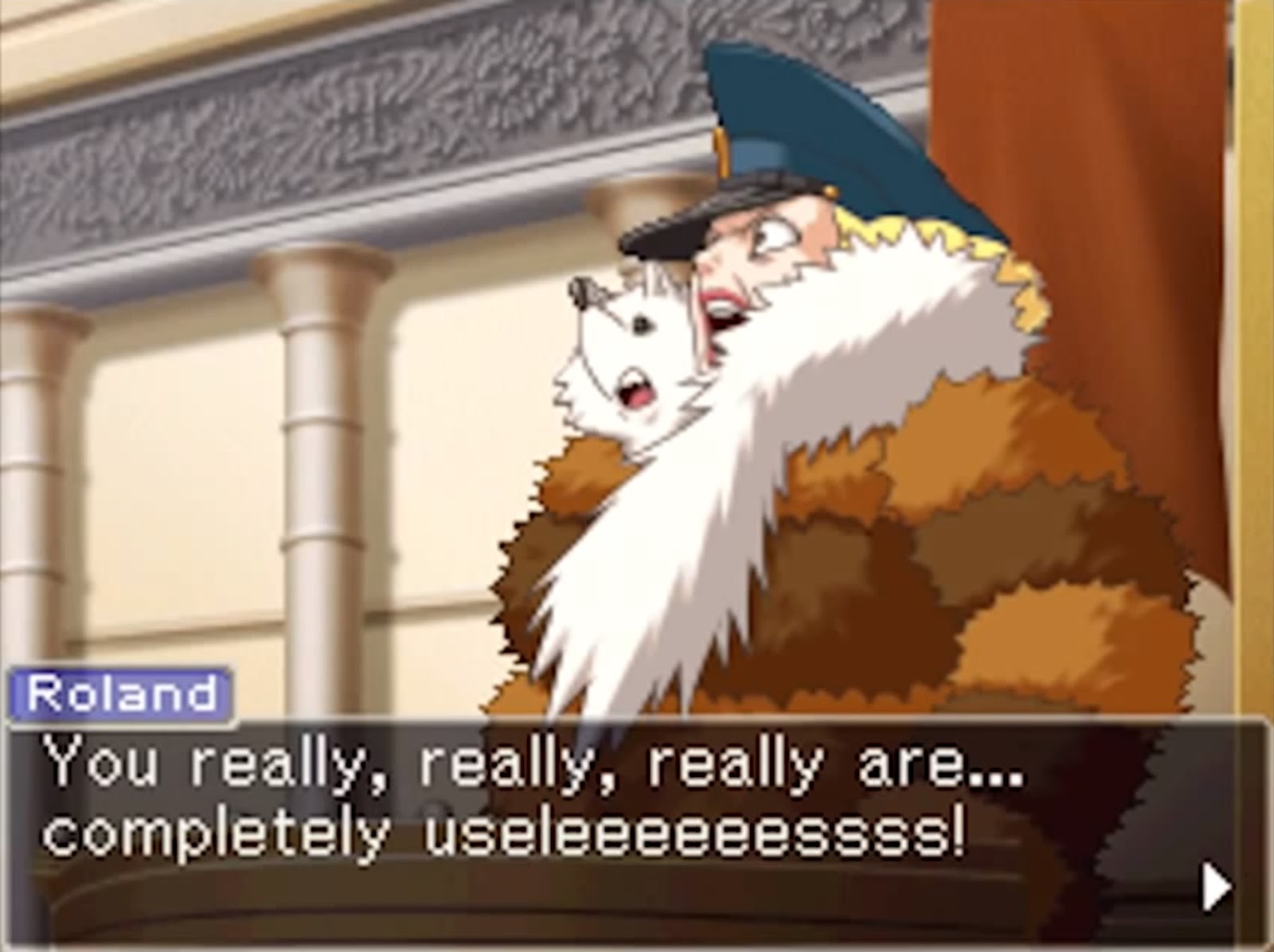
Sebastian surpasses Blaise, who I hesitate to call his father at this point, and thanks to him both Blaise and Patricia lose their cases. In spite of how often he called his son as such, Blaise is revealed as the real idiot between the two, having his men kidnap the wrong child and losing his case as a result. Patricia goes so far as to call him 'useless,' a term he himself liked to describe Sebastian with.

Patricia speaks the truth for once. Source: ZSlyer on YouTube

Though the trial ends on a high note, the case is far from over. Shi-Long Lang steps in and formally accuses Judge Courtney of murdering President Huang, and the mastermind is still on the loose. As the case progresses, Shi-Long Lang finally reveals why his family lost their credibility as law enforcers in Zheng-Fa: The president was kidnapped for ransom and a journalist photographing the event was murdered. Not just that, the event happened at an orphanage that used to be where the Grand Tower is built now. From that point onward, his father's bond with the president was gone. Just like Edgeworth, Lang inherited an unresolved case from his father.

Through investigation, Edgeworth uncovers a truly shocking fact: There was no kidnapping at the orphanage. President Huang was murdered by the assassin Dogen, and subsequently replaced by his body double - and Patricia Roland, Blaise Debeste and the body double himself were the people who made it happen. And it gets worse: The reason president Huang had even come to this orphanage unprotected was to meet his son, the existence of whom he was keeping a secret. It's finally revealed that John Marsh is President Huang's son, but the president was assassinated before ever meeting him. Dai-Long Lang, Shi-Long's father, knew that the president had been replaced but kept that secret locked up to prevent the country from descending into even worse chaos. He took it to his grave but thanks to his son Lang, the secret comes out at last.

It is at this time that Judge Courtney reveals she had intended to speak with President Huang to finally tell him about his son, and she brought the Lion Lilies - representing the bond between parent and child - to explain this to him.


To make the situation at the orphanage even more confusing, the treacherous trio had hoped to kill the assassin Dogen to ensure there were no witnesses. But Dogen was guided to safety by Simon, who was staying at the orphanage at that time. This leads to the relevation that Sirhan Dogen saved Horace Knighley and Simon Keyes after the IS-7 Incident.

Simon and Horace, stuck in a car and freezing. Source: ZSlyer

Not only does this relevation complete the puzzle, revealing Simon as the mastermind, but it also unveils another connection. Simon became Dogen's acolyte and idolized him enough to save him after the presidential assassination. He continued corresponding with him even during his stay in Patricia Roland's prison. It's not a stretch to say they had a twisted kind of father-son relationship as well.

But though he probably saw Sirhan Dogen as more of a father than Dane Gustavia, he can't rid himself of the connection between him and his biological father. During the final confrontation, he tries to make the point that he feels nothing for his father and is nothing like him. It's very clear that Simon is a tragic figure in a way, still hoping years after his abandonment that his father would return and blaming himself for it.

Source: ZSlyer

He claims that he doesn't care anymore, and that he has no connection with his father whatsoever. That claim falls apart when Edgeworth points out that he committed a murder and threw off the time of death by keeping the body in cold storage, exactly as his father did.

Source: ZSlyer

Not only that, but Raymond brings up that Simon doesn't like sweets - most likely a result of losing his father, who he always tasted sweet desserts for.

Source: ZSlyer

In the end, the decisive proof against Simon ends up being the pollen of the Lion Lilies. Because Simon had killed the body double by crushing him under the weight of his hot air balloon, the pollen from the flowers that Courtney had given him ended up sticking to the bottom of the balloon's basket.  The Bouquet of Lion Lilies is, quite fittingly, the final piece of evidence. 


Local mastermind defeated by pollen. Source: ZSlyer

Using the power of John and Courtney's bond, Edgeworth and his friends prove beyond a doubt that Simon killed the President's body double. The case doesn't end there - what follows is an incredibly powerful scene where the theme is emphasized once more. Shelly de Killer, who had been observing the case from the shadows, finally steps in to kill Simon Keyes because he asked him to kill 'President Huang', not revealing that the target was actually a body double. However, Sirhan Dogen steps in to save Simon, once again indebting the latter to the former.


Source: ZSlyer

It's clear that Dogen cares deeply about Simon, the only person whose death he prevented rather than caused. His willingness to die for Simon proves him a better father than Dane Gustavia ever was. Even De Killer himself seems touched by the gesture, and decides there is no merit in fighting Dogen just to end Simon's life.

Dogen and Simon prepare to leave for prison, but John Marsh stops them. He confronts Dogen with the fact that he murdered his father, President Huang - so Dogen presents him with a simple choice. He gives him his knife and tells him, in no uncertain terms, to end his life, to take revenge for his father. Simon himself even seems to approve of the idea, having lived his life planning and executing vengeful plots.


Source: ZSlyer

But John shows a wisdom beyond his years, realizing that while revenge might make him feel better, it would cause great pain to the people he loves - especially Courtney, his mother. He expresses his faith in the courts - entirely opposite to Simon - because he has faith that his mother and Edgeworth will serve justice.


Wisest words ever said by a kid wearing cow horns. Source: ZSlyer

Dogen and Simon finally return to prison together, and the case finally comes to a satisfying conclusion. But there are a few arcs that still need to be wrapped up, most notably Edgeworth's. Edgeworth ultimately decides to stay as a prosecutor, explaining to Raymond Shields that he believes he can save people on the Prosecutor's Path, just as his father and Phoenix Wright do as defense attorneys.


Talk about taking a third option. Source: ZSlyer

In spite of the fact that they may have different jobs and titles, Edgeworth chooses to save people and pursue the truth as his father did. Ray is truly impressed with how much Edgeworth has grown, and how much he has become like his father.

Source: ZSlyer

After Edgeworth clarifies his reasons for returning to the position of prosecutor, Judge Courney returns his badge to him. Edgeworth reassures her that she had every reason to act as she did during the trial of Patricia Roland, considering her son was in danger, and Judge Courtney expresses great optimism for Edgeworth's future as a prosecutor. She reveals that, just as with so many people in this story, it was her bond with John that helped her through the tough battle against the corruption in the P.I.C.

Source: ZSlyer

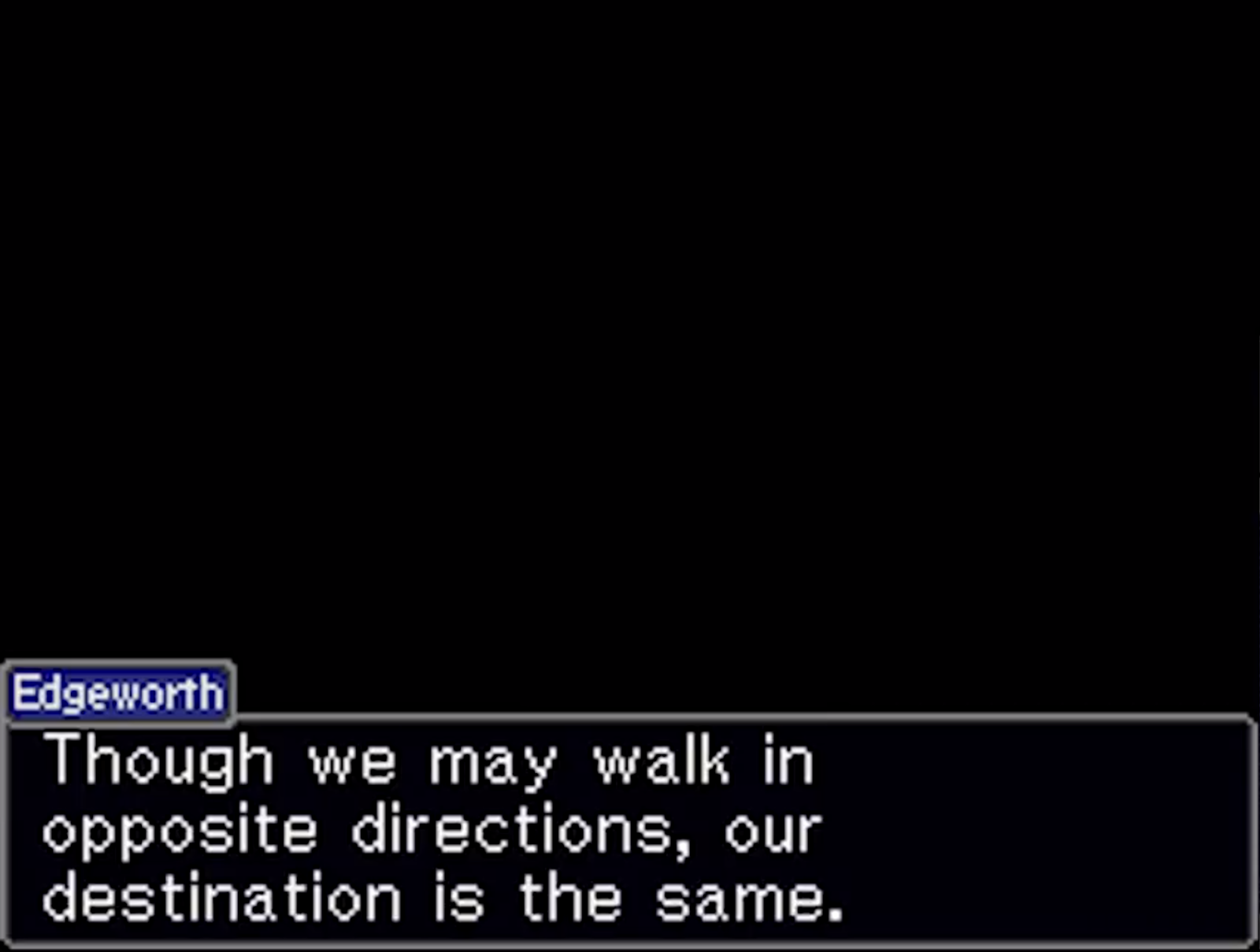
The credits give us a quick look at how everyone is doing, and we return to Edgeworth and friends, discussing what comes next. Gumshoe finally gets a raise, which isn't necessarily related to this subject but I wanted to point it out anyway. At the very end, Edgeworth sums up the conclusion of his arc quite beautifully. I won't even try to paraphrase it. Here:


Powerful. Source: ZSlyer

_

And that brings Ace Attorney Investigations 2, and its strong themes of the bond between parents and children, to its conclusion. I noticed that the game focused strongly on the theme of parents and their children on my first playthrough, but I didn't realize just how universally present it is. I hope I helped you see the Ace Attorney series and Ace Attorney Investigations 2 in a different light!

Family is a major overarching theme in Ace Attorney, and I've actually considered writing an article about siblings in Ace Attorney as well. There are obvious examples like Maya and Mia, as well as Apollo and Trucy, but just like the theme of parenthood it might just be even more prevalent than you think. 

Feel free to share your thoughts about this article in the comments, or by reaching out to me. Thank you for taking the time to read this article, which I have sporadically worked on over a period of many months. Let's meet again soon to discuss more art and design!