I've played a lot of Bloodstained: Ritual of the Night - a Metroidvania and spiritual successor to the Castlevania series - recently. I haven't finished the game and am not ready to share my general thoughts yet. But one of the things I'm really enjoying about the game is the option to customize the playable character with various hairstyles and colours. Character customization is very uncommon in Metroidvanias, so I think there's value in talking about it. So! I just wanted to write a fun article to show off a few of the "looks" I've given Miriam so far. This is a 'just for fun' article, not a serious analysis or critique.
For context, you can customize Miriam's hairstyle, hair color, skin color, eye color and pick two colors for her clothes. She can also be equipped with various accessoires.
Unfortunately this is the only picture I have of the original look I gave her, with red hair, purple clothes and a pirate hat. Fortunately, this does give me the opportunity to express how happy I am that Robert Belgrade got a small role in this game as the vampire on the right, Orlok Dracule. Robert Belgrade was the original voice of Alucard in Castlevania: Symphony of the Night and hasn't starred in any Castlevania since, so it feels poetic and just right to have him return like this.
I really like this one, though I probably should've taken the mask off. The blue and green clothes with the blonde hair and bow make for a pretty striking look in my opinion. It's a bit reminiscent of Elsa from Frozen, especially with the braided hair.
I like to call this one the 'dapper' look. It's mostly because of the hat, but Miriam is already pretty dapper by default. I decided to experiment with darker skin in this look as well, as you can even change that. That lead to my most distinctive experiment yet:
I call this one the 'demon' look. I think it's very striking how the blue skin contrasts with the red clothes, and the haircut and demon mask definitely help with the feel. Probably the most aesthetically pleasing look I've given her, in my own opinion. Have you played any Bloodstained: Ritual of the Night? Please share how you customized Miriam and why. I'll share my serious thoughts about the game in a future article.
I recently finished the latest installment in the 3D Mario series, Super Mario Odyssey, and I loved it! But I'd like to share some random thoughts about it. Sometimes, the 'Some Thoughts About' series of articles is structured much like a review, but since this game's been reviewed to death, I just want to touch on a few points that I think are worth discussing: How the game continues the series' recent use of motion controls, how cohesive its world feels and to what degree the game shifts the series back to a nonlinear, exploration-based style. In Motion
Motion controls became an integral part of the Mario games on the Wii. It was genuinely impossible to beat Super Mario Galaxy and its sequel without shaking the Wii remote and using the pointer controls.
The Nintendo Switch, the Wii's "grandchild" as it were, also has motion controls - but those don't seem to be the focus. As such, you can use motion controls in Odyssey, but it's mostly optional. But though it's mostly a matter of convenience, the game still seems to want to make motion controls more relevant. For this reason, the motion control version of many actions is a better version. For example, you can move faster as a Bullet Bill by holding the button, but you can move even faster if you shake the Joycons. Personally, I would've preferred it if the motion controls were just another alternative and not a "superior" version.
Cohesive World
Super Mario Sunshine is probably the most controversial out of the 3D Marios, with most people ranking it at the top or the bottom of the series - usually not in between. One thing most of us can agree on, though, that it sets up the most cohesive world - that is to say, everything feels connected and like it's part of the same place.
This makes it completely distinct from other 3D Marios, where you enter various disconnected worlds that are connected by a hub - like Peach's Castle or Rosalina's Observatory. In spite of the developers placing Odyssey on Sunshine's side of the fence in the sense that they consider it an 'exploration' type platformer, it's the least cohesive 3D Mario yet. That is neither a positive nor a negative, but it's something to think about. Not only do the game's Kingdoms not really connect logically, they are completely different in terms of artstyle and music. If you were to take Mario out of the picture, you'd scarcely believe that New Donk City, Mt. Volbono, the Ruined Kingdom and Bonneton all exist within the same game and the same world.
It would be unfair to say this applies to the whole game, however. The worlds with more "traditional themes," like the ice-themed Shiveria, beach-themed Bubblaine and desert-themed Tostarena don't seem like an impossible fit in terms of style, though they still don't connect logically.
Exploring
In the time leading up to the release of Super Mario Odyssey, Nintendo made it very clear that they considered it a return to the formula of Super Mario 64 and Super Mario Sunshine. Unlike the Galaxy games and 3D World, this game would go back to having exploration-based levels instead of linear challenges. The strange thing is, this is true in some ways, but not in others.
Mario Odyssey's worlds are indeed large and open to be explored, that much is true, but there's still a very clear intended route to start with. Each world has its own set of story missions that must be played in order (with a rare exception occurring in Shiveria, where you can play 4 missions in any order) and until the story missions are complete, many of the optional Moons are inaccessible. In that sense, it can feel a little bit like Mario 64 or Sunshine; but once you complete a world's story missions, the way it opens up is more akin to Rare collectathons like Banjo-Kazooie. At that point, the worlds are exactly as open and explorable as promised.
But while the worlds eventually open up, the game as a whole does not. A beloved quality of Mario 64 and Super Mario Galaxy was that any Star was as good as another; if you had enough, you could move on to many new worlds at once. This allowed you to skip missions and even worlds you didn't like. In Odyssey, the Moons only ever serve the purpose of getting you to the next world. Sometimes the game allows you to pick which of two possible worlds to do first, but that's the only choice you're getting. You can't even skip over a level if you have enough Moons because the game specifically requires a certain amount of Moons from that particular level before it'll allow you to progress.
So while Odyssey's worlds do offer more room for exploration after you finish their story mission, the game's structure on a larger scale is much more linear than any 3D Mario so far. Even Super Mario 3D World, which is very linear, had more branching paths.
Conclusion
Super Mario Odyssey wants motion controls to be optional and yet relevant, so it allows greater conveniences and slightly better actions with the motion controls. I think committing to either making the motion controls integral, or completely optional, would have been better. Super Mario Odyssey is not committed to making a cohesive world. In that regard, it is more like Mario Galaxy than Sunshine; variation over cohesion. It is up to the player to decide whether they prefer this or not. Super Mario Odyssey's levels allow for exploration, but they are fairly linear until you complete the story missions. The game's actual structure is almost completely linear, even moreso than Galaxy 2 and 3D world and completely unlike Mario 64 and Mario Sunshine. Those were just some thoughts about the game, but I do have to stress that Mario Odyssey is an amazing Mario game and a must-buy for any Switch owner. If you have any thoughts about the game, good or bad, please feel free to share them in the comments.
Recently, fans of the classic GameCube RPG 'Paper Mario: The Thousand-Year Door' have been part of a hashtag campaign to convince Nintendo to remaster or possibly even remake the game to bring it to a new audience. I want to give you some insight on the movement and explain my own reasons for wanting a remaster of this beloved cult classic. Puppet with a Plan
On July 27th 2019, Arlo - a family friendly gaming YouTuber - made a video starting the hashtag and an associated petition. Arlo's been making content about the Paper Mario franchise for a long time and like myself, he believes that the Paper Mario franchise has lost much of what made it great - whereas the Thousand-Year Door represents everything that made the series great in the first place. His video is well worth checking out, both for context and because he's a downright entertaining content creator:
Not long after Arlo posted his video officially starting the campaign, the hashtag quickly became populated with thousands of Tweets explaining why the Thousand-Year Door deserves a remaster, as well as mountains of fan art. It's well worth browsing through the hashtag to see just how much the fans care: https://twitter.com/hashtag/RemasterThousandYearDoor
Looks good on paper
So now you're up to speed about what's going on - people want a remaster of Paper Mario: The Thousand-Year Door. But why? I'm going to divide this segment into three subsections - Content, Context and Improvements.
Content
The most straightforward reason why Thousand-Year Door deserves a remaster is that it is an excellent videogame. It takes the formula of classic JRPGs and distills it down to something more simple, quick and involved thanks to the timed Action Commands. There are no ridiculously high numbers or overly complicated hierarchies of weaknesses and strengths - everything explains itself intuitively. Flying enemies need to be jumped on, spiked enemies need to be hit with the hammer and so on. Battles have many solutions for you to discover and you never have to grind. And instead of a complex system of equipment with many minor statistical differences and percentages, there are just badges that allow you to shape the way you play by adding all new abilities or other game changing additions to your arsenal.
Rock solid gameplay aside, the game's presentation is timeless. The game has a focus on simple, colorful and immediately recognizable characters that stick out from the simple 3D backgrounds. The clear, simple speech bubbles and easily readable font are reminiscent of comic books and make sure you'll never get tired of reading.
The game's soundtrack is also amazing, featuring catchy tunes, emotional pieces and a lot of downright weird stuff as well. One of my favorites will always be the battle theme:
But one of the most unexpected virtues of the Paper Mario series are the games' stories and the way they expand the world that Mario and his friends inhabit. Mario games are famous for being lighthearted and joyful, but the Paper Mario games have moments of deep sadness or even fear that you'd never see in the mainline series. Thousand-Year Door is not afraid to add some darker depths to the world of Mario. I won't go in-depth to prevent spoilers, but let's just talk about how the game starts. Mario walks into Rogueport, and the first thing that happens is a Goomba girl gets attacked by a suspicious figure and no one lifts a finger to help; Mario and the girl escape into town and the first visual that greets you is a gallows with a noose. In a Mario game.
The intro segment continues to lay it on thick, showing you two mafioso beating a few people up in the background and having you get robbed moments after. The message is clear: You've left the Mushroom Kingdom - this is a new place in Mario's world, with a good deal more crime and cynicism.
But that's not to say that Paper Mario: The Thousand-Year Door is an entirely grim game. The game has a fantastically goofy sense of humour and its tone is still optimistic. It's just not afraid to show you the seedy side of Mario's world, a side that we've never really seen again.
There's so much more I want to say about the story and incredible characters, but the purpose of this article is to argue for a rerelease or remake of the game, so I really don't want to spoil any more than I already have.
So, we've got an amazingly fun RPG with beautiful visuals, catchy music and a story that - while charming and humorous - is not afraid to tread dark and scary ground. It's one-of-a-kind, and more people ought to be able to try it for that reason alone.
Context
On a more meta level, a major reason why we need a remaster or remake of Thousand-Year Door is because the game is stuck in a forgotten generation. With the Wii U and Switch leaving GameCube backwards compatability behind, you can only officially play the game with a GameCube and GameCube disc. This means you'll have to either own or buy a GameCube, and then get the game, which might not be cheap depending on where you live.
And even if you did have the financial stability to buy a GameCube with all the bells and whistles, the game is also just fairly unknown. The GameCube was a difficult time for Nintendo, as we all know, and only a handful of games on the system could really be called major successes. A new release wouldn't just make the game more accessible, it'd also just make more people aware of it. With Nintendo's marketing team backing it, the game could enjoy a much greater success on the Switch than it ever did on the GameCube.
Another matter is the current state of the series. The two latest installments, Paper Mario: Sticker Star and Paper Mario: Color Splash did not sell very well and were disliked by critics and fans alike (you can read an article I wrote about it here: https://arjenartdesign.blogspot.com/2017/06/paper-mario-color-splash-critique-1.html), and it's easy to see why: The games aren't bad, but they've completely abandoned what people enjoyed about the series to begin with - namely, the exciting combat and amazing story. Remaking The Thousand-Year Door would be an opportunity for Nintendo to show they understand what the fans want, and would potentially allow them to continue the series in a way that the fans would love.
In conclusion, remastering the game just makes sense; it makes the game more accessible, it allows Nintendo to market the game as new - which they've been doing quite effectively with Wii U ports on Switch - and thus it'll be seen and played by many new people as well as the fans. It would also be exactly what the fans want after the series changed its focus away from what made fans fall in love with it to begin with.
Improvements
A game doesn't need to be perfect to get a remaster or remake - on the contrary, a rerelease is the perfect opportunity to iron out a few of the problems. Assuming the hypothetical remaster is just that and not a remake, this is a moot point, but if the game gets the full HD treatment like Wind Waker - another GameCube classic - there are things they could do to make the game even better. This segment will feature some very minor gameplay spoilers.
Just like Wind Waker's Triforce chart/piece quest was considered just a bit too tedious, so too does The Thousand-Year Door have its padded segments. Chapter 4 and 5 in particular ask you to run back and forth through the same area more times than is really necessary. Simply adding a pipe that warps you between the two extreme ends of the area would fix this problem. A faster way to switch partners and use items would also be a big plus.
The game also has a few gags that are pretty funny, but drag on for too long - one, for example, involves you having to follow a character through many previously visited areas. This could be fixed by shortening the quest a lot or allowing you to warp from any location once you've opened an area's fast travel pipe.
These are just a few minor improvements that would make an already great game even more amazing, and a remaster/remake is the perfect opportunity to make it happen.
The Final Page
To summarize, the game deserves a remaster for its exciting combat, great presentation and compelling story. It needs a remaster to reach a new audience and become more accessible for fans and newcomers alike. A remaster would be a great opportunity for Nintendo to score points with the fans and improve upon a beloved classic. All in all, there's nothing to lose and everything to gain. That's why I and so many fans want Nintendo to #RemasterThousandYearDoor.
Please let me know what you think in the comments. Did I make a good case, or are you not convinced? Are there other games you think need to be remastered?
I've been playing a lot of Rare's Sea of Thieves lately. The game has had a tough time of it, struggling to captivate people due to its unpolished nature, lack of content and rather steep price. But even though those are all valid problems, I want to highlight a few ways in which the game still has that Rare spark we've known since many console generations ago. Jiggies and Jingles
During Rare's peak, they made several "collectathon" platformers like Banjo-Kazooie. One of the many ways in which these classics outperformed the competition was its soundtrack, and particularly, its sound design. Every single pick up has a distinctive sound to it.
Sea of Thieves' soundtrack usually stays in the background, but like in Banjo-Kazooie, Rare made sure that there are still distinctive sounds and jingles to each situation and achievement. At the start, you can do voyages for 3 main guilds. Each guild has a distinctive music track when you come close to one of its representatives, but it doesn't end there - each guild has a jingle for when you start one of their voyages, when you complete an objective within the voyage (like discovering a chest or defeating a skeleton captain) and when you sell an item to them. Some unique items, like the Chest of Sorrows or the Chest of 1000 Grogs, even have their own unique jingles as well.
And even in battles, there are unique musical flourishes for getting a hit on another player, getting a hit on a Kraken's tentacle (a very small jingle for landing a sniper shot, a slightly longer one for landing a cannonball shot) and getting a hit on the Megalodon. The list just goes on and on; Sea of Thieves' entire library of sound and music is a labour of love - and that famous 'Rare flair' is in more than just the jingles.
Environmental and Reactive Music
The Nintendo 64 was a breeding ground for all kinds of revolutionary and groundbreaking developments, not least of all in terms of game audio. Contextual musical changes weren't unheard of (take the added drums when riding Yoshi in Super Mario World), but Banjo-Kazooie and its sequel pioneered having radical seamless changes between various very different versions of the same theme. For example, Treasure Trove Cove has a theme for being above and underwater which it can smoothly transition between:
Sea of Thieves is a very different game; there are no levels with their own default themes that can subsequently be iterated upon. Rather, the whole world is open to you, and the music can transition to many themes to fit the situation. Like Banjo, you'll be treated to unique and beautifully relaxing music if you decide to explore the ocean beneath the waves and you'll hear a given company's musical theme if you approach their representative at an outpost. Like Ocarina of Time, another N64 classic, unique music plays when you encounter an enemy - and there are unique tracks depending on the kind of encounter. Are you fighting the megalodon at sea, or a cursed skeleton ship? Or are you fighting skeletons on the shore? There's a track for most any situation.
And with every new update, the game's already massive library of contextual jingles and tracks expands. In an update, The Hunter's Call was added to the game - an entirely new faction with its own jingles. With the Hunter's Call came the ability to fish, and fishing has its own music as well. It seems there is no brake on this train, or rather, ship - it's clear that Rare is committed to making Sea of Thieves' audio as absolutely perfect as it can be. If you needed any more proof that music is a high priority, note that any Sea of Thieves character comes with 4 instruments by default that they can play a few tracks on - with other players, too.
Eye Candy
When it comes to that 'Rare magic,' I think the music and sound comes to mind first. But their games have visuals to match; just as each collectible in Rare's classic collectathons had a distinctive sound, it also had a distinctive design. But a major difference between the games of yore and Sea of Thieves is that the items in Sea of Thieves don't have a unique utility (like the ability to fly or become invincible in Banjo); they just have a unique value and are meant for a specific faction. For example, the Gold Hoarders want treasure chests, and the Order of Souls wants skulls.
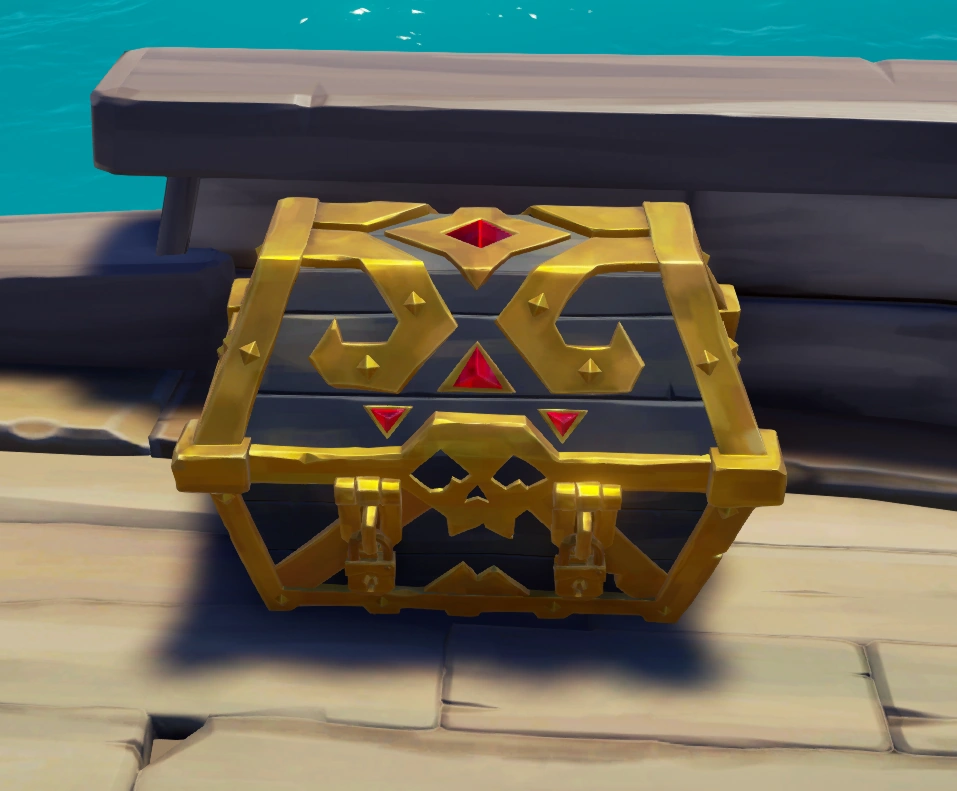
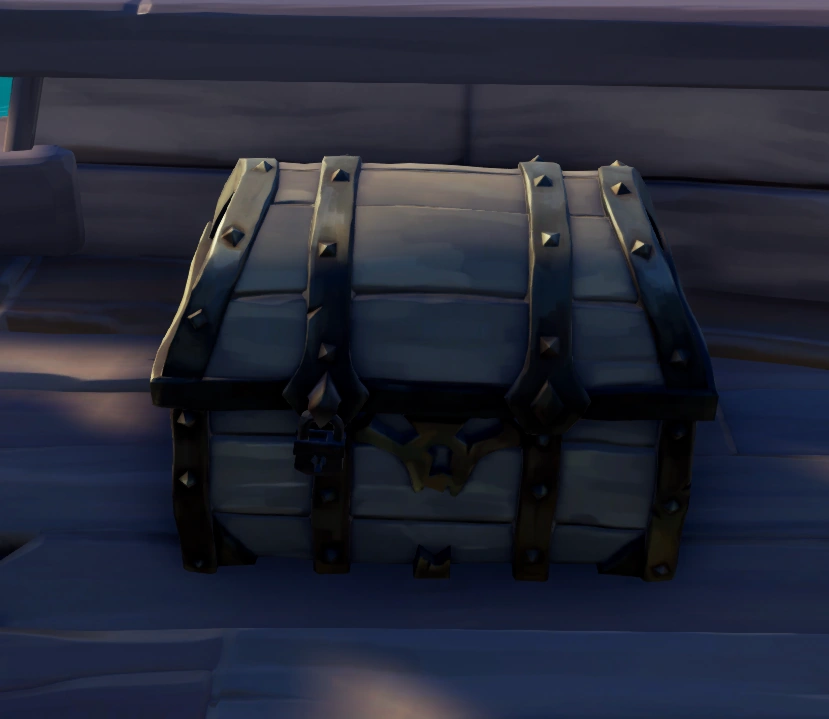
So rather than design the items based on their function, they're designed based on their associated faction and value. You can immediately tell by the look of an item which faction it's for and how valuable it is. Consider these two chests:
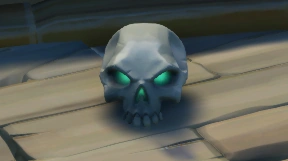
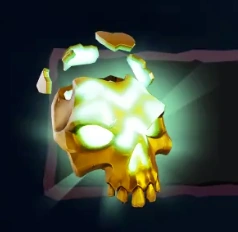
You don't need anyone to tell you which of these is more valuable, and that goes for the skulls too:
And this is just barely scratching the service, as each type of treasure has more tiers than I've shown, the Merchant Alliance has its own line of treasure, there are different types of enemies with clear visual cues and colours - the game's presentation is as splendid visually as it is in sound.
Conclusion No one can deny that Sea of Thieves has had, and still has, its problems. But the Rareware we know and love is still clearly visible in the details. Their flair for giving every little thing its own distinctive sound, music and look has stayed alive to this very day and is one of the main attractions of Sea of Thieves on the whole. And they're still expanding on the game, so the amount of little details will only increase as time goes on.
Have you had any experiences with Sea of Thieves? Did you enjoy it, or did the game's shortcomings get in the way of your enjoyment? Please let me know!
Overwatch's latest hero, Sigma, was revealed recently - along with the fact that he's Dutch. I was rather delighted by this reveal. I haven't played Overwatch much lately, but the team puts a lot of effort and detail into each character and seeing a Dutch character brought to life like this is a remarkable experience. I look forward to seeing all the references to Dutch culture in his voice lines, sprays and skins. And all of this got me thinking about being 'represented' as a Dutch person.
During my childhood years, I consumed a lot of American (and some British) media and noticed that a lot of European countries would come up depending on the stories and setting. Germany, France and Italy were big names that characters would visit or at least refer to - but never really the Netherlands. And when the Netherlands would come up, the depiction would either be insulting (like Austin Powers' Goldmember) or just plain wrong, having the "Dutch" people speak German (like in the Bond movie Diamonds Are Forever). At the time, this irritated me a lot, but I've come to understand that there are simply many factors working against "proper representation" for the Dutch. For one, our country is tiny, smack dab in between of Great Britain, Germany and France and the English name for our language is Dutch, which sounds an awful lot like the Germans' name for German, 'Deutsch.' No events in recent history can set us as easy heroes or villains, either, and the Dutch accent is hard to pin down and imitate - not iconic at all. So rather than getting annoyed at lacking or incorrect representation, I've just come to appreciate the times when we get acknowledged at all.
And to celebrate this occasion, I wanted to have a look at a few random examples of that:
Windmillville
Mario Party 7 has a 'vacation' theme, so the boards are all based around famous locations. For example, the 'Grand Canal' is based on Venice in Italy. But my favorite board is Windmillville, and it's easy to see why.
Windmillville is an idyllic fantasy representation of some Dutch stereotypes. Meadows and tulips (an important Dutch industry), accompanied by windmills (for which we are famous) which also function as banks you invest in (referring to the Dutch's historical financial savvy). Windmillville gets it right by not trying to be accurate, it's just a glorious exaggeration of some clichés made into a Mario Party board.
Age of Empires III
This example relies more on history than the last, but the Dutch are a faction in Ages of Empires III. While the voice lines for the units are a bit stilted and awkward, the faction itself is interesting and well realized, hinging primarily on the Netherlands' history as a financially forward thinking and trading nation by allowing you to build banks, among other things.
Red
This is a minor example, but in Pokémon Black & White (and its sequel), there are a few members of Team Plasma named after colors in various languages. One of the sages is called 'Rood,' which is the Dutch word for red. This is cool, but it would've been even better if it had been Orange (Oranje) - because that's the name of our royal family, and thus considered our national color. Still a neat detail, though!
Red Alert 3
Red Alert 3 is a goofy and downright entertaining RTS. One of its greatest strengths is its all-star cast crazy factions and charming presentation. This all comes to a head when the Empire of the Rising Sun (one of the factions) led by George Takei leads an assault on final allied base in Amsterdam.
It's not a literal copy of Amsterdam, but the canals are there and the architecture of the civilian buildings is noticeably Dutch. I thought it was a really cool location for the finale of the Empire's campaign.
Nintendo in General
This pertains less to the actual content of games and more to their localizations, but starting with the Wii U Nintendo started translating more of their major games to Dutch. The Legend of Zelda: Breath of the Wild and Mario Odyssey are both the first major games in their respective franchises that were given a Dutch translation. I recently completed Mario Odyssey, and I really appreciated the translation even if I didn't need it.
_
So, that's it! Just a few examples of how Dutch and the Dutch are represented in videogames. There are Dutch developers, of course, but I specifically wanted to look at how non-Dutch parties handle it.
How about you? Are you from a country or culture that you feel is or isn't properly represented? Please share your experiences down below!
Recently I played the adorable indie RPG, HEARTBEAT. This isn't going to be a full-blown review, just some random thoughts about the game.
HEARTBEAT is a traditional turn-based RPG that takes place in a fantasy world inhabited by humans and Mogwai. Mogwai are a huge group of magical creatures, divided into subcategories based on their elemental affinity - a bit like Pokémon that can talk. Certain special humans, called Conjurers, can form special bonds with Mogwai and thus draw power from each other. Conjurers are rare and most towns have a single one to protect them from any threat. In HEARTBEAT, you play as Eve Staccato, the Conjurer assigned to protect a small village, as she ventures further and further from her home and gets wrapped up in a larger conflict.
Gameplay
Gameplay-wise, I don't really have that much to say about HEARTBEAT. It functions very much like any other turn-based RPG, but I will make a note of some of its unique qualities.
- The HEART meter charges up your Limit Break, but it's shared between all characters - as their hearts are all connected. This means all damage dealt and taken to and from all characters charges the meter, but only one character gets to use a Limit Break type attack before the meter depletes again. A shared or combo attack like in Chrono Trigger might've been fun, but I understand why it was resolved the way it was.
- Mogwai have elemental affinities, but humans do not. That means that Eve, your main character, is neither strong nor weak against any element by default - however, when a Mogwai becomes her friend, she will often get a shard of their core, essentially their soul, which will allow you use up a turn to switch to their element and gain its strengths and weaknesses on the fly. This offers some neat strategies, though it's still very simple.
- There are two characters in the game that attack on their own, outside your control, when they join you. One of them, a kind of moth baby that you get to give a name to, stays with you throughout the entire game. The 'moth baby' can transform into a baby version of most friends and foes you encounter and can level each of its forms. It's the only other character besides Eve that you can control the elemental affinity of, adding another layer of strategy.
- In spite of its cute presentation, this game is not recommended for beginners. In battle, information appears at the top screen in rapid succession and disappears just as quickly, and the phrases are often full of icons and abbreviations that you'll have to learn to recognize. I think the interface in battle could've used some work, like a log showing the events of the last few turns. There are plenty of examples of this, but for some reason Heartstone - which is really more a card game than a turn-based RPG - comes to mind.
- The overworld works as expected for any JRPG, but the characters that accompany you each have a unique ability they can apply in the overworld. These are used to solve simple environmental puzzles or reveal secrets. They're usually fine, but puzzles that require precise timing can get a bit annoying. To clarify, when you press on a switch to start a timed event, you may immediately press the button to start running, but because you weren't fully on the tile yet or because the switch was still activating, it doesn't work, costing you valuable time. Enemies are not random encounters but can be seen and (if desired) avoided on the map, which I think is a plus.
Presentation HEARTBEAT's presentation is one of its main attractions. It features a large cast of expressive, distinctive characters with beautiful sprite portraits.
HEARTBEAT's world is a delight to explore. Vibrant colors, catchy tunes and hundreds of beautiful and detailed sprites are just the tip of the iceberg, and the clean and sharp interface ensures you won't be distracted from it. Each character has a unique design, and most characters come with their own musical theme and a battle variation of said theme. A tremendous amount of effort was put into realizing this world and characters. If I had to say something negative, I guess not all of the music is as memorable - but with as many tracks as the game has, not every single one could be equally iconic.
Story
I'll keep this mostly spoiler free, but as I mentioned at the start, you take on the role of Eve Staccato - a conjurer with the power to form pacts with Mogwai - on a quest that gradually increases in scale. She's accompanied by the Mogwai she made her first pact with, Klein Gremory, a Cat Sith Mogwai with a mysterious background. Eve and Klein are the protagonist and deuteragonist, with other characters coming and going in the story while they remain. Its huge cast is one of HEARTBEAT's strengths, but also one of its weaknesses, as the story cannot focus on a single character and their arc for too long. Characters' conflicts are resolved quickly or relegated to the background while the story continues without them in favor of another character.
MINOR SPOILERS: ___
I don't feel I have the authority to give in-depth feedback on a game's story, but I personally have my doubts about the pacing. While I appreciate the way the conflict escalates from something relatively minor to a larger scale over time, it takes a long time for the real "goal" to come into view.
A game that does a similar thing is Chrono Trigger; the initial hook is time travel and the potential dangers of it, but the game shows its hand soon after, revealing that the time travel is a means to prevent the eventual apocalypse. In my opinion, Chrono Trigger's initial hook is more engaging, and I personally prefer that it reveals its ultimate goal a bit earlier. What this amounts to is that HEARTBEAT's story takes a while to get to the point, which means you may lose interest if you're not invested in the characters. Once the story picks up, though, it picks up in a big way.
Like so many of the story based RPG Maker games of yore, HEARTBEAT boasts multiple endings. There's only one true, good ending, with all the other endings ranging from somber and unsatisfying to shockingly grim, especially considering the game's otherwise mild content. I was impressed by the detail in some of the bad endings; most of them feature unique portraits, a fair bit of dialogue and even a unique battle or two. It's a shame so few people will get to see them, though, because the good ending is incredibly easy to get. I feel like the game could've asked a little more of me to get it, but it's preferable to the alternative - the last thing I would've wanted was a bad ending because you failed to talk to character X seven times in a row on two missable occasions (yes, I AM talking to you, Ib). ___
Other Thoughts - One thing I really appreciate about RPGs with a lot of dialogue is that they acknowledge when certain conversations have been had. Say, a character has a long confession to make - then when you speak to them again, all they say is 'Thanks for listening' instead of repeating the same thing again. Unfortunately HEARTBEAT does have a few occasions, which I won't spoil, where a conversation that has value in the context of the story repeats when the character is spoken to again. It's a minor annoyance, but an annoyance nonetheless. - Some moments that are otherwise well written - like an emotional climax of a character's story - can feel less deserved because of how quickly characters are shuffled in and out of the party. I wonder if this is a fair critique on my part, or if I'm just being too harsh on a game that simply has a lot of characters? Unfortunately, no one I know personally has played the game; maybe I should look up a few playthroughs to get some other perspectives. If you do play it, let me know what you thought! - The game has a fair bit of humour. It got a few chuckles out of me, but some jokes land better than others.
Some of the portraits for humorous side characters did get a laugh out of me; the game's visuals are its strong point in more ways than one.
- Because the game is otherwise lighthearted, rare unsettling moments hit hard. A few music tracks and visuals gave me chills. I'd post them here, but I am still trying to avoid spoilers. - The vast majority of important characters are female and all playable characters are. This is justified in-universe; a Conjurer needs to be attuned with a Mogwai, which are either 'Yin' or 'Yang' (essentially male or female). Two characters that are not female accompany you at a given point (those are the characters you can't control I mentioned under gameplay), but because they're not "attuned" to you, they can't be instructed and take actions on their own accord though they're still on your side. This idea is neat, but it doesn't play much of a role in the story itself beyond lore. I've always found the idea of having characters on your side that act on their own interesting; Susie from Toby Fox's Deltarune is a great example of a character acting on their own in a way that is less interesting from a gameplay point of view (always attacks the top character in the same way, and enemies are always warned the same way by ACTing) but more interesting from a story point of view. - You can collect cards of the locations and characters in the game, if you're into that kind of thing. IO definitely didn't spend two hours buying packs (just in-game money, no worries) to get the rare card I wanted.
Conclusion
HEARTBEAT is a competent turn-based RPG that distinguishes itself in some minor ways. Its story is slow and features too many characters for its own good, but the story gets good and the characters are entertaining and well designed. The game's presentation is excellent. If you're into the genre, give it a shot: https://store.steampowered.com/app/984560/HEARTBEAT/
I recently finished indie puzzle game, The Sexy Brutale. The Sexy Brutale is a puzzle game revolving around going back in time and repeating the same few hours to figure out the workings of the mansion and the movements of the guests and staff to prevent the guests from being murdered. I'd like to share my thoughts about the game, good and bad, here. Presentation
The game immediately makes a good impression. The setpieces are quite impressive and will easily convince you you're walking through a stylish, old-fashioned mansion. The setpieces are so impressive, in fact, that the game took longer than expected to load in certain rooms and showed empty space in the meantime - as the timer kept ticking on. It wasn't a huge issue, but it happened pretty consistently around major area transitions.
The music is also great, featuring many jazzy bangers. Each major section of the mansion has its own music, and the tracks build towards a climax as the preventable death of the guests you're trying to save in that section approaches. The sound effects are fine in general, with my only gripe being that the noise that plays when there is a ghost in the room - the sound of roaring fire followed by a loud cackle - is too loud, and it plays every time. Either making the sound more subtle or only playing it the first time you discover a given ghost would be a way to fix this.
All in all, the presentation is fantastic with only minor nitpicky complaints concerning loading times and a sound effect or two that can get too loud and repetitive.
Gameplay
In many ways, the game feels like a real-time point and click adventure. Your actions mainly consist of walking around, examining objects, picking up items and using items on objects. The looming time limit is the major threat, but you're also not allowed to explore rooms where a living person currently is. If you enter such a room, the person's mask - and everyone in the game wears one - will come alive and chase you down. In this state, nothing in the room can be interacted with, and if the enemy mask touches you for too long, it will drain your health. It's very basic, but that's because it really only exists to keep you out of the room; this forces you to think ahead and take note when people enter certain rooms. Some rooms are just blocked off arbitrarily, however, as recognized by the interact circle being red and the door being on fire - something the game could explain a bit better. My only real gripe with the core gameplay is that the player character, Lafcardio, moves pretty slowly and that some area transitions take too long - for example, if you interact with a ladder or stairway by accident, there's no way to cancel out of the several seconds it'll take to go back and forth. In a bog standard point and click adventure that'd just be a nuisance, but considering you're on a timer that doesn't stop for text boxes or transitions, it's a slightly bigger problem here.
This plays into the key part of The Sexy Brutale's puzzles; it's all about time. Some of the murders can only be prevented by putting the pieces in place long before the unfortunate guest breathes his or her last. Each guest has a schedule, and only by learning it - as well as the staff's movements and their murder method - can you ultimately save them. Every time the clock hits midnight, or when you use your pocket watch, you'll return to the start of the day. You will lose any items you're carrying but knowledge - like keycodes and secret passages - will be preserved so you can get the items back pretty easily.
Every time a guest is saved, you acquire their mask and special power. Some of these are game changers, while most of them barely matter. An example of the former is the Superior Hearing power. By holding a button, you can hear all footsteps and conversations in the rooms around you, which helps you keep tabs on everyone and lets you overhear critical information. Other powers include shattering glass objects and picking locks, but these are only used a few times in the story and are otherwise applied to find optional collectibles. One of the powers allows you to see ghosts, but only when their associated candle is lit. This leads to a strange situation where you need to find the lighter to fully capitalize on this power, and when you do, it stays with you forever in your item menu - completely contrary to all other items except the wristwatch you start with. It's a strange inconsistency and makes me feel like the lighter should've been added as part of the mask when found instead of put in a separate item menu.
In terms of difficulty, the game never gets very hard. Provided you find an area's clock and winding key, you can set it as your spawn point and you can restart the day whenever you want, as often as you want. What can be frustrating, however, is waiting for a specific moment of the day to reoccur - say, you know one of the guests says something important at 3 PM, so you want to skip to that, but unfortunately you can only skip to 4 PM and 8 PM. I don't really understand this limit; if you're at the clock and you inserted its winding key, why can't you skip to whichever time you want? This is not a game breaker, but it will lead to the occasional few minutes of waiting around, which can get especially frustrating if you just barely miss a vital point of information. But once it all comes together, it's very satisfying. The last few puzzles in particular had me smiling from ear to ear when I used all the pieces and information the game had presented throughout and applied them. The game also has a secret ending you can acquire by gathering all the optional collectibles, which is a fun extra for people who enjoy exploring every nook and cranny.
The Sexy Brutale's gameplay holds up pretty well, but is bogged down by some strange inconsistencies. But when it's good, which is most of the time, it is really good.
Story
I don't want to spoil the story for you, so I'll keep this as general as possible. In the Sexy Brutale, you play as Lafcardio, a guest at the hotel-casino the game is named for. He and all the other guests are killed by the staff for unknown reasons, but a mysterious entity revives him and gives him the power to go back in time. His - and by extension your - mission is to use your power to save the other guests and figure out what's going on.
The characters are well-written and have a lot of snark and dark humour to offer, which got a chuckle out of me on several occasions. The murders themselves also vary from mundane - like someone getting shot in the chest - to utterly bizarre, like being eaten by a giant spider. When you save a guest, you're treated to a funny or heartwarming scene between them and Lafcardio before moving on to the next. It's nice to have those moments, especially because the game's tone is pretty grim and cynical overall.
I'll leave you to discover what's really going on at The Sexy Brutale and why the guests are getting murdered, but I will say that the ending has some pretty impressive foreshadowing. If you're like me, you'll have a few moments where things click and you go 'Oh, so that's why' or 'So that's what that meant.'
The Sexy Brutale's story is as dark as it is comedic, but knows when to take a moment for sincere interactions between the characters. It has plenty of twists to offer and I enjoyed it a lot.
Comparisons
I made a conscious effort not the draw the obvious comparisons in the content above, but two obvious examples of games that have some similarities would be Ghost Trick: Phantom Detective and The Legend of Zelda: Majora's Mask - two games that also revolve around time-based puzzles. I didn't want to invoke these games in the actual content of the review because, while there are parallels, the games are still so different that it's not really fair to put one in the shadow of the other. A similar situation arrises when comparing Ace Attorney to Danganronpa; those games are closer to each other than any two given random visual novels, but the similarities are still too shallow to call them one of a kind.
With that said, if you were to compare them, The Sexy Brutale falls somewhere in the middle of Majora's Mask and Ghost Trick. Like Ghost Trick, it revolves around interacting with the environment to prevent a murder, but Ghost Trick's puzzles are much more compact (they're usually limited to one room and you always return to 4 minutes before the person's death as opposed to the start of the day like in Brutale). Like Majora's Mask, it spans across a larger amount of time, across multiple environments, and all murders are occurring at about the same time. In the end, though, it's really nothing like either game when it comes to how it plays.
In Conclusion With an impressive and stylish presentation, compelling story and characters and entertaining puzzle gameplay, The Sexy Brutale is an impressive piece of work. It's held back slightly by some inconsistencies in its design and presentation, but nothing that ruins the game. Give it a try!