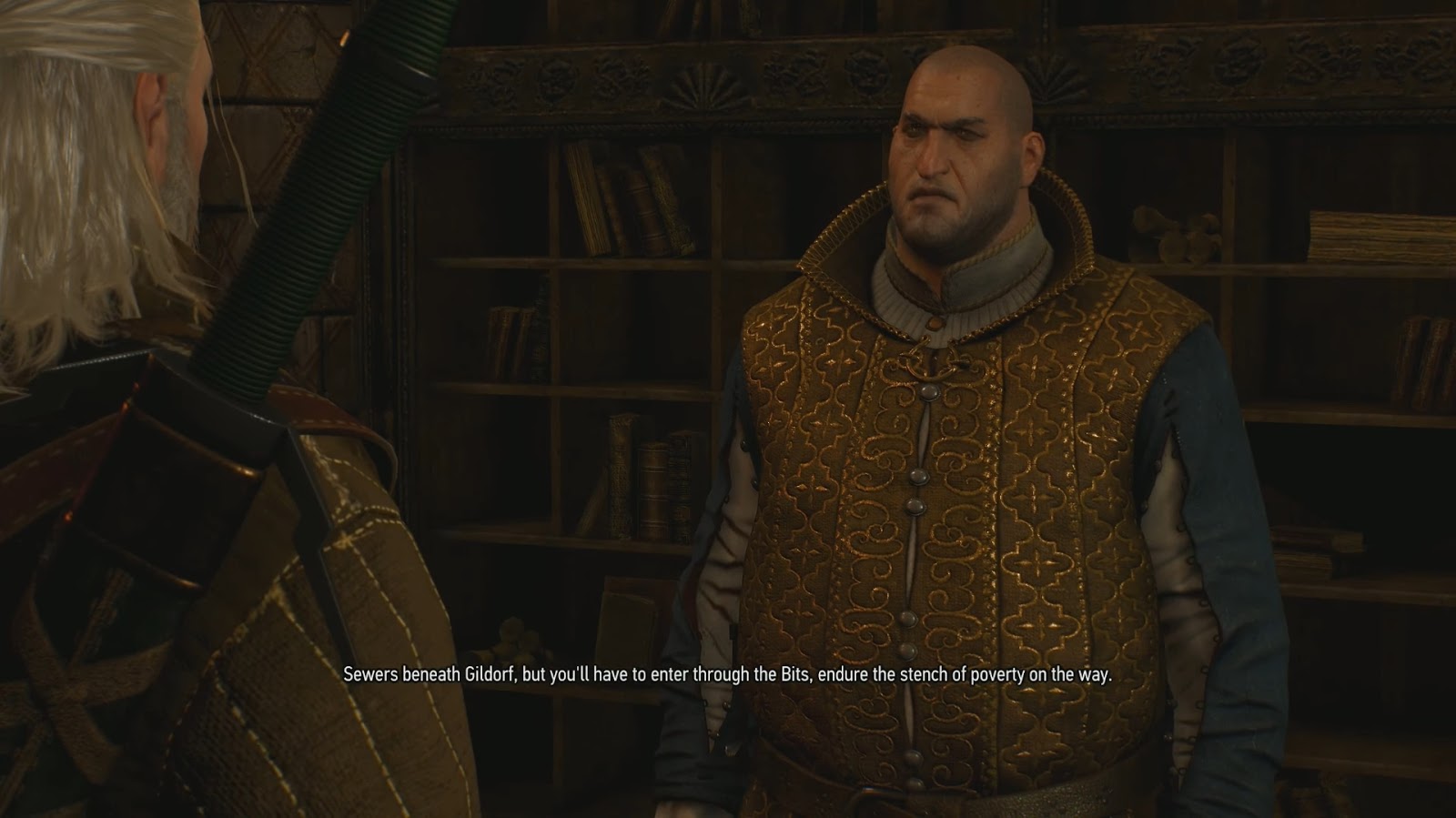
It's hard to believe that the Witcher 3 will be 5 years old this year. When it was released in 2015, this open-world RPG was met with an overwhelmingly positive response. Of particular note was the fact that even seemingly small sidequests would often have interesting twists and choices on offer. I loved almost every second of this game when I played it, but one of the larger sidequests that tied into the main story disappointed me deeply. I want to explain why. Beware, this article assumes you have a basic understanding of the Witcher 3's plot, and there will be some spoilers.
The Underbelly of Novigrad
At one point in the story, Geralt's search for Ciri leads him to Novigrad, a city untouched by the war with Nilfgaard but dealing with its own battles, namely between the local religious cult and various crime syndicates. In his search, Geralt meets the leaders of the Novigrad gangs, one of whom is Sigismund Dijkstra, Redania's former spymaster. He's easily one of my favorite characters in the game. His wit and biting sarcasm make most interactions between him and Geralt a treat, and their begrudging cooperation is a highlight in an already compelling narrative. https://www.youtube.com/watch?v=RiLasX4Q5ww
What's both entertaining and frightening about Dijkstra is that he figures out most of the things Geralt tries to hide from him. He always seems perfectly in control of the situation, and it's completely believable that he managed to thrive even among dangerous criminals. For instance, Dijkstra asks Geralt to investigate who broke into his safe. Geralt already knows it was his friend Dandelion, but keeps this from Dijkstra to prevent complications. However, Dijkstra figures it out soon after and calls Geralt out for omitting this information. I think it's important to establish this because it's part of why I really dislike a later quest.
If you follow Triss' questline to its conclusion, Dijkstra will help you save the mages by shipping them out of Novigrad before the cult of the Eternal Fire can get them. This opens up a questline where Dijkstra reveals his true plans - he wants to assassinate Radovid, the king of Redania. Radovid is burning everyone and everything with even the vaguest relation to magic or alchemy, and Dijkstra wants to get rid of him to restore Redania to its former glory as a fair and just country. If you refuse to get involved, it ends there, but if you help Dijkstra and his co-conspirators with a small favor, a new line of quests opens in the endgame.
The War with Nilfgaard
In the final hours of the game, you return to Novigrad to prepare for the final battle. One of the main quests has you meeting Dijkstra once again, though not on the friendliest terms - he's holding someone captive that you need on your side for the finale. If you resolve the situation by breaking his leg, the questline is also lost, but if you persuade him by sharing critical information, he puts his plan to assassinate Radovid into action. This final quest in a long chain of quests is called Reason of State.
Dijkstra works together with Roche, a friend from the Witcher 2 and Thaler, a friend from The Witcher 1. Couple that with the fact that the Witcher 2 revolved around the shifting power in the Northern Realms after another king was assassinated, and it lends a sense of high stakes to this final step in a long journey of choices that could've locked you out of attempting this if you made any mistakes. If you choose to get involved, Geralt needs to personally lure Radovid from the safety of his ship so the assassination can play out, and it's appropriately exciting and climactic.
The assassination goes as planned, more or less, but then the aftermath plays out. The conspirators reveal that they have a deal with Nilfgaard; if they were to successfully assassinate Radovid, Temeria could remain its own state with its own laws and leadership, albeit as a vassal state of Nilfgaard. This is an interesting turn of events, and the game allows you to share your thoughts on whether this is a good idea, but then the quest takes a drastic turn.
Dijkstra reveals that he no longer wants to stand by the deal with Nilfgaard. Now that Radovid has been eliminated, he intends to unite the Northern Realms himself and repel Nilfgaard completely. He then proceeds to do the stupidest, most out-of-character thing in the game and bluntly claims that his co-conspirators have to die for his plan to work. He bluntly tells Geralt to just go away while he does this, and you are left with the choice of either letting him kill characters you've known for two or three games or fighting back, in which case he is unceremoniously killed in the following battle.
I don't necessarily dislike the idea of the conspirators disagreeing on the exact terms of how the Northern Realms will be ruled, but Dijkstra coming out swinging and deciding to kill his co-conspirators while assuming Geralt won't do anything about it is just stupid, especially because Roche and Thaler are his friends. He invokes the supposed Witcher neutrality regarding political affairs, but conveniently forgets that Geralt literally involved himself in their political assassination, making the expectation of neutrality completely ridiculous at that point. Earlier he even told Geralt that Witcher neutrality is just an excuse Witchers hide behind when he tries to get him involved in the assassination, so why does he suddenly think it's going to matter when he's about to backstab some people Geralt knows? And perhaps this temporary lapse in judgment could be forgiven, but if he had any of the brains that he clearly had when he was first introduced, he would immediately back down if Geralt showed resistance. After all, he should know full well that he and his two random bodyguards can't win against Geralt and several armed combatants. But he doesn't, and if you choose to defend Roche and Thaler, a short battle ensues where you easily kill Dijkstra and his men. A thoroughly anticlimactic end for what was one of the greatest characters in the game. If you allow Dijkstra to do what he wants, he successfully kills Thaler and Roche and proceeds to successfully defend Temeria from Nilfgaard. This outcome is decent enough, but it comes at such a high price in terms of character deaths and your own morality, that almost no one will consider it preferable.
In Summary
I hope I was able to articulate why this particular questline disappointed me so much. To go over it one more time:
Dijksta, a highly intelligent and scheming character, involves Geralt and his friends in a political assassination plot. At the end of the questline, he decides to betray his co-conspirators and murder them, expecting Geralt to stay out of it and let him murder some old friends because of "Witcher neutrality" - even though Geralt sacrificed his neutrality to become part of the plot in the first place. When Geralt resists, he attempts to kill Geralt too, even though he should know he can't win the fight, having seen Geralt's combat skills. In a few minutes, a complex and brilliant character is turned into a mustache twirling moron to manufacture a "choice."
Even so...
Sidequests and Witcher contracts in the Witcher 3 are famous for being well written and often having a few surprises and interesting player choices up their sleeves. In general, Witcher 3 stands tall as one of my favorite open-world games with some of the best writing and characters we've seen in the game industry as a whole. That's the reason why a small blemish like I described in this article sticks out so much. But this quest was the one and only time that I was disappointed like that, and the rest of the game deserves all the praise it gets. I look forward to seeing what they made of Cyberpunk 2077, which releases next month!
_
It's been years since I played Witcher 3, but I just really wanted to get my thoughts out about this one. Thanks for reading, and please feel free to share your feedback.
I've been making steady progress in my Resident Evil marathon and recently finished a lesser known installment in the RE series, Resident Evil: Code Veronica. This classic-style survival horror adventure combines the static camera angles with some camera movement and focuses on Claire Redfield's journey to find her brother Chris. I've dedicated a few articles about interesting and frustrating parts of the Resident Evil series and I'd like to highlight an especially odd design choice in this one. Up to Code
Code Veronica plays much the same as other Resident Evil games of its time, requiring you to navigate various locations with tank controls and managing your resources while dealing with the undead and solving puzzles. The moment-to-moment gameplay is identical to other RE games in that regard, but there are a few differences in the presentation and structure.
Like I mentioned in the intro, Code Veronica mostly uses static camera angles, but sometimes the camera moves with the character. On a few occasion, it's used effectively to build tension in a hallway where the camera slowly moves further away from you, or zooms in on a point of interest, but it usually feels unnecessary and unnatural. It doesn't add or detract much when it really comes down to it. The presentation itself is passable. It's clear what everything is supposed to be, but the colors are generally muddy and muted, with a fog hanging over almost everything. It's saved from being poor by some great music, character designs and a handful of interesting areas - the Private Residence comes to mind.
In terms of structure, there are larger separate areas like in Resident Evil 3 or 0, but the game makes you backtrack through earlier areas a lot like in Resident Evil 1. This is not too big of a problem if you know what you're doing, but increases the frustration tenfold if you're not sure where to go or what to do because the solution could be anywhere you've been up to this point.
With the exception of a very shoe-horned in Albert Wesker, the story is quite interesting. In her search for her brother, Claire Redfield is captured and brought to mysterious island that she has to escape from. The antagonist is an interesting and somewhat tragic character and the twists and turns along the path of this game's narrative might surprise you.
All in all, RE: Code Veronica is similar to other Resident Evil games, with some odd design choices in its structure and visuals.
From Claire to Chris
Some time after the midway point, the perspective switches and you take control of Chris, Claire's brother. He starts with his own resources, but I immediately noticed that he could access the items I put into the item box as Claire. This is a departure from the character switch in Resident Evil 3 where Carlos has his own item box and cannot access Jill's items. This gave me a headstart as Chris, but at the same time, I felt a little worried about carrying Claire's items around as Chris. If this character switch segment worked like any of the Resident Evil games so far, we would finish Chris' segment and switch back over to Claire for the finale.
To prevent a situation where Claire wouldn't have the necessary resources, I went out of my way to put all of Chris' items into the item box when the switch was about to happen - and I felt pretty smart about it when we did indeed switch back to Claire and she was fully equipped with enough firepower to knock down three final bosses and then some. So you can imagine my surprise when, after a brief segment as Claire, the game switched right back to Chris - instantly putting me in a boss fight with zero resources. To prevent an unwinnable situation like in Resident Evil 0, I had put myself in an unwinnable situation.
It required me to redo a segment, but I decided it was fair enough - this situation occurred because I overprepared for something that ultimately didn't happen. I let Chris keep most of his resources, went through Claire's segment again and defeated the boss when we switched to Chris. I was satisfied that I had given Chris enough to make it through the boss, while still leaving Claire with the most firepower. So imagine my surprise, again, when we never switched back to Claire and all her weapons were permanently out of my reach. For some reason, the entire finale is played as Chris, even though the game started out as a story about Claire. Story-wise, I thought it was a bit disappointing that Chris robbed the finale instead of letting Claire do it. Design-wise, it's just deeply flawed. To get the most out of all your resources, you need to put them in the box before switching characters, but doing that can get you locked into an unwinnable boss battle (both Claire and Chris have to fight a powerful boss in their segments). It's also just natural to assume that you'll finish the game with the character you started as, but that doesn't happen either - so if you gave up Chris' resources for Claire, too bad! You'll have to do the final boss with your knife and some scraps.
This problem was so easy to prevent, too. They could've just given you a prompt that you would not be playing as Claire again, or they could've automatically put everything in her pockets in the item box. Yes, it would reveal ahead of time that you're going to end the game as Chris, so I understand why you wouldn't want to do it for narrative reasons, but this is a situation where good game design should be valued over keeping secrets. A good compromise might be to put all of Claire's items in the item box if you die to the final boss a few times - at that point, there's nothing left to hide.
With all that said, the final boss was still manageable. It took me a few attempts, but it wasn't a brick wall like Resident Evil 0 - and if my resources had really proven completely inadequate to complete the final boss, I would've had to redo a far smaller segment than Resident Evil 0 made me redo.
Closing Thoughts
I enjoyed Resident Evil: Code Veronica. It's a lot longer than other Resident Evil games, to the point that its original release required two disks, and tries a few new things to varying degrees of success. Aside from the fatal design flaw I discussed in this article, I'd say it's a challenging but fine installment in the Resident Evil series. I'll remember the challenging bosses, story and music for a long time to come, but I've already forgotten the visuals.
It feels nice to be getting my thoughts out about some of the classics I've experienced lately. Thank you for reading! I hope you'll join me for whatever's next, and of course, your suggestions and feedback are always welcome.
Final Fantasy 13 is a fairly controversial installment in the beloved Final Fantasy series of RPGs, with critics disliking its battle system and highly linear level design. Now that the conversation around the game has mostly died down, I'd like to share a few thoughts of my own. As this game has been thoroughly discussed in the past, I'd mainly like to focus on how my opinions differ from the general consensus, and how they do not. Living, Breathing Worlds (Presentation)
Square-Enix may make its mistakes, but they always seem to get the presentation just right. Final Fantasy XIII truly was a visual marvel for its time with dozens of complex, beautifully designed characters, landscapes and enemies. It looks more impressive than many recent games do. And in typical Final Fantasy fashion, it has the soundtrack to match.
The only minor problem I had with the presentation was that some enemy designs and animations are re-used quite a bit. While the re-used designs usually get updated and look more unique than mere recolors, it's still pretty noticeable.
The voice acting is also solid and does a good job of representing the characters.
Hallways and Automatic Battles (Gameplay)
I mentioned this briefly in the first few lines of this article, but people have some fundamental problems with the way this game is structured as well as its battle system.
Let's start by discussing the way the game's environments or levels are structured. It gained the nickname 'Final Hallway XIII' in certain circles because its levels are very linear and rarely necessary to visit again after you simply go from A to B. You simply walk through lengthy corridors and fight monsters, with the occasional tiny side path hiding a treasure. The game opens up eventually, but it happens so late into the game and so much is optional that it'll only make a difference if you really care to explore every corner of the world.
Enemies can be encountered in the overworld - that is, there are no random encounters in the traditional sense. Once you run into an enemy in the overworld, that's when you enter the battle system.
Final Fantasy 13 is a turn-based RPG, but you can't rest on your laurels. It uses a so-called active time battle system. Both your and your enemies' turns load in real time, and your enemy will continue to attack even if you don't. But you won't have to fiddle with menus too much, because of the game's second controversial feature - auto battling. Select the button, and the character you're controlling will just fill their turn with logical actions based on the situation. The real strategy in FFXIII isn't in choosing individual moves, but in controlling your party's Paradigm. To put it simply, each character can fulfill a few Roles, and each of those has its own specialty. Commandos maximize damage, Medics heal their teammates, Sentinels attract enemies and take damage for the team, Synergists buff teammates and so on. You don't select the roles individually either, however. Outside of battle, you'll prepare a set Paradigms - that is, different ways of dividing the roles among the characters - and during battles, you can switch between them at will. It's a surprisingly involved system, but to simplify it, you could have prepared a paradigm to attack enemies, a paradigm to protect against powerful attacks and a paradigm to heal up. In the battle itself, all you do is respond to the situation by shifting paradigms and occasionally use an item or summon when necessary.
In this regard, FFXIII is a very streamlined game. Exploration is simplified in such a way that there's little more than going from A to B, and battles are simplified in such a way that when you've prepared your paradigms, much of the battle resolves itself. I honestly don't think there's anything inherently wrong with linear environments or auto battles, but perhaps the combination of the two made people feel like every part of the game is stuck to the rails? I personally didn't mind this very much at all, as I've always preferred games that have clear destinations over games that make you wander around - and while the battle system took some getting used to, I thoroughly enjoyed exploring just how many possible Paradigms there are. I particularly like the Paradigm 'Bully,' where you have a Commando to damage the enemy, a Synergist to buff your team and a Saboteur to debuff the enemy.
To summarize, Final Fantasy XIII's environments and battles both move on set tracks, though the environments more than the battles. Exploration doesn't really come into play until much later in the game, while you'll be experimenting with the unique Paradigms soon after you start. The ways this game simplifies the formula of turn-based RPGs, and perhaps Final Fantasy games in particular, was not appreciated by some fans, but I personally thought it was a refreshing take on the formula.
A World that Hates You (Narrative)
The story of Final Fantasy 13 is, in true Square-Enix fashion, pretty complicated. You may regularly need to consult the in-game datalog to get a handle on exactly what's going on. I'll try to give you a quick summary, but I may make a few mistakes:
In the world of Final Fantasy 13, most humans live in a closed community called Cocoon. Cocoon is like a small planet floating above the world below, protected and provided for by powerful machines known as fal'Cie. The people of Cocoon are particularly afraid of anything to do with the world below - called Gran Pulse - because they were at war with it once. The problems start when a fal'Cie on the side of Gran Pulse appears in Cocoon. Its very presence starts a mass panic because fal'Cie can mark humans as their servants - such a human is called a l'Cie - so even if the fal'Cie is defeated, one or more people could have been marked as the fal'Cie's servant and become a danger to Cocoon. This kickstarts an event called the 'Purge,' where the Cocoon leadership tries to forcibly ship off everyone that could've possibly come into contact with the Pulse fal'Cie. The events of the game start during this Purge, with each of the characters having their own role to play. The backstory of the game, which is revealed gradually, is all about the days leading up to the Purge and what all the characters were doing at that time.
In the opening events of the game, the Purge is happening and each of the characters is involved in it in some way. I won't go into too many of the details, but the inciting event that leads into the rest of the journey is important to mention: The characters run into the Pulse fal'Cie and try to destroy it, but instead, it marks them as its "servants", l'Cie. Now they're considered the "enemy" of Cocoon and are given a vague goal by the fal'Cie which they have to complete or else they'll turn into mindless monsters known as Cie'th. This starts a journey of trying to navigate a world that hates them to figure out how they can escape their fate, and if they even should.
I think the story holds up overall, but definitely prepare yourself for the usual Square-Enix shenanigans - they'll use a lot of new terms (ie fal'Cie, l'Cie, Cie'th) and talk about a lot of places and people to establish their fully realized world and it can get overwhelming. The game has a datalog to mitigate this a little bit, but you'll still have to pay pretty close attention. You may find yourself asking 'What just happened?' a few times. The only thing I'd genuinely call a plothole occurs very late in the game, so I won't spoil it, but it feels like the characters' goal completely flips around at one point.
Speaking of the characters, there are 6 playable characters in total - Lightning, Snow, Sazh, Hope, Vanille and Fang. Which ones you like is going to come down to personal preference, but the most universally liked character seems to be Sazh and the most universally disliked character seems to be Hope. I can identify with the appreciation for Sazh. Very different from the brooding characters we often see in JRPGs, he's a very expressive person and his goals are easy to empathize with - he just wants to reunite with his son. I understand the dislike for Hope as well - he's the youngest character in the cast and mostly driven by misplaced anger. It makes sense in the context of the story, of course, but I can understand that not everyone had the patience to want to deal with an angry child. The rest of the cast is pretty strong and I particularly like Vanille - a cheerful girl with a hidden guilty conscience - and Snow, a natural born leader with endless optimism and courage.
All in all, FF13's high stakes story holds up, but there are an overwhelming amount of names and things to remember - makes sure you pay attention and occasionally consult the datalog, or you may get lost. Which characters you do or don't like is going to come down to personal preference. Save for one or two strange plotholes, it's a great journey.
Final Words (Conclusion)
Final Fantasy 13 represented a shift in the series that a lot of fans didn't appreciate, but looking at it for what it is, I found a lot to love about it. The strategy isn't gone from the battles because you can auto battle, it has simply moved to preparing and shifting between paradigms - and the linearity was never really a problem for me to begin with. With that said, I can understand that streamlining both the exploration and the combat made some people like the game is a lot less involved than other JRPGs. Even so - with incredible music and visuals, a mostly strong cast and very thoroughly realized world, Square-Enix took me on an unforgettable ride with this game. Just don't do what I did and take long breaks between sessions, or the already complex story will really make your head spin.
Final Fantasy 13 is an interesting case in that it has two direct sequels, Final Fantasy 13-2 and Lightning Returns: Final Fantasy 13. I've already finished the former and am now playing the latter, so you can expect me to share some thoughts about those games as well. Because Final Fantasy 13 is so radically different from its predecessors, it's especially interesting to discuss how the developers iterated (and didn't iterate) upon what it established.
_
Thank you for reading and I apologize for the long hiatus. The first few months of 2020 weren't very productive in terms of article writing, but I'll slowly build it up again over the next few months. Please bear with me and please let me know if you have any feedback or suggestions. Have a good one!
Last year, I wrote an article going over all the games I had played in 2018. It had been a pretty bad year, so it was a big help to reflect on the good things I experienced. 2019 has been a much better year, but it's also been busy. Even so, I did take the time to play a lot of games, and I want to say a few words about all of them. Let's get started! Sonic Mania
A friend kindly gifted me this game, knowing I'm a casual fan of the Sonic series. It's actually the first game I played this year, though I started it in very late 2018. I had an absolute blast with the game and loved exploring the new worlds and watching the spectacle unfold. Some of the musical tracks in Sonic Mania are my favorites in the whole series, like 'Dimension Heist', the special stage theme:
Sonic Mania is proof that sometimes you just need to trust your greatest fans and give them the reigns. Sometimes people do know what they want.
Shantae: Half-Genie Hero
Shantae is an interesting series, always balancing between a level-based structure and more Metroid-based free exploration. Half-Genie Hero was the latest game in the series when I played it, and it represented a reboot for the series, starting the story back at the beginning before Pirate's Curse. The game revolves around Shantae's ability to transform into various animal forms, each of which has its own unique abilities and mobility. With beautiful art and music, a witty sense of humor and plenty of cute characters, it's no wonder the game was a success and they have since announced a sequel which I am very much looking forward to as well!
Slay the Spire (Again!)
Slay the Spire is a card based roguelite that I thoroughly enjoyed last year... but I hadn't tried the third character, the Defect, yet. So I sank my teeth into Slay the Spire again this year and wrecked a few bosses with this highly entertaining new character.
Klonoa 2
Klonoa was another PS1 classic I tried on stream and really loved. I wanted to move on to the next game right away, but unfortunately, we ran into technical problems with PS2 streaming and had to stop after two streams. What I experienced in those first few streams made a great impression, though, so I'll probably stream it again some day when I can make it work.
The Castlevania Journey
After finishing Symphony of the Night late last year, my Castlevania journey finally continued in January and continued throughout most of the year. I would write a summary for each game individually, but I actually already did that a while ago and I don't think it's necessary to repeat it all. Please have a look at all my thoughts here: https://steemit.com/gaming/@arjendesign/a-year-of-castlevania
Quiet Months (Intermission)
After playing a game games in January, there were a few months of low activity as I struggled to find some additional work. Freelance work is unstable and I needed something on the side. The search felt pretty hopeless throughout February, but I finally got that stable side job in March. After getting accustomed to the structure, I started playing games for fun again regularly in April.
Viridi
A therapeutic garden simulator that allows you to tend to your own little garden. I was looking for something I could start up occasionally but wouldn't have to commit much time or effort to, and this game suited my needs quite well at that time. I wrote a full article on it just a while ago, which you can read right here:
HEARTBEAT
HEARTBEAT is an adorable turn-based RPG absolutely bursting at the seams with cute characters and beautiful sprites. I enjoyed it a lot, but noted in my article that its story does burn at a slow pace, and that the absolutely huge cast of characters can make it a little unfocused. I loved it, though, and I thoroughly recommend it to any fan of RPGs. If you want to read more, please have a look at my full article:
Final Fantasy XIII (Ongoing)
Now, here's a game I know I won't be finishing this year. Final Fantasy XIII is one of the major installments in the beloved Final Fantasy franchise. The game itself is pretty controversial. I waited for all the heat to die down before finally hopping into this one so I could do it with a fair perspective, and while a lot of the criticism is valid - like the game's heavily linear structure and simplified battle system - I really love the characters and actually think the Paradigms are an interesting way to streamline battles. Essentially, rather than assigning character specific actions, you continuously shift "paradigms" where you assign each character a different strategic role like 'Medic,' 'Ravager,' 'Synergist' and so on and they will take their own actions accordingly. The game is also jaw-droppingly gorgeous and I look forward to seeing the rest of it. So, no spoilers please!
LiEat
LiEat is a series of three short Wolf RPG Editor games developed by Miwashiba, a mysterious Japanese developer. The game revolves around a dragon girl called Efina who can make lies manifest as little creatures, which she can then eat. This makes her an effective lie detector and gets her involved in various mysteries across a journey of self discovery with her caretaker. I wrote a longer article about all of Miwashiba's amazing RPGs right here:
Highway Blossoms
It might be a stretch to call this game, as Highway Blossoms is really more a 'kinetic novel' - that is, a visual novel with no choices or mechanics. Essentially a digital graphic novel. Highway Blossoms is the story of two girls who are both on the road, going nowhere for their own reasons, and banding together to find a legendary treasure. Of course, the treasure more serves as the background for the blossoming relationship between the two characters. I thought the story and voice acting were pretty good, and the 'joke' modes you get after beating the game made me laugh. It's not really my type of game or story, but it was fun to try something different.
The Sexy Brutale
This oddly-named puzzle game was recommended to me because I really love Ghost Trick: Phantom Detective. The two games are very different, but they share this one core idea: Solving murders by preventing them using time travel powers. In the Sexy Brutale, you play as Lafcardio, a priest in a mysterious hotel casino called 'The Sexy Brutale' where all the guests are getting murdered overnight. It's up to you to prevent those murders so you can gain there powers and make your way deeper into the hotel and find out who's behind it all. I loved the game's stylized presentation, the intricate puzzles that forced you to take note of each character's movements and actions throughout the day and the game's dark sense of humour. I wrote my full thoughts down in this article:
Mario Odyssey
Even though my work situation allowed me to make my own schedule, console gaming was so separated from my work (not to mention expensive) that I left it behind for a while after the disappointing lifetime of the Wii U. But in June 2019, I finally got my hands on a Switch with Mario Odyssey, and I loved it. The Mario series has a special place in my heart and I often cite Super Mario Galaxy 2 as one of my all-time favorite games, and it was a real treat to finally play the newest installment in this amazing franchise. Odyssey had bigger worlds, tons of collectibles and dropped the linear structure of its predecessors to return to 64 and Sunshine's open ended structure. I wrote some thoughts about how the game continued (or didn't continue) the trends established in the Wii-era Mario games too: https://steemit.com/gaming/@arjendesign/some-thoughts-about-super-mario-odyssey
Mario + Rabbids Kingdom Battle Like so many other people, I don't really like the Rabbids. They're simplistic, loud and annoying - in essence, the Minions of videogames. But you simply can't overlook a turn-based tactical RPG with Mario characters, especially not if Grand Kirkhope is doing the soundtrack. Because it involves the Rabbids, the game's sense of humor doesn't really appeal to me, but its presentation and gameplay are very fun. I'm about two worlds in and intend to continue in 2020.
Cadence of Hyrule
I really liked Crypt of the Necrodancer and was absolutely thrilled to see the studio behind that get its hands on a genuine Nintendo IP. Cadence of Hyrule is fantastically fun, offering a new spin on Zelda gameplay and Zelda music with its Necrodanger rhythm game flair - but it also gives me hope that Nintendo may allow smaller studios to try other things just like this. It's good that Nintendo is cautious with its IPs, but they took a risk here and it paid off handsomely. Let's see how other dependable indie devs handle some of those big Nintendo names, I say!
Bloodstained: Ritual of the Night
The final destination of the Castlevania journey we started last October. Ritual of the Night is a huge Kickstarter success and a great revival of the 'Igavania.' I loved streaming the game and the music sticks by me to this day. I actually wrote down my thoughts in an article earlier this year: https://steemit.com/gaming/@arjendesign/some-thoughts-about-bloodstained-ritual-of-the-night
Lumino City
An adorable, visually appealing point & click game that was on my to-do list for a long time... and still is, really. I played it for a few hours and really liked the style, but found myself frustrated by the puzzles. The game gives you a huge book with hundreds of pages, and I believe you're expected to find the right page to go with certain mechanisms you come across, but I couldn't muster the patience to get through it. I still want to give it another chance, though, and maybe I will in 2020.
Cogs
Cogs is a three-dimensional sliding puzzle game with a shiney steampunk style. I really enjoyed it, though it's the kind of game I can only really play in small doses. Read my full thoughts here: https://steemit.com/gaming/@arjendesign/some-thoughts-about-cogs
Nine Hours, Nine Persons, Nine Doors
The 'Zero Escape' series had been on my to-do list since the days of the Nintendo DS, when the game was first released. But I was not confident in my ability to solve escape rooms, especially not under pressure, and had some important plot details spoiled for me... so I delayed and delayed until I finally started on the series in 2019. I loved every second of 999, with its vibrant characters, fantastic music and inventive escape rooms. It's only a shame that the series peaked so early. Read my full thoughts here: https://steemit.com/gaming/@arjendesign/some-thoughts-about-nine-hours-nine-persons-nine-doors
Virtue's Last Reward
The second game in the 'Zero Escape' series. It pushed the series forward in many substantial ways with a huge amount of story branching and an even crazier storyline, but it was held back by some tedious mechanics, repetition and an ugly presentation. I still enjoyed it, but it never quite hit the highs that 999 did for me. Read my full thoughts here: https://steemit.com/gaming/@arjendesign/some-thoughts-about-virtue-s-last-reward
Zero Time Dilemma
The third game in the 'Zero Escape' series and the only one in the series where I took long breaks between sessions. The game is still alright, with some good characters, writing and escape rooms. However, it failed to live up to its role as the conclusion to a trilogy, having an awful presentation, fatal problems with its storytelling and leaving many questions unanswered. You can read my full, angry thoughts here: https://steemit.com/gaming/@arjendesign/many-thoughts-about-zero-escape-zero-time-dilemma
Puggsy
A Sega Mega Drive/Genesis classic about a potato man that carries things and uses real physics. A technological marvel far ahead of its time with beautiful music and visuals, but some unfortunately weak boss battles. This game represents a certain milestone for me, because I've known about it for over a decade but simply never played it myself. It's weird to finally play a game when you've had some of its soundtrack in your work music playlists for years. Anyway, I streamed the whole game, and you can read my thoughts about it here: https://steemit.com/gaming/@arjendesign/some-thoughts-about-puggsy
Deep Rock Galactic
A coop multiplayer game focused on doing mining missions on hostile planets. I loved that each character had a unique role and there were so many ways to achieve your goals; some characters can make platforms, while others can just dig through the ground and walls. I played a few sessions with friends during a free weekend, but I should pick it up again in the future.
Detention
An atmospheric 2D puzzle-horror game set in Taiwan under martial law. I played this game as one of my 'October' horror games, and while it fits the bill, I was surprised to see the tone shift from terrifying to tragic as the story progressed. The game wasn't all that scary to me, but I really enjoyed it. I also want to make a special note that this developer had their next game, 'Devotion,' removed from sale because some text disparaging the Chinese president had been left in it. It's especially sad after experiencing the cry for free speech in Detention; apparently it's fine to criticize any other country's regime. If you want, you can read my thoughts in a bit more detail here: https://steemit.com/gaming/@arjendesign/scary-thoughts-on-detention
Penumbra: Black Plague
Here's a story for you: Before my YouTube channel was mostly a stream archive, I actually tried to make it into a Let's Play channel - hence the name 'ArjenPlays.' And Penumbra: Overture was one of the very first horror games I "let's played" along with SCP: Containment Breach. This all happened in the distant past of 2015. To get back to the present, for this Halloween I was planning to finally get back to this trilogy and pick it back up by streaming the second game. I think the game has good qualities, and the 'voice' that accompanies you provides plenty of dark comedy, but I don't know if will continue streaming it. A slow-paced third person horror game that requires you to solve puzzles while being chased around? Add an audience to that mix, and you've got a lot of stress. I may finish it on my own, however, as it does seem to be an improvement over the first 'Penumbra.'
Silence of the Sleep
A 2D puzzle exploration horror game, just like Detention. This is another game I have been aware of for some time; way back when it released, a few YouTubers I liked made a 'first impressions' video - but none of them went on to finish it. It took a while, but eventually my curiosity got the better of me, and I tried it out. The game is very impressive for a one-man project, with a fascinating narrative and some genuine scares, but it overplays its hand sometimes with monsters appearing too much and being too visible, taking away the tension and replacing it with frustration. It's probably still my favorite horror game of this year, however. Read my mixed thoughts here: https://arjenartdesign.blogspot.com/2019/10/scary-thoughts-about-silence-of-sleep.html
Pony Island
A puzzle 'meta' game where you try to defeat a haunted arcade cabinet. It's short and sweet and I played it through in one session, which I think is the best way to do it. The game was a bit less surprising than it could have been if I had played it when it just released, since 'meta' games are a lot more common these days. I still thought it was great fun though, and I thought the mechanic where you solve problems by "programming" them out of the game was interesting. There's also more to the story than you might expect. Read my full thoughts here: https://arjenartdesign.blogspot.com/2019/10/scary-thoughts-about-pony-island.html
Uncanny Valley
Last October I was really on a roll with simple but effective 2D horror games like Detention and Silence of the Sleep. I thought I'd keep the train going with 'Uncanny Valley,' another game in the same genre but with a simpler artstyle. I liked the initial build up, but the game apparently glitched causing the story to never progress anymore. After a lot of random experimentation, I did get an ending, but it was absolutely horrifying and didn't really motivate me to try again because I felt I was being punished for the game's mistakes. The game has a real problem communicating, and unfortunately, the dev isn't that willing to listen to feedback. Never say never, but Uncanny Valley can stay right where it is for now. My thoughts in a bit more detail:
Resident Evil HD
In October 2018, I gave my Twitch channel a new direction: To stream all Metroidvania Castlevania games. With the completion of Ritual of the Night and 'Penumbra: Overture' not really scratching the itch, I finally picked up another series I've been avoiding for a long time. I started on the Resident Evil series with the HD remake of the first game. I decided to start on the hardest difficulty, and while that made the experience quite tough, it definitely helped me appreciate the 'survival' ascept of this survival horror classic. The most interesting and difficult part was definitely that saving is a limited resource in the Resident Evil games, requiring you to use an 'Ink Ribbon' on a typewriter to actually keep your progress. I described my experiences with this unique limited resource more here:
On a more personal note, I'm really happy I finally started on this series and I love it - even when it gets frustrating. It also feels good to have a clear direction for my Twitch channel.
Resident Evil 0
After having a great time with Resident Evil, I thought I'd strike while the iron was hot and started on the prequel right away. On top of the usual resource management, Resident Evil 0 also requires you to manage two characters with their own health and inventory space. Most of the game was perfectly fine, if derivative, but an overly linear structure combined with bullet sponge-y bosses made it possible to save the game in an unwinnable situation. This happened to me twice, and the second time, I used Cheat Engine for the first time ever just to be done with it, as I had spent literal hours beating my head against a certain boss and realizing I simply didn't have the firepower to take it down. Aside from those two very negative experiences, though, the game was still solid. You can read more about my experiences here:
A cute and simplistic first-person shooter by a Japanese developer. I tried this game on a whim and actually really liked its simply level structure. It's all about figuring out the structure of the level and running your way through it as quickly as you can. It did start to wear on me after a while, but maybe I'll pick it back up in the future and see if more mechanics are added.
BEEP
Another puzzle platformer that's been sitting in my Steam list for many years. I tried it randomly to clear out my to-do list. It's functional, but didn't grab my attention in any real way. I might pick it up again some day.
Action Henk
A runner game about a toy action hero trying to reclaim his lost glory. It's all about finding the fastest, most efficient way to get through the stages with various jumps and sliding. This game has a special meaning to me because it's actually from my native country, the Netherlands. The backgrounds are nicely detailed, but the character models look a little bit unpleasant. I especially loved the music and trying again and again to shave off a second is very addictive. Sometimes the game is so fast, you need to fail a stage a few times to really figure out where to do, but this is pretty harmless because the levels are so short and restarting happens instantly. I enjoyed the game a lot, so I'm actually surprised I didn't write a full article about it. Maybe I will next year.
Spec Ops: The Line
A seemingly generic military shooter about a group of American soldiers performing a mission in Dubai, but it gradually turns into a scathing commentary on the genre. This type of 'cover shooter' isn't usually my genre, and I did have a lot of trouble with some sections, but there are many great details in the presentation. For example, the voice lines of the characters in your squad become increasingly unhinged as the situation gets messier. When it all seems simple enough, and it's you versus what seem to be terrorists, they're very professional - but as the game progresses and you've found yourself having to fight American soldiers and possibly harming civilians, the voice lines become angrier, laden with profanity and outright desperate-sounding. Because the game is known as a commentary, I was expecting ridiculous levels of 'meta,' but the 'meta' elements are actually very subtle and restrained. The game works perfectly well like a military shooter in its own right, which you could see as a positive or a negative considering its message. Either way, it was interesting!
Resident Evil 2 (Remake)
Which version of Resident Evil 2 to play was a much harder choice than for the first game. The REmake seemed like an improvement in every way, but the Resident Evil 2 remake also seemed very different. It trades the static camera angles for an over-the-shoulder third person action camera, and it's also very recent. On top of that, the Resident Evil 1 remake is a classic in its own right, but the Resident Evil 2 remake is still quite new. But in the end, I'm glad I decided to play this version - I really love the game and all the ways it reimagines the series. Even on the hardest difficulty, it is easier than 1 and 0, but I honestly don't mind - it's still hard enough! I can't offer my full thought yet, because while I've finished Leon's campaign, I still need to finish Claire's and the extra campaigns. And of course, I'm streaming it all, so do stop by if you get the opportunity.
VVVVVV
One of the indie darlings of yore, a classic among indie platformers that I simply never tried, maybe because I got it in a Humble Bundle during time where I felt "retro style" games oversaturated the market a bit. Not really a fair reason, but when you have hundreds of games to play, you can start to prioritize one over the other for any number of silly reasons. Regardless, I finally tried it and really enjoyed it. It's a platformer where you don't really "jump" per se, but rather, each jump reverses gravity. It's a simple but effective idea that really makes you think about the level design in a different way, especially when additional mechanics get thrown into the mix. And I really loved the music.
Shovel Knight: King of Cards
Yacht Club finally released their final DLC for Shovel Knight after continously working on the game since its release in 2013 - and they nailed it, again. The 'King of Cards' expansion revolves around King Knight, a character whose movement revolves around shoulder bashing and chaining together spin jumps. It's funny, it's charming and they structured it so that it consists of many smaller stages instead of fewer larger ones. This keeps everything more varied, and on top of that, they added a genuinely fun card game called Joustus to go along with the campaign. It's unbelievable how much mileage we've gotten out of the Shovel Knight Treasure Trove pack and I look forward to seeing whatever Yacht Club works on next!
Luigi's Mansion 3
A long awaited third installment in a beloved series. Luigi's Mansion was a classic, designed with enough content to keep you busy for long time, and yet a skilled player could find their way through the mansion in mere hours. That's why the game is still well-liked by speedrunners. Luigi's Mansion 2 for the 3DS had an even better presentation and more variation, but the transition to handheld caused changes people disagreed with - like separated levels with separated missions. Luigi's Mansion 3 brings the best of both worlds and truly represents a high point for the series. It all takes place in a huge hotel, returning to the cohesion of Luigi's Mansion 1, but each floor is themed to allow for the visual and thematic diversity of Luigi's Mansion 2. I'm so happy it exists and I can't wait to keep playing it.
Closing Words
Phew! I never expect these articles to take the sheer amount of work they do; maybe I should spend less time on games in 2020 to make it easier next time... Regardless, I had a really great year in terms of gaming, and I'm looking forward to what awaits us in 2020 as well. 2019 had a rough start, but starting with Q2, the game train started and never stopped. I streamed many amazing games, I picked up console gaming again and I checked off quite a few games from my to-do list. A pretty big success!
To zoom out a bit, it's also been a great year for me on Steem. A lot of people have supported my articles, art and videos and it was a major encouragement while I sorted things out with my work. I've written more articles this year than I have in, well, years! And it's all thanks to your kind support. I hope you'll continue to go on these adventures with me, whether it be by reading my articles, watching my streams or enjoying my art.
I want to wish you all a beautiful and blessed 2020 - and if you have a moment, why don't you share your favorite games from 2019 right here? I'll try to respond to everyone.